Kirjojen hintavertailu. Mukana 11 244 527 kirjaa ja 12 kauppaa.

Kirjahaku

Etsi kirjoja tekijän nimen, kirjan nimen tai ISBN:n perusteella.

12 kirjaa tekijältä Michael Devitt

Biological Essentialism

Biological Essentialism

Michael Devitt

Oxford University Press
2023
sidottu
Biological Essentialism addresses three main issues. The first concerns the essences (natures, identities) of biological taxa, particularly species. Kripke and other metaphysicians hold that these essences are (at least partly) intrinsic, underlying, probably largely genetic properties. This view, based largely on intuitions, is dismissed by the consensus in the philosophy of biology as being incompatible with Darwinism and reflecting ignorance of biology. Biological Essentalism argues that the demands of biological explanation show that the metaphysicians are right. The positive view of the consensus is that the essences are wholly relational: taxa must have certain histories. Biological Essentialism argues that there is indeed an historical component to the essence, but this component presupposes an intrinsic component. Its second issue concerns the essences of biological individuals. Metaphysicians have had much to say about this, again on the basis of intuitions. Many hold that an individual is essentially a member of its species. This has recently been unequivocally rejected by philosophers of biology. Biological Essentialism appeals to biological explanation again to argue for essential membership; furthermore, to argue for the Kripkean view that an organism's essence is partly intrinsic and partly relational (a matter of origin). Finally, the book addresses the lively contemporary issue of whether race is biologically “real”. From the perspective developed earlier, the book argues that there are indeed racial kinds, in some sense, that are “in the realm of the biological”. These kinds also have partly historical and partly intrinsic underlying essences.
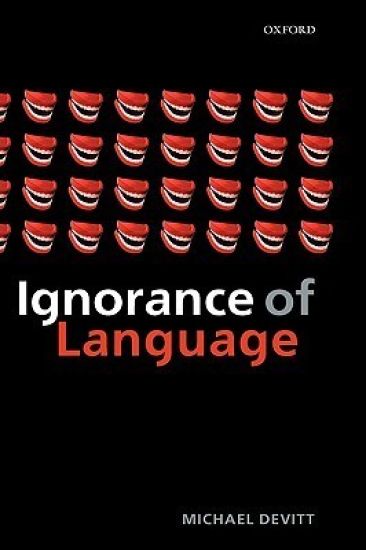
Ignorance of Language

Ignorance of Language

Michael Devitt

Clarendon Press
2006
sidottu
The Chomskian revolution in linguistics gave rise to a new orthodoxy about mind and language. Michael Devitt throws down a provocative challenge to that orthodoxy. What is linguistics about? What role should linguistic intuitions play in constructing grammars? What is innate about language? Is there a 'language faculty'? These questions are crucial to our developing understanding of ourselves; Michael Devitt offers refreshingly original answers. He argues that linguistics is about linguistic reality and is not part of psychology; that linguistic rules are not represented in the mind; that speakers are largely ignorant of their language; that speakers' intuitions do not reflect information supplied by the language faculty and are not the main evidence for grammars; that the rules of 'Universal Grammar' are largely, if not entirely, innate structure rules of thought; indeed, that there is little or nothing to the language faculty. Devitt's controversial theses will prove highly stimulating to anyone working on language and the mind.
Ignorance of Language

Ignorance of Language

Michael Devitt

Oxford University Press
2008
nidottu
The Chomskian revolution in linguistics gave rise to a new orthodoxy about mind and language. Michael Devitt throws down a provocative challenge to that orthodoxy. What is linguistics about? What role should linguistic intuitions play in constructing grammars? What is innate about language? Is there a 'language faculty'? These questions are crucial to our developing understanding of ourselves; Michael Devitt offers refreshingly original answers. He argues that linguistics is about linguistic reality and is not part of psychology; that linguistic rules are not represented in the mind; that speakers are largely ignorant of their language; that speakers' intuitions do not reflect information supplied by the language faculty and are not the main evidence for grammars; that the rules of 'Universal Grammar' are largely, if not entirely, innate structure rules of thought; indeed, that there is little or nothing to the language faculty. Devitt's controversial theses will prove highly stimulating to anyone working on language and the mind
Putting Metaphysics First

Putting Metaphysics First

Michael Devitt

Oxford University Press
2010
sidottu
The metaphysical part of this book is largely concerned with realism issues. Michael Devitt starts with realism about universals, dismissing Plato's notorious 'one over many' problem. Several chapters argue for a fairly uncompromising realist view of the external physical world of commonsense and science. Both the nonfactualism of moral noncognitivism and positivistic instrumentalism, and deflationism about truth, are found to rest on an antirealism that is hard to characterize. A case is presented for moral realism. Various biological realisms are considered. Finally, an argument is presented for an unfashionable biological essentialism. The second part of the book is epistemological. Devitt argues against the a priori and for a Quinean naturalism. The intuitions that so dominate 'armchair philosophy' are emipirical not a priori. Throughout the book there is an emphasis on distinguishing metaphysical issues about what there is and what it's like from semantic issues about meaning, truth, and reference. Another central theme, captured in the title, is that we should 'put metaphysics first'. We should approach epistemology and semantics from a metaphysical perspective rather than vice versa. The epistemological turn in modern philosophy, and the linguistic turn in contemporary modern philosophy, were something of disasters.
Reference and Beyond

Reference and Beyond

Michael Devitt

Oxford University Press
2025
sidottu
In Reference and Beyond, Michael Devitt explores philosophy of language from a naturalistic approach. A dominant theme of this book is the semantics of proper names, definite descriptions, and demonstratives. It shows that these terms have conventional "referential" uses to express "singular" thoughts. Those uses are explained by a unified "causal" theory: a term's reference is largely fixed in an object by a causal link between the person and the object when it is, or was, the focus of that person's perception. Furthermore, Devitt argues that a term's meaning is its largely causal mode of reference. So, a related theme is the rejection of the "direct reference" view that the meaning of a name is its bearer. Another theme in Reference and Beyond concerns thoughts and their ascriptions, including "de se" thoughts and Kripke's Paderewski puzzle. Devitt approaches the semantics of ascriptions from a perspective on thoughts, thus according with the slogan, "Put Metaphysics First," that governs the author's approach to all philosophical problems. A further framework is naturalism. Languages are parts of the spatio-temporal world playing causal roles in virtue of certain properties, "meanings." The task of a theory of language is then to explain the nature of those causally significant properties. The book takes a very dim view of the popular idea that "propositions" have a place in explanations of meanings. The naturalism leads to a rejection of the received view that theories of language must rest on an evidential base of speakers' intuitions and to a search for a respectable empirical base.
Putting Metaphysics First

Putting Metaphysics First

Michael Devitt

Oxford University Press
2010
nidottu
The metaphysical part of this book is largely concerned with realism issues. Michael Devitt starts with realism about universals, dismissing Plato's notorious 'one over many' problem. Several chapters argue for a fairly uncompromising realist view of the external physical world of commonsense and science. Both the nonfactualism of moral noncognitivism and positivistic instrumentalism, and deflationism about truth, are found to rest on an antirealism that is hard to characterize. A case is presented for moral realism. Various biological realisms are considered. Finally, an argument is presented for an unfashionable biological essentialism. The second part of the book is epistemological. Devitt argues against the a priori and for a Quinean naturalism. The intuitions that so dominate 'armchair philosophy' are emipirical not a priori. Throughout the book there is an emphasis on distinguishing metaphysical issues about what there is and what it's like from semantic issues about meaning, truth, and reference. Another central theme, captured in the title, is that we should 'put metaphysics first'. We should approach epistemology and semantics from a metaphysical perspective rather than vice versa. The epistemological turn in modern philosophy, and the linguistic turn in contemporary philosophy, were something of disasters.
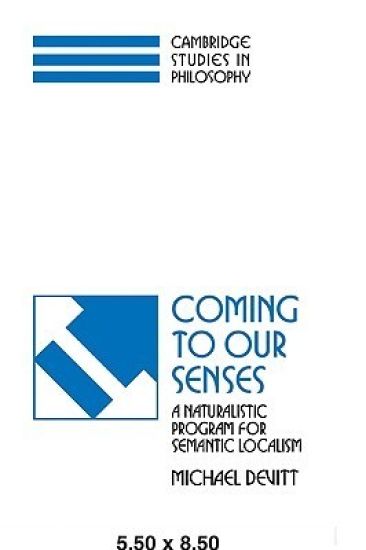
Coming to our Senses

Coming to our Senses

Michael Devitt

Cambridge University Press
1995
sidottu
Michael Devitt is a distinguished philosopher of language. In this new book he takes up one of the most important difficulties that must be faced by philosophical semantics: namely, the threat posed by holism. Three important questions lie at the core of this book: what are the main objectives of semantics; why are they worthwhile; how should we accomplish them? Devitt answers these ‘methodological’ questions naturalistically and explores what semantic programme arises from the answers. The approach is anti-Cartesian, rejecting the idea that linguistic or conceptual competence yields any privileged access to meanings. This new methodology is used first against holism. Devitt argues for a truth-referential localism, and in the process rejects direct-reference, two-factor, and verificationist theories. The book concludes by arguing against revisionism, eliminativism, and the idea that we should ascribe narrow meanings to explain behaviour.
Coming to our Senses

Coming to our Senses

Michael Devitt

Cambridge University Press
1995
pokkari
Michael Devitt is a distinguished philosopher of language. In this new book he takes up one of the most important difficulties that must be faced by philosophical semantics: namely, the threat posed by holism. Three important questions lie at the core of this book: what are the main objectives of semantics; why are they worthwhile; how should we accomplish them? Devitt answers these ‘methodological’ questions naturalistically and explores what semantic programme arises from the answers. The approach is anti-Cartesian, rejecting the idea that linguistic or conceptual competence yields any privileged access to meanings. This new methodology is used first against holism. Devitt argues for a truth-referential localism, and in the process rejects direct-reference, two-factor, and verificationist theories. The book concludes by arguing against revisionism, eliminativism, and the idea that we should ascribe narrow meanings to explain behaviour.
Realism and Truth

Realism and Truth

Michael Devitt

Princeton University Press
1997
pokkari
In this provocative and wide-ranging book, Michael Devitt argues for a thoroughgoing realism about the common-sense and scientific physical world, and for a correspondence notion of truth. Furthermore, he argues that, contrary to received opinion, the metaphysical question of realism is distinct from, and prior to, any semantic question about truth. The book makes incisive responses to Putnam, Dummett, van Fraassen, and other major anti-realists. The new afterword includes an extensive discussion of the metaphysics of nonfactualism, and new thoughts on the need for truth and on the determination of reference.
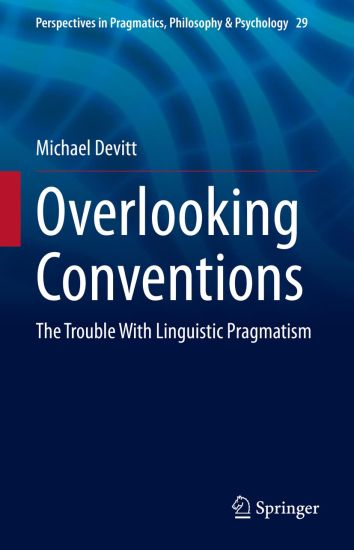
Overlooking Conventions

Overlooking Conventions

Michael Devitt

Springer Nature Switzerland AG
2021
sidottu
This book criticizes the methodology of the recent semantics-pragmatics debate in the theory of language and proposes an alternative. It applies this methodology to argue for a traditional view against a group of “contextualists” and “pragmatists”, including Sperber and Wilson, Bach, Carston, Recanati, Neale, and many others. The author disagrees with these theorists who hold that the meaning of the sentence in an utterance never, or hardly ever, yields its literal truth-conditional content, even after disambiguation and reference fixing; it needs to be pragmatically supplemented in context.The standard methodology of this debate is to consult intuitions. The book argues that theories should be tested against linguistic usage. Theoretical distinctions, however intuitive, need to be scientifically motivated. Also we should not be guided by Grice’s “Modified Occam’s Razor”, Ruhl’s “Monosemantic Bias”, or other such strategies for “meaning denialism”. From this novel perspective, the striking examples of context relativity that motivate contextualists and pragmatists typically exemplify semantic rather than pragmatic properties. In particular, polysemous phenomena should typically be treated as semantic ambiguity. The author argues that conventions have been overlooked, that there’s no extensive “semantic underdetermination” and that the new theoretical framework of “truth-conditional pragmatics” is a mistake.
Overlooking Conventions

Overlooking Conventions

Michael Devitt

Springer Nature Switzerland AG
2022
nidottu
This book criticizes the methodology of the recent semantics-pragmatics debate in the theory of language and proposes an alternative. It applies this methodology to argue for a traditional view against a group of “contextualists” and “pragmatists”, including Sperber and Wilson, Bach, Carston, Recanati, Neale, and many others. The author disagrees with these theorists who hold that the meaning of the sentence in an utterance never, or hardly ever, yields its literal truth-conditional content, even after disambiguation and reference fixing; it needs to be pragmatically supplemented in context.The standard methodology of this debate is to consult intuitions. The book argues that theories should be tested against linguistic usage. Theoretical distinctions, however intuitive, need to be scientifically motivated. Also we should not be guided by Grice’s “Modified Occam’s Razor”, Ruhl’s “Monosemantic Bias”, or other such strategies for “meaning denialism”. From this novel perspective, the striking examples of context relativity that motivate contextualists and pragmatists typically exemplify semantic rather than pragmatic properties. In particular, polysemous phenomena should typically be treated as semantic ambiguity. The author argues that conventions have been overlooked, that there’s no extensive “semantic underdetermination” and that the new theoretical framework of “truth-conditional pragmatics” is a mistake.