Kirjojen hintavertailu. Mukana 12 390 323 kirjaa ja 12 kauppaa.

Kirjahaku

Etsi kirjoja tekijän nimen, kirjan nimen tai ISBN:n perusteella.

19 kirjaa tekijältä Michael E. Taylor

Partial Differential Equations

Partial Differential Equations

Michael E. Taylor

Springer-Verlag New York Inc.
1996
nidottu
Mathematics is playing an ever more important role in the physical and biological sciences, provoking a blurring of boundaries between scientific disciplines and a resurgence of interest in the modem as weIl as the classical techniques of applied mathematics. This renewal of interest, both in research and teaching, has led to the establishment of the series: Texts in Applied Mathematics (TAM). The development of new courses is a natural consequence of a high level of excitement on the research frontier as newer techniques, such as numerical and symbolic computer systems, dynamical systems, and chaos, mix with and reinforce the traditional methods of applied mathematics. Thus, the purpose of this textbook series is to meet the current and future needs of these advances and encourage the teaching of new courses. TAM will publish textbooks suitable for use in advanced undergraduate and beginning graduate courses, and will complement the Applied Mathematical Sci­ ences (AMS) series, which will focus on advanced textbooks and research level monographs.

Measure Theory And Integration

Measure Theory And Integration

Michael E. Taylor

Amer Mathematical Society
2006
sidottu
This self-contained treatment of measure and integration begins with a brief review of the Riemann integral and proceeds to a construction of Lebesgue measure on the real line. From there the reader is led to the general notion of measure, to the construction of the Lebesgue integral on a measure space, and to the major limit theorems, such as the Monotone and Dominated Convergence Theorems. The treatment proceeds to $L^p$ spaces, normed linear spaces that are shown to be complete (i.e., Banach spaces) due to the limit theorems. Particular attention is paid to $L^2$ spaces as Hilbert spaces, with a useful geometrical structure. Having gotten quickly to the heart of the matter, the text proceeds to broaden its scope.There are further constructions of measures, including Lebesgue measure on $n$-dimensional Euclidean space. There are also discussions of surface measure, and more generally of Riemannian manifolds and the measures they inherit, and an appendix on the integration of differential forms. Further geometric aspects are explored in a chapter on Hausdorff measure.The text also treats probabilistic concepts, in chapters on ergodic theory, probability spaces and random variables, Wiener measure and Brownian motion, and martingales. This text will prepare graduate students for more advanced studies in functional analysis, harmonic analysis, stochastic analysis, and geometric measure theory.
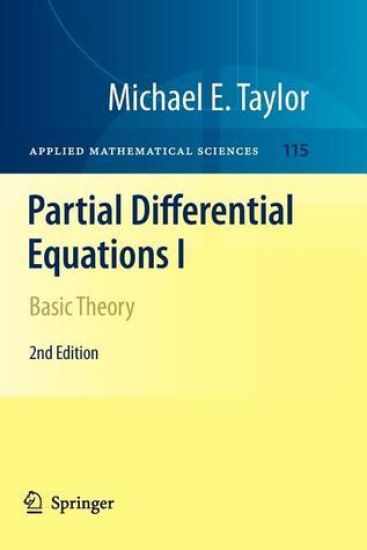
Partial Differential Equations I

Partial Differential Equations I

Michael E. Taylor

Springer-Verlag New York Inc.
2012
nidottu
The first of three volumes on partial differential equations, this one introduces basic examples arising in continuum mechanics, electromagnetism, complex analysis and other areas, and develops a number of tools for their solution, in particular Fourier analysis, distribution theory, and Sobolev spaces. These tools are then applied to the treatment of basic problems in linear PDE, including the Laplace equation, heat equation, and wave equation, as well as more general elliptic, parabolic, and hyperbolic equations.The book is targeted at graduate students in mathematics and at professional mathematicians with an interest in partial differential equations, mathematical physics, differential geometry, harmonic analysis, and complex analysis.
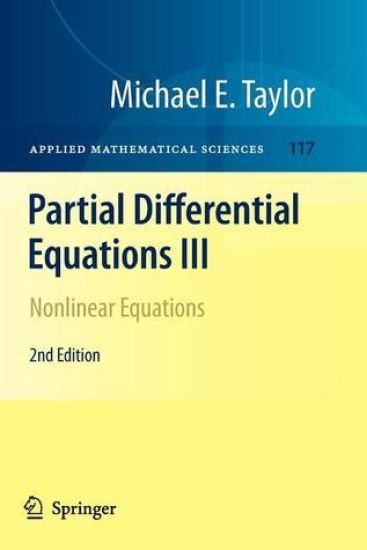
Partial Differential Equations III

Partial Differential Equations III

Michael E. Taylor

Springer-Verlag New York Inc.
2012
nidottu
The third of three volumes on partial differential equations, this is devoted to nonlinear PDE. It treats a number of equations of classical continuum mechanics, including relativistic versions, as well as various equations arising in differential geometry, such as in the study of minimal surfaces, isometric imbedding, conformal deformation, harmonic maps, and prescribed Gauss curvature. In addition, some nonlinear diffusion problems are studied. It also introduces such analytical tools as the theory of L Sobolev spaces, H lder spaces, Hardy spaces, and Morrey spaces, and also a development of Calderon-Zygmund theory and paradifferential operator calculus. The book is aimed at graduate students in mathematics, and at professional mathematicians with an interest in partial differential equations, mathematical physics, differential geometry, harmonic analysis and complex analysis
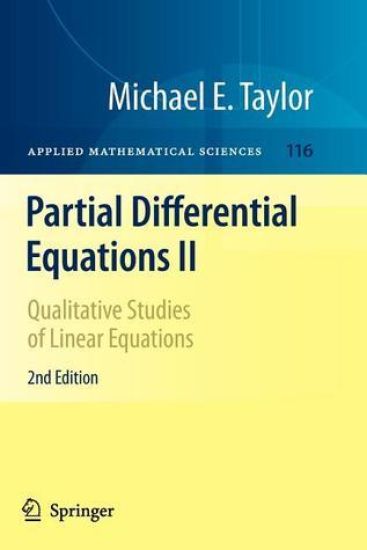
Partial Differential Equations II

Partial Differential Equations II

Michael E. Taylor

Springer-Verlag New York Inc.
2012
nidottu
This second in the series of three volumes builds upon the basic theory of linear PDE given in volume 1, and pursues more advanced topics. Analytical tools introduced here include pseudodifferential operators, the functional analysis of self-adjoint operators, and Wiener measure. The book also develops basic differential geometrical concepts, centred about curvature. Topics covered include spectral theory of elliptic differential operators, the theory of scattering of waves by obstacles, index theory for Dirac operators, and Brownian motion and diffusion.
Introduction to Analysis in One Variable

Introduction to Analysis in One Variable

Michael E. Taylor

American Mathematical Society
2020
nidottu
This is a text for students who have had a three-course calculus sequence and who are ready to explore the logical structure of analysis as the backbone of calculus. It begins with a development of the real numbers, building this system from more basic objects (natural numbers, integers, rational numbers, Cauchy sequences), and it produces basic algebraic and metric properties of the real number line as propositions, rather than axioms. The text also makes use of the complex numbers and incorporates this into the development of differential and integral calculus. For example, it develops the theory of the exponential function for both real and complex arguments, and it makes a geometrical study of the curve (expit)(expit), for real tt, leading to a self-contained development of the trigonometric functions and to a derivation of the Euler identity that is very different from what one typically sees. Further topics include metric spaces, the Stone–Weierstrass theorem, and Fourier series.
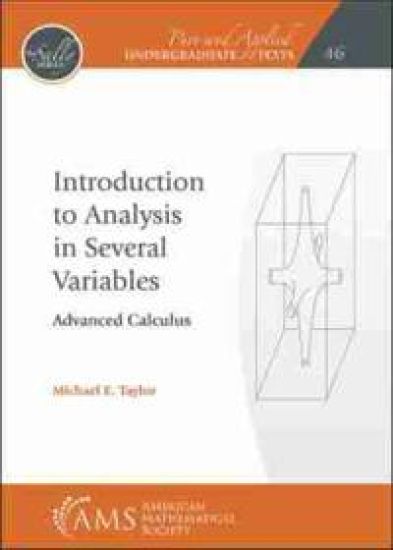
Introduction to Analysis in Several Variables

Introduction to Analysis in Several Variables

Michael E. Taylor

AMERICAN MATHEMATICAL SOCIETY
2020
pokkari
After a review of topics from one-variable analysis and linear algebra, this text treats in succession multivariable differential calculus, including systems of differential equations, and multivariable integral calculus. It builds on this to develop calculus on surfaces in Euclidean space and also on manifolds.
Linear Algebra

Linear Algebra

Michael E. Taylor

AMERICAN MATHEMATICAL SOCIETY
2020
pokkari
Explores linear algebra with the view that it is an important gateway connecting elementary mathematics to more advanced subjects, such as advanced calculus, systems of differential equations, differential geometry, and group representations.
Introduction to Complex Analysis

Introduction to Complex Analysis

Michael E. Taylor

AMERICAN MATHEMATICAL SOCIETY
2019
nidottu
In this text, the reader will learn that all the basic functions that arise in calculus--such as powers and fractional powers, exponentials and logs, trigonometric functions and their inverses, as well as many new functions that the reader will meet--are naturally defined for complex arguments. Furthermore, this expanded setting leads to a much richer understanding of such functions than one could glean by merely considering them in the real domain. For example, understanding the exponential function in the complex domain via its differential equation provides a clean path to Euler's formula and hence to a self-contained treatment of the trigonometric functions. Complex analysis, developed in partnership with Fourier analysis, differential equations, and geometrical techniques, leads to the development of a cornucopia of functions of use in number theory, wave motion, conformal mapping, and other mathematical phenomena, which the reader can learn about from material presented here.This book could serve for either a one-semester course or a two-semester course in complex analysis for beginning graduate students or for well-prepared undergraduates whose background includes multivariable calculus, linear algebra, and advanced calculus.
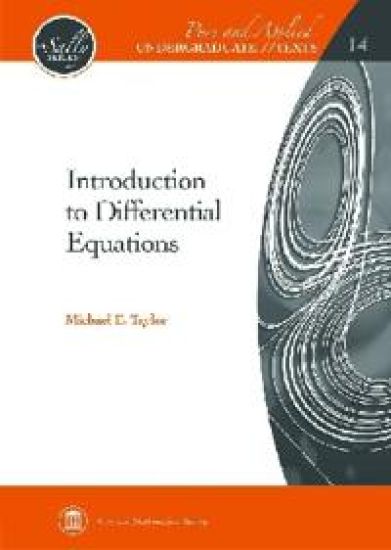
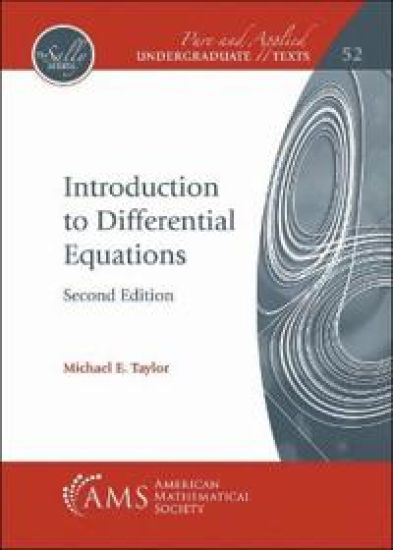
Introduction to Differential Equations

Introduction to Differential Equations

Michael E. Taylor

AMERICAN MATHEMATICAL SOCIETY
2022
nidottu
This text introduces students to the theory and practice of differential equations, which are fundamental to the mathematical formulation of problems in physics, chemistry, biology, economics, and other sciences. The book is ideally suited for undergraduate or beginning graduate students in mathematics, and will also be useful for students in the physical sciences and engineering who have already taken a three-course calculus sequence.This second edition incorporates much new material, including sections on the Laplace transform and the matrix Laplace transform, a section devoted to Bessel's equation, and sections on applications of variational methods to geodesics and to rigid body motion. There is also a more complete treatment of the Runge-Kutta scheme, as well as numerous additions and improvements to the original text. Students finishing this book will be well prepared for advanced studies in dynamical systems, mathematical physics, and partial differential equations.
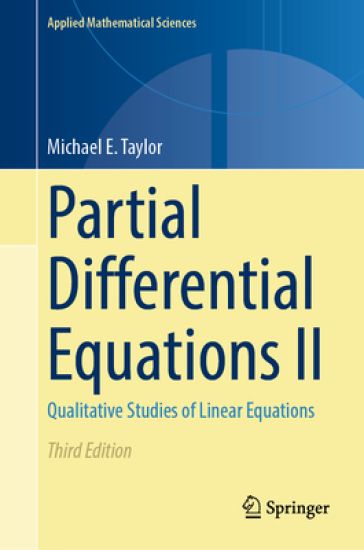
Partial Differential Equations II

Partial Differential Equations II

Michael E. Taylor

Springer International Publishing AG
2023
sidottu
This second in the series of three volumes builds upon the basic theory of linear PDE given in volume 1, and pursues more advanced topics. Analytical tools introduced here include pseudodifferential operators, the functional analysis of self-adjoint operators, and Wiener measure. The book also develops basic differential geometrical concepts, centered about curvature. Topics covered include spectral theory of elliptic differential operators, the theory of scattering of waves by obstacles, index theory for Dirac operators, and Brownian motion and diffusion. The book is targeted at graduate students in mathematics and at professional mathematicians with an interest in partial differential equations, mathematical physics, differential geometry, harmonic analysis, and complex analysis.The third edition further expands the material by incorporating new theorems and applications throughout the book, and by deepening connections and relating concepts across chapters. It includes new sections on rigid body motion, on probabilistic results related to random walks, on aspects of operator theory related to quantum mechanics, on overdetermined systems, and on the Euler equation for incompressible fluids. The appendices have also been updated with additional results, ranging from weak convergence of measures to the curvature of Kahler manifolds.Michael E. Taylor is a Professor of Mathematics at the University of North Carolina, Chapel Hill, NC.Review of first edition: “These volumes will be read by several generations of readers eager to learn the modern theory of partial differential equations of mathematical physics and the analysis in which this theory is rooted.”(Peter Lax, SIAM review, June 1998)
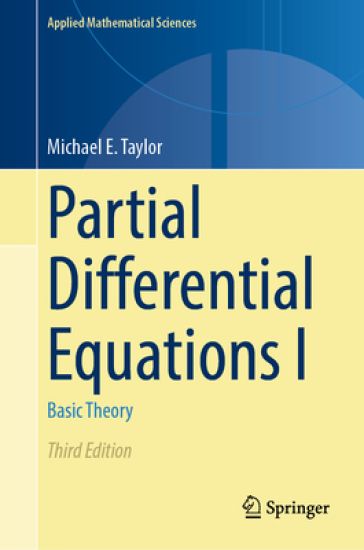
Partial Differential Equations I

Partial Differential Equations I

Michael E. Taylor

Springer International Publishing AG
2023
sidottu
The first of three volumes on partial differential equations, this one introduces basic examples arising in continuum mechanics, electromagnetism, complex analysis and other areas, and develops a number of tools for their solution, in particular Fourier analysis, distribution theory, and Sobolev spaces. These tools are then applied to the treatment of basic problems in linear PDE, including the Laplace equation, heat equation, and wave equation, as well as more general elliptic, parabolic, and hyperbolic equations. The book is targeted at graduate students in mathematics and at professional mathematicians with an interest in partial differential equations, mathematical physics, differential geometry, harmonic analysis, and complex analysis.The third edition further expands the material by incorporating new theorems and applications throughout the book, and by deepening connections and relating concepts across chapters. In includes new sections on rigid body motion, on probabilistic results related to random walks, on aspects of operator theory related to quantum mechanics, on overdetermined systems, and on the Euler equation for incompressible fluids. The appendices have also been updated with additional results, ranging from weak convergence of measures to the curvature of Kahler manifolds.Michael E. Taylor is a Professor of Mathematics at the University of North Carolina, Chapel Hill, NC.Review of first edition: “These volumes will be read by several generations of readers eager to learn the modern theory of partial differential equations of mathematical physics and the analysis in which this theory is rooted.”(Peter Lax, SIAM review, June 1998)
Partial Differential Equations III

Partial Differential Equations III

Michael E. Taylor

Springer International Publishing AG
2023
sidottu
The third of three volumes on partial differential equations, this is devoted to nonlinear PDE. It treats a number of equations of classical continuum mechanics, including relativistic versions, as well as various equations arising in differential geometry, such as in the study of minimal surfaces, isometric imbedding, conformal deformation, harmonic maps, and prescribed Gauss curvature. In addition, some nonlinear diffusion problems are studied. It also introduces such analytical tools as the theory of L^p Sobolev spaces, Holder spaces, Hardy spaces, and Morrey spaces, and also a development of Calderon-Zygmund theory and paradifferential operator calculus. The book is targeted at graduate students in mathematics and at professional mathematicians with an interest in partial differential equations, mathematical physics, differential geometry, harmonic analysis, and complex analysis. The third edition further expands the material by incorporating new theorems and applications throughout the book, and by deepening connections and relating concepts across chapters. It includes new sections on rigid body motion, on probabilistic results related to random walks, on aspects of operator theory related to quantum mechanics, on overdetermined systems, and on the Euler equation for incompressible fluids. The appendices have also been updated with additional results, ranging from weak convergence of measures to the curvature of Kahler manifolds.Michael E. Taylor is a Professor of Mathematics at the University of North Carolina, Chapel Hill, NC.Review of first edition: “These volumes will be read by several generations of readers eager to learn the modern theory of partial differential equations of mathematical physics and the analysis in which this theory is rooted.”(Peter Lax, SIAM review, June 1998)
Partial Differential Equations II

Partial Differential Equations II

Michael E. Taylor

Springer International Publishing AG
2024
nidottu
This second in the series of three volumes builds upon the basic theory of linear PDE given in volume 1, and pursues more advanced topics. Analytical tools introduced here include pseudodifferential operators, the functional analysis of self-adjoint operators, and Wiener measure. The book also develops basic differential geometrical concepts, centered about curvature. Topics covered include spectral theory of elliptic differential operators, the theory of scattering of waves by obstacles, index theory for Dirac operators, and Brownian motion and diffusion. The book is targeted at graduate students in mathematics and at professional mathematicians with an interest in partial differential equations, mathematical physics, differential geometry, harmonic analysis, and complex analysis. The third edition further expands the material by incorporating new theorems and applications throughout the book, and by deepening connections and relating concepts across chapters. It includes new sections on rigid body motion, on probabilistic results related to random walks, on aspects of operator theory related to quantum mechanics, on overdetermined systems, and on the Euler equation for incompressible fluids. The appendices have also been updated with additional results, ranging from weak convergence of measures to the curvature of Kahler manifolds. Michael E. Taylor is a Professor of Mathematics at the University of North Carolina, Chapel Hill, NC. Review of first edition: “These volumes will be read by several generations of readers eager to learn the modern theory of partial differential equations of mathematical physics and the analysis in which this theory is rooted.” (Peter Lax, SIAM review, June 1998)
Partial Differential Equations I

Partial Differential Equations I

Michael E. Taylor

Springer International Publishing AG
2024
nidottu
The first of three volumes on partial differential equations, this one introduces basic examples arising in continuum mechanics, electromagnetism, complex analysis and other areas, and develops a number of tools for their solution, in particular Fourier analysis, distribution theory, and Sobolev spaces. These tools are then applied to the treatment of basic problems in linear PDE, including the Laplace equation, heat equation, and wave equation, as well as more general elliptic, parabolic, and hyperbolic equations. The book is targeted at graduate students in mathematics and at professional mathematicians with an interest in partial differential equations, mathematical physics, differential geometry, harmonic analysis, and complex analysis.The third edition further expands the material by incorporating new theorems and applications throughout the book, and by deepening connections and relating concepts across chapters. In includes new sections on rigid body motion, on probabilistic results related to random walks, on aspects of operator theory related to quantum mechanics, on overdetermined systems, and on the Euler equation for incompressible fluids. The appendices have also been updated with additional results, ranging from weak convergence of measures to the curvature of Kahler manifolds. Michael E. Taylor is a Professor of Mathematics at the University of North Carolina, Chapel Hill, NC. Review of first edition: “These volumes will be read by several generations of readers eager to learn the modern theory of partial differential equations of mathematical physics and the analysis in which this theory is rooted.” (Peter Lax, SIAM review, June 1998)
Partial Differential Equations III

Partial Differential Equations III

Michael E. Taylor

Springer International Publishing AG
2024
nidottu
The third of three volumes on partial differential equations, this is devoted to nonlinear PDE. It treats a number of equations of classical continuum mechanics, including relativistic versions, as well as various equations arising in differential geometry, such as in the study of minimal surfaces, isometric imbedding, conformal deformation, harmonic maps, and prescribed Gauss curvature. In addition, some nonlinear diffusion problems are studied. It also introduces such analytical tools as the theory of L^p Sobolev spaces, Holder spaces, Hardy spaces, and Morrey spaces, and also a development of Calderon-Zygmund theory and paradifferential operator calculus. The book is targeted at graduate students in mathematics and at professional mathematicians with an interest in partial differential equations, mathematical physics, differential geometry, harmonic analysis, and complex analysis. The third edition further expands the material by incorporating new theorems and applications throughout the book, and by deepening connections and relating concepts across chapters. It includes new sections on rigid body motion, on probabilistic results related to random walks, on aspects of operator theory related to quantum mechanics, on overdetermined systems, and on the Euler equation for incompressible fluids. The appendices have also been updated with additional results, ranging from weak convergence of measures to the curvature of Kahler manifolds. Michael E. Taylor is a Professor of Mathematics at the University of North Carolina, Chapel Hill, NC. Review of first edition: “These volumes will be read by several generations of readers eager to learn the modern theory of partial differential equations of mathematical physics and the analysis in which this theory is rooted.” (Peter Lax, SIAM review, June 1998)
Measure Theory and Integration

Measure Theory and Integration

Michael E. Taylor

AMERICAN MATHEMATICAL SOCIETY
2006
nidottu
This self-contained treatment of measure and integration begins with a brief review of the Riemann integral and proceeds to a construction of Lebesgue measure on the real line. From there the reader is led to the general notion of measure, to the construction of the Lebesgue integral on a measure space, and to the major limit theorems, such as the Monotone and Dominated Convergence Theorems. The treatment proceeds to $L^p$ spaces, normed linear spaces that are shown to be complete (i.e., Banach spaces) due to the limit theorems. Particular attention is paid to $L^2$ spaces as Hilbert spaces, with a useful geometrical structure. Having gotten quickly to the heart of the matter, the text proceeds to broaden its scope. There are further constructions of measures, including Lebesgue measure on $n$-dimensional Euclidean space. There are also discussions of surface measure, and more generally of Riemannian manifolds and the measures they inherit, and an appendix on the integration of differential forms. Further geometric aspects are explored in a chapter on Hausdorff measure. The text also treats probabilistic concepts, in chapters on ergodic theory, probability spaces and random variables, Wiener measure and Brownian motion, and martingales. This text will prepare graduate students for more advanced studies in functional analysis, harmonic analysis, stochastic analysis, and geometric measure theory.