Kirjojen hintavertailu. Mukana 11 699 587 kirjaa ja 12 kauppaa.

Kirjahaku

Etsi kirjoja tekijän nimen, kirjan nimen tai ISBN:n perusteella.

6 kirjaa tekijältä Michael F. Holt

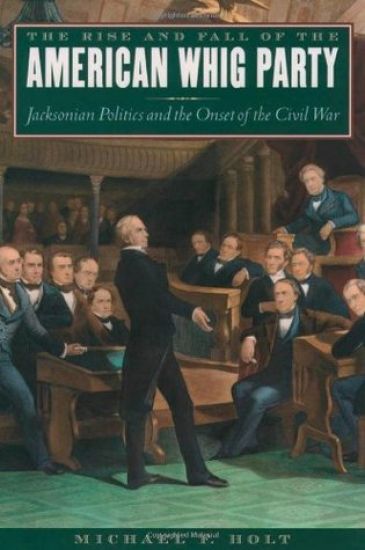
The Rise and Fall of the American Whig Party

The Rise and Fall of the American Whig Party

Michael F. Holt

OXFORD UNIVERSITY PRESS INC
2003
nidottu
The political home of Henry Clay, Daniel Webster, Horace Greeley, and the young Abraham Lincoln, the American Whig Party was involved at every level of American politics—local, state, and federal—in the years before the Civil War, and controlled the White House for eight of the twenty-two years that it existed. Now, in The Rise and Fall of the American Whig Party, Michael F. Holt gives us the only comprehensive history of the Whigs ever written—a monumental history covering in rich detail the American political landscape from the Age of Jackson to impending disunion. In Michael Holt's hands, the history of the Whig Party becomes a political history of the United States during the tumultuous Antebellum period. He offers a panoramic account of a time when a welter of parties (Whig, Democratic, Anti-Mason, Know Nothing, Free Soil, Republican) and many extraordinary political statesmen (including Andrew Jackson, John C. Calhoun, William Seward, Daniel Webster, Martin Van Buren, and Henry Clay) struggled to control the national agenda as the U.S. inched towards secession. It was an era when Americans were passionately involved in politics, when local concerns drove national policy, and when momentous political events rocked the country, including the Nullification Controversy, the Panic of 1837, the Annexation of Texas, the Compromise of 1850, and the Kansas-Nebraska Act. Holt captures all of this as he shows that, amid this contentious political activity, the Whig Party continuously strove to unite North and South, repeatedly trying to find a compromise position. Indeed, the Whig Party emerges as the nation's last great hope to prevent secession and civil war. The Rise and Fall of the American Whig Party is a magisterial work of history, one that has already been hailed by William Gienapp of Harvard as "one of the most important books on nineteenth-century politics ever written."
The Political Crisis of the 1850s

The Political Crisis of the 1850s

Michael F. Holt

WW Norton Co
1985
nidottu
Holt sees the Civil War as representing a breakdown in America's democratic political process, more specifically the Second Party System of Whigs and Democrats. He demonstrates this system's success, beginning in the 1820s and 1830s, in confining sectional disputes safely within the political arena. With the breakdown of vital two-party competition in the 1850s, sectional issues increasingly took on ideological dimension, causing, Americans North and South to see in them dangerous threats to cherished republican institutions. No longer manageable within the arena of politics, sectional differences had to be resolved with in the arena of battle. The Political Crisis of the 1850s offers a clearly written account of politics (state and federal), sectionalism, race, and slavery from the 1820s through to the Civil War, brilliantly combining the behavioral and ideological approaches to political history.
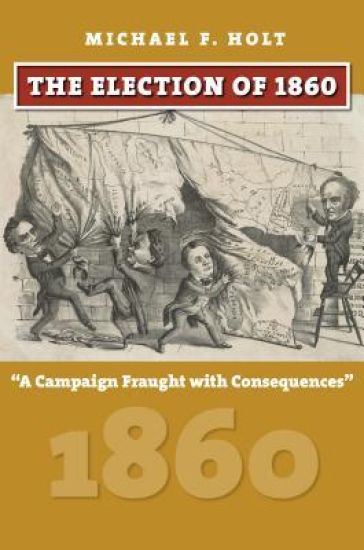
The Election of 1860

The Election of 1860

Michael F. Holt

University Press of Kansas
2017
sidottu
Because of its extraordinary consequences and because of Abraham Lincoln’s place in the American pantheon, the presidential election of 1860 is probably the most studied in our history. But perhaps for the same reasons, historians have focused on the contest of Lincoln versus Stephen Douglas in the northern free states and John Bell versus John C. Breckinridge in the slaveholding South. In The Election of 1860 a preeminent scholar of American history disrupts this familiar narrative with a clearer and more comprehensive account of how the election unfolded and what it was actually about. Most critically, the book counters the common interpretation of the election as a referendum on slavery and the Republican Party’s purported threat to it. However significantly slavery figured in the election, The Election of 1860 reveals the key importance of widespread opposition to the Republican Party because of its overtly anti-southern rhetoric and seemingly unstoppable rise to power in the North after its emergence in 1854. Also of critical importance was the corruption of the incumbent administration of Democrat James Buchanan—and a nationwide revulsion against party. Grounding his history in a nuanced retelling of the pre-1860 story, Michael F. Holt explores the sectional politics that permeated the election and foreshadowed the coming Civil War. He brings to light how the campaigns of the Republican Party and the National (Northern) Democrats and the Constitutional (Southern) Democrats and the newly formed Constitutional Union Party were not exclusively regional. His attention to the little-studied role of the Buchanan Administration, and of perceived threats to the preservation of the Union, clarifies the true dynamic of the 1860 presidential election, particularly in its early stages.
The Sarbanes-Oxley Act

The Sarbanes-Oxley Act

Michael F. Holt

CIMA Publishing
2005
nidottu
The Sarbanes-Oxley Act is a mandatory requirement for all corporations listed in the US. Compliance is not an option. This book is written as a “working manual? for the senior management to grasp the Act and its implications. It provides a section by section overview of the Act and the appropriate action to take in each case. There is coverage of how UK companies listed in, or doing business with America also have to comply with the Sarbanes-Oxley Act. A description of the UK version of SOX is also included. The Appendix describes the (minor) variations for Canadian listed corporations based on Ontario Securities Commission and British Columbia Securities Commission rules.
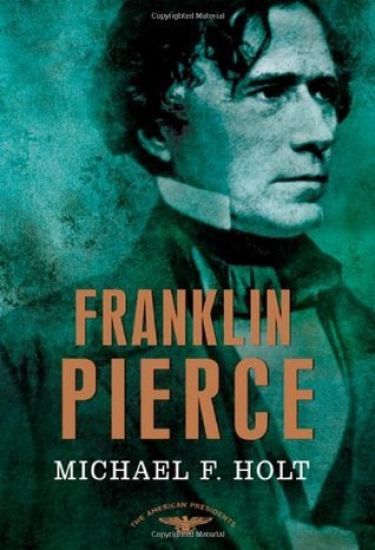
Franklin Pierce

Franklin Pierce

Michael F. Holt

Times Books
2010
sidottu
The genial but troubled New Englander whose single-minded partisan loyalties inflamed the nation's simmering battle over slavery Charming and handsome, Franklin Pierce of New Hampshire was drafted to break the deadlock of the 1852 Democratic convention. Though he seized the White House in a landslide against the imploding Whig Party, he proved a dismal failure in office.Michael F. Holt, a leading historian of nineteenth-century partisan politics, argues that in the wake of the Whig collapse, Pierce was consumed by an obsessive drive to unify his splintering party rather than the roiling country. He soon began to overreach. Word leaked that Pierce wanted Spain to sell the slave-owning island of Cuba to the United States, rousing sectional divisions. Then he supported repeal of the Missouri Compromise, which limited the expansion of slavery in the west. Violence broke out, and "Bleeding Kansas" spurred the formation of the Republican Party. By the end of his term, Pierce's beloved party had ruptured, and he lost the nomination to James Buchanan.In this incisive account, Holt shows how a flawed leader, so dedicated to his party and ill-suited for the presidency, hastened the approach of the Civil War.
Political Parties and American Political Development from the Age of Jackson to the Age of Lincoln
For more than twenty years Michael F. Holt has been considered one of the leading specialists in the political history of the United States. Political Parties and American Political Development from the Age of Jackson to the Age of Lincoln is a collection of some of his more important shorter studies on the politics of nineteenth-century America.The collection focuses on the mass political parties that emerged in the 1820s and their role in broader political developments from that decade to 1865. Holt includes essays on the Democratic, Antimasonic, Whig, and Know Nothing parties, as well as one on Abraham Lincoln's relationship with the congressional wing of the Republican party during the Civil War. Almost all essays touch on the broad question of the role of partisan politics in explaining the outbreak of the war. Individual essays address the following questions as well: What explains the birth and death of powerful third parties? What was the relationship among economic conditions, party performance in office (especially legislative performance), and the mobilization of an unprecedented number of voters between 1836 and 1840? Why did the Whigs find it necessary to nominate military hero Zachary Taylor as their presidential candidate in 1848? What explains the death of the Whig party? What role did ethnoreligious issues and the Know Nothing party play in the realignment of the 1850s and the ultimate triumph of the Republican party? In what ways did the continuation of two-party competition after 1860 help the North win the Civil War? Most of the essays have been published previously over a twenty-year span, but there are also two new pieces. ""The Mysterious Disappearance of the American Whig party,"" originally delivered as the Commonwealth Fund Lecture at University College London in February, 1990, seeks to explain why the Whig party died in the 1850s. This essay contrasts the fate of the Whig party with the fates of the Republican party in the 1930s and 1970s and the British Conservative party in the 1840s and 1850s - parties that survived similar, indeed graver, challenges than those to which the Whigs succumbed. In addition, Holt has written and excellent introduction in which he explains how he came to write the essays and reflects upon them in light of the current state of political history as a discipline. Political Parties and American Political Development from the Age of Jackson to the Age of Lincoln offers provocative insights into both the history of nineteenth-century politics and the way it is studied.