Kirjojen hintavertailu. Mukana 11 342 296 kirjaa ja 12 kauppaa.

Kirjahaku

Etsi kirjoja tekijän nimen, kirjan nimen tai ISBN:n perusteella.

5 kirjaa tekijältä Michael Hardt

The Subversive Seventies

The Subversive Seventies

Michael Hardt

OXFORD UNIVERSITY PRESS INC
2023
sidottu
A thought-provoking reconsideration of how the revolutionary movements of the 1970s set the mold for today's activism. The 1970s was a decade of "subversives". Faced with various progressive and revolutionary social movements, the forces of order--politicians, law enforcement, journalists, and conservative intellectuals--saw subversives everywhere. From indigenous peasant armies and gay liberation organizations, to anti-nuclear activists and Black liberation militants, subversives challenged authority, laid siege to the established order, and undermined time-honored ways of life. Every corner of the left was fertile ground for subversive elements, which the forces of order had to root out and destroy--a project they pursued with zeal and brutality. In The Subversive Seventies, Michael Hardt sets out to show that popular understandings of the political movements of the seventies--often seen as fractious, violent, and largely unsuccessful--are not just inaccurate, but foreclose valuable lessons for the political struggles of today. While many accounts of the 1970s have been written about the regimes of domination that emerged throughout the decade, Hardt approaches the subversive from the perspectives of those who sought to undermine the base of established authority and transform the fundamental structures of society. In so doing, he provides a novel account of the theoretical and practical projects of liberation that still speak to us today, too many of which have been all but forgotten. Departing from popular and scholarly accounts that focus on the social movements of the 1960s, Hardt argues that the 1970s offers an inspiring and useful guide for contemporary radical political thought and action. Although we can still learn much from the movements of the sixties, that decade's struggles for peace, justice, and freedom fundamentally marked the end of an era. The movements of the seventies, in contrast, responded directly to emerging neoliberal frameworks and other structures of power that continue to rule over us today. They identified and confronted political problems that remain central for us. The 1970s, in this sense, marks the beginning of our time. Looking at a wide range of movements around the globe, from the United States, to Guinea Bissau, South Korea, Chile, Turkey, and Italy, The Subversive Seventies provides a reassessment of the political action of the 1970s that sheds new light not only on our revolutionary past but also on what liberation can be and do today.
Labor Of Dionysus

Labor Of Dionysus

Michael Hardt

University of Minnesota Press
1994
nidottu
“Labor is the living, form-giving fire,” Marx wrote. “It is the transitoriness of things, their temporality, as their transformation by living time.” How is it, then, that labor, with all its life-affirming potential, has become the means of capitalist discipline, exploitation, and domination in modern society? The authors expose and pursue this paradox through a systematic analysis of the role of labor in the processes of capitalist production and in the establishment of capitalist legal and social institutions. Critiquing liberal and socialist notions of labor and institutional reform from a radical democratic perspective, Hardt and Negri challenge the state-form itself.In the twentieth century, labor has become central to the material and formal constitution of the State, as a complex nexus of value and right. And yet, in living labor and social cooperation, which cut across the divisions of workdays and wage relations, the authors identify a total critique of capitalist practice as well, presenting not only the negation of the present social order but also the affirmation of an alternative system of value, norms, and desires. The forms in which this potential is expressed, from the social movements of the 1960s to those of the 1990s, are the “prerequisites of communism” already existing in contemporary society.
Gilles Deleuze

Gilles Deleuze

Michael Hardt

University of Minnesota Press
1993
nidottu
The key to understanding Deleuze's complete body of work."A coherent and systematic reading of a philosopher who has consistently courted the incoherent and systematic. What we must avoid are encounters with those who cultivate sad passions (the men of ressentiment in the Nietzschean formulation); and we must increase our power to compose new relationships with compatible bodies with whom we share a common notion. Hardt's exceptional book is one such joyful encounter." -Times Literary Supplement"An excellent book. The project of Gilles Deleuze is to situate Deleuze squarely in the camp of those who seek to deepen and transform our philsophical understanding and political situation. Hardt seems to me to be directly on target." -Substance"Both for its object and its method of study, here is a work that will mark the future of the field of Deleuzian studies." -Eric Alliez, Critique"Hardt's reading of Deleuze is complex and precise. He follows the intricacies of the argument and of the shifting positions with considerable skill, thus providing us with a study not only of the Deleuzian way of doing philosophy, but of Deleuzian reading-of the selectivity of its targets, of its agonistic approach to philosophy, through indirect attack on one main opponent. Reading Hardt reading Deleuze reading, we can understand, for instance, why Deleuze's exposition usually takes the form not of a dialectic but of a correlation, of a system of differences." -Radical Philosophy"How can we forget the dialectic? How an we affirm a constitutive ontology? Through its efforts to respond to these questions, Gilles Deleuze's philosophical apprenticeship presents the Bildungsroman of any contemporary philosophy that wants to break away from the destiny of modernity. Michael Hardt unravels the guiding thread of this philosophy of the future." -Antonio Negri"Hardt's interpretations are exceptionally well-grounded in the history of philosophical discourse, a discourse he exercises with discipline and rare insight. As the only major work on Deleuze in English, this book will undoubtedly set the standard for any future study of one of France's most important thinkers-and it is a very high standard, indeed." -Peggy Kamuf
Gilles Deleuze

Gilles Deleuze

Michael Hardt

Routledge
1993
sidottu
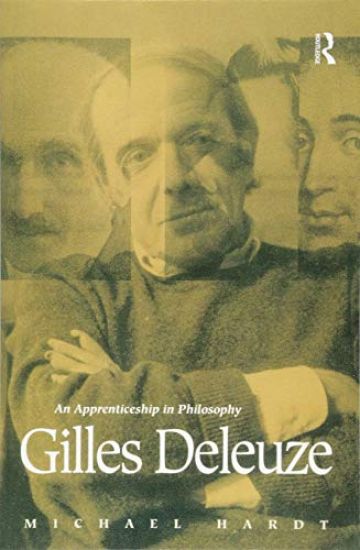
First published in 2005. Gilles Deleuze, a major figure in the intellectual history of the late 20th century, inaugurated the radical non-Hegelianism that has marked French intellectual life during the past three decades. Many poststructuralist and postmodernist practices can be traced to Deleuze's 1962 resurrection of Nietzsche against Hegel. Hardt shows how Deleuze's early analysis of Bergson's critique of ontology and determination led him to a conception of a positive movement of differentiation and becoming, which in turn led him to the field of forces, sense, value, and the thematic of power and affirmation in Nietzsche. The theory of power in Nietzsche provided the link for Deleuze to an ethics of active expression in Spinoza. Deleuze's discovery and analysis of Spinoza's cultivation of joy and practice at the center of ontology finally resulted in a complete break from the Hegelian paradigm that had reigned over continental philosophy and history. Michael Hardt is the translator of Antonio Negri's "The Savage Anomaly: The Power of Spinoza's Metaphysics and Politics" (Minnesota, 1990), Giorgio Agamben's "The Coming Community" (Minnesota, 1993), and co-author (with Antonio Negri) of "Labor of Dionysus" (Minnesota).
Gilles Deleuze

Gilles Deleuze

Michael Hardt

Routledge
1993
nidottu
First published in 2005. Gilles Deleuze, a major figure in the intellectual history of the late 20th century, inaugurated the radical non-Hegelianism that has marked French intellectual life during the past three decades. Many poststructuralist and postmodernist practices can be traced to Deleuze's 1962 resurrection of Nietzsche against Hegel. Hardt shows how Deleuze's early analysis of Bergson's critique of ontology and determination led him to a conception of a positive movement of differentiation and becoming, which in turn led him to the field of forces, sense, value, and the thematic of power and affirmation in Nietzsche. The theory of power in Nietzsche provided the link for Deleuze to an ethics of active expression in Spinoza. Deleuze's discovery and analysis of Spinoza's cultivation of joy and practice at the center of ontology finally resulted in a complete break from the Hegelian paradigm that had reigned over continental philosophy and history. Michael Hardt is the translator of Antonio Negri's "The Savage Anomaly: The Power of Spinoza's Metaphysics and Politics" (Minnesota, 1990), Giorgio Agamben's "The Coming Community" (Minnesota, 1993), and co-author (with Antonio Negri) of "Labor of Dionysus" (Minnesota).