Kirjojen hintavertailu. Mukana 12 371 011 kirjaa ja 12 kauppaa.

Kirjahaku

Etsi kirjoja tekijän nimen, kirjan nimen tai ISBN:n perusteella.

6 kirjaa tekijältä Michael Hymers

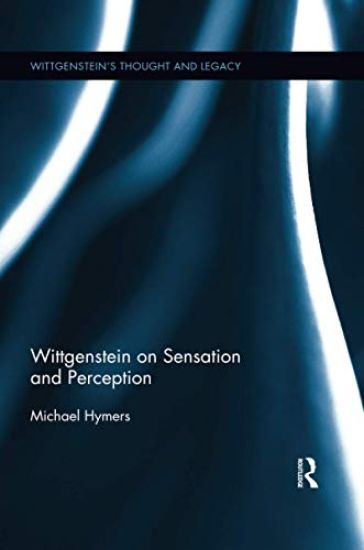
Wittgenstein on Sensation and Perception
This book offers two novel claims about Wittgenstein’s views and methods on perception as explored in the Philosophical Investigations. The first is an interpretive claim about Wittgenstein: that his views on sensation and perception, including his critique of private language, have their roots in his reflections on sense-datum theories and on what Hymers calls the misleading metaphor of phenomenal space. The second is a major philosophical claim: that Wittgenstein’s critique of the misleading metaphor of phenomenal space is of ongoing relevance to current debates concerning first-person authority and the problem of perception because we are still tempted to draw inferences about the phenomenal that only apply to the physical. Many contemporary discussions of these topics are thus premised on the very confusions Wittgenstein sought to dispel. This book will appeal to Wittgenstein scholars who are interested in the Philosophical Investigations and to philosophers of perception who may think that Wittgenstein’s views are mistaken, irrelevant, or already adequately appreciated.
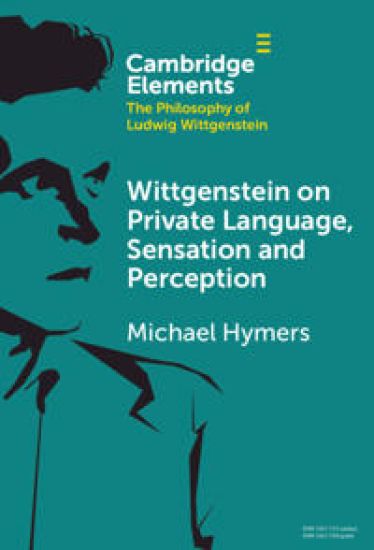
Wittgenstein on Private Language, Sensation and Perception

Wittgenstein on Private Language, Sensation and Perception

Michael Hymers

Cambridge University Press
2025
sidottu
Wittgenstein's critique of private language in the Philosophical Investigations does not attempt to refute the possibility of a private sensation-language, let alone in any one argument, as has often been thought. Nor does it aim to establish that language is intrinsically social. Instead, PI §§243–315 presents a series of arguments, suggestions, questions, examples and thought-experiments whose purpose is to undermine the temptation to think of sensations and perceptual experiences as private objects occupying a private phenomenal space. These themes are clear developments of Wittgenstein's earlier critique of sense-datum theories (1929–1936) and his insight that naming is more complex than he had assumed in the Tractatus.
Wittgenstein on Private Language, Sensation and Perception

Wittgenstein on Private Language, Sensation and Perception

Michael Hymers

Cambridge University Press
2025
pokkari
Wittgenstein's critique of private language in the Philosophical Investigations does not attempt to refute the possibility of a private sensation-language, let alone in any one argument, as has often been thought. Nor does it aim to establish that language is intrinsically social. Instead, PI §§243–315 presents a series of arguments, suggestions, questions, examples and thought-experiments whose purpose is to undermine the temptation to think of sensations and perceptual experiences as private objects occupying a private phenomenal space. These themes are clear developments of Wittgenstein's earlier critique of sense-datum theories (1929–1936) and his insight that naming is more complex than he had assumed in the Tractatus.
Wittgenstein on Sensation and Perception

Wittgenstein on Sensation and Perception

Michael Hymers

Acumen Publishing Ltd
2017
sidottu
This book offers two novel claims about Wittgenstein’s views and methods on perception as explored in the Philosophical Investigations. The first is an interpretive claim about Wittgenstein: that his views on sensation and perception, including his critique of private language, have their roots in his reflections on sense-datum theories and on what Hymers calls the misleading metaphor of phenomenal space. The second is a major philosophical claim: that Wittgenstein’s critique of the misleading metaphor of phenomenal space is of ongoing relevance to current debates concerning first-person authority and the problem of perception because we are still tempted to draw inferences about the phenomenal that only apply to the physical. Many contemporary discussions of these topics are thus premised on the very confusions Wittgenstein sought to dispel. This book will appeal to Wittgenstein scholars who are interested in the Philosophical Investigations and to philosophers of perception who may think that Wittgenstein’s views are mistaken, irrelevant, or already adequately appreciated.