Kirjojen hintavertailu. Mukana 11 627 220 kirjaa ja 12 kauppaa.

Kirjahaku

Etsi kirjoja tekijän nimen, kirjan nimen tai ISBN:n perusteella.

26 kirjaa tekijältä Michael J. Shapiro

Aesthetics of Equality

Aesthetics of Equality

Michael J. Shapiro

OXFORD UNIVERSITY PRESS INC
2023
nidottu
Presuming that the problem of political equality, as it bears on both persons and assemblages, is about being accorded access to the material and symbolic resources needed to manage an effective civic presence, Michael J. Shapiro's critical interventions engage the way aesthetic genres illustrate this problem. Addressing literary, cinematic, photographic, musical, art historical, and architectural compositions, Shapiro's inquiries encounter the way a wide variety of texts elevate voices, bodies, and life dramas that have existed below thresholds of recognition. In Aesthetics of Equality, Shapiro offers a guide to aesthetic methods that emphasize the way writing strategies engage diverse artistic genres to articulate political problems. Emphasizing relationships between compositional form and ideational commitment, while focusing on the texts' protagonists (aesthetic subjects), the analyses cover a wide variety of spaces and historical moments in scenes ranging from ancient Israel and Egypt in the Old Testament's Genesis to the ethno-histories of California and Texas, with attention on the right to urban space in such megacities as Paris, New York, Los Angeles, and Istanbul.
Thinking Outside the Canon

Thinking Outside the Canon

Michael J. Shapiro

OXFORD UNIVERSITY PRESS INC
2025
nidottu
Thinking Outside the Canon traces author Michael J. Shapiro's intellectual journey as a political theorist who has adapted multidisciplinary practices and unconventional texts across his career to develop a more diverse model of doing theory. Theorizing textuality and historiography, Shapiro draws on a variety of disciplinary idioms and texts that span across genres and geographies, ranging from Caribbean fiction to Ukraine war fictional ethnographies. As well, he covers an array of scales and spaces, from the state to the individual room. As such, Thinking Outside the Canon reflects how the field of political theory has grown and shifted through the author's own textual odyssey. After recovering the early portion of his own political theory odyssey, Shapiro traces his departures from the canon. He recounts how, through this departure, he refashioned his scholarship via a series of textual engagements and composed the basis of an instructional inquiry focused on textuality and historiography. Finally, Shapiro relates how Thinking Outside the Canon functions as his own learning text, as both a theorist and writer and as a student, looking towards the future of the political theory canon and its usefulness.
Cinematic Geopolitics

Cinematic Geopolitics

Michael J. Shapiro

Routledge
2008
sidottu
In recent years, film has been one of the major genres within which the imaginaries involved in mapping the geopolitical world have been represented and reflected upon. In this book, one of America's foremost theorists of culture and politics treats those aspects of the "geopolitical aesthetic" that must be addressed in light of both the post cold war and post 9/11 world and contemporary film theory and philosophy. Beginning with an account of his experience as a juror at film festival’s, Michael J. Shapiro’s Cinematic Geopolitics analyzes the ways in which film festival space and both feature and documentary films function as counter-spaces to the contemporary "violent cartography" occasioned by governmental policy, especially the current "war on terror." Influenced by the cinema-philosophy relationship developed by Gilles Deleuze and the politics of aesthetics thinking of Jacques Ranciere, the book’s chapters examines a range of films from established classics like the Deer Hunter and the Battle of Algiers to contemporary films such as Dirty Pretty Things and the Fog of War. Shapiro’s use of philosophical and theoretical works makes this cutting edge examination of film and politics essential reading for all students and scholars with an interest in film and politics.
Cinematic Geopolitics

Cinematic Geopolitics

Michael J. Shapiro

Routledge
2008
nidottu
In recent years, film has been one of the major genres within which the imaginaries involved in mapping the geopolitical world have been represented and reflected upon. In this book, one of America's foremost theorists of culture and politics treats those aspects of the "geopolitical aesthetic" that must be addressed in light of both the post cold war and post 9/11 world and contemporary film theory and philosophy. Beginning with an account of his experience as a juror at film festival’s, Michael J. Shapiro’s Cinematic Geopolitics analyzes the ways in which film festival space and both feature and documentary films function as counter-spaces to the contemporary "violent cartography" occasioned by governmental policy, especially the current "war on terror." Influenced by the cinema-philosophy relationship developed by Gilles Deleuze and the politics of aesthetics thinking of Jacques Ranciere, the book’s chapters examines a range of films from established classics like the Deer Hunter and the Battle of Algiers to contemporary films such as Dirty Pretty Things and the Fog of War. Shapiro’s use of philosophical and theoretical works makes this cutting edge examination of film and politics essential reading for all students and scholars with an interest in film and politics.
Methods and Nations

Methods and Nations

Michael J. Shapiro

Routledge
2004
sidottu
Methods and Nations critiques one of the primary deployments of twentieth-century social science: comparative politics whose major focus has been "nation-building" in the "Third World," often attempting to universalize and render self-evident its own practices. International relations theorists, unable to resist the "cognitive imperialism" of a state-centric social science, have allowed themselves to become colonized. Michael Shapiro seeks to bring recognition to forms of political expression-alternative modes of intelligibility for things, people, and spaces-that have existed on the margins of the nationhood practices of states and the complicit nation-sustaining conceits of social science.
Methods and Nations

Methods and Nations

Michael J. Shapiro

Routledge
2004
nidottu
Methods and Nations critiques one of the primary deployments of twentieth-century social science: comparative politics whose major focus has been "nation-building" in the "Third World," often attempting to universalize and render self-evident its own practices. International relations theorists, unable to resist the "cognitive imperialism" of a state-centric social science, have allowed themselves to become colonized. Michael Shapiro seeks to bring recognition to forms of political expression-alternative modes of intelligibility for things, people, and spaces-that have existed on the margins of the nationhood practices of states and the complicit nation-sustaining conceits of social science.
War Crimes, Atrocity and Justice

War Crimes, Atrocity and Justice

Michael J. Shapiro

Polity Press
2014
sidottu
What do we know about war crimes and justice? What are the discursive practices through which the dominant images of war crimes, atrocity and justice are understood? In this wide ranging text, Michael J. Shapiro contrasts the justice-related imagery of the war crimes trial (for example the solitary, headphone-wearing defendant at the Hague listening with intent to a catalogue of charges) with ?literary justice?: representations in literature, film, and biographical testimony, raising questions about atrocities and justice that juridical proceedings exclude. By engaging with the ambiguities exposed by the artistic and experiential genres, reading them alongside policy and archival documentation and critical theoretical discourses, Shapiro?s War Crimes, Atrocity, and Justice challenges traditional notions of ?responsibility? in juridical settings. His comparative readings instead encourage a focus on the conditions of possibility for war crimes as they arise from the actions of states, non-state agencies and individuals involved in arms trading, peace keeping, sex trafficking, and law enforcement and adjudication. Theory springs to life as Shapiro draws on examples from legal discourse, literature, media, film, and television, to build a nuanced picture of politics and the problem of justice. It will be of great interest to students of film and media, literature, cultural studies, contemporary philosophy and political science
War Crimes, Atrocity and Justice

War Crimes, Atrocity and Justice

Michael J. Shapiro

Polity Press
2014
nidottu
What do we know about war crimes and justice? What are the discursive practices through which the dominant images of war crimes, atrocity and justice are understood? In this wide ranging text, Michael J. Shapiro contrasts the justice-related imagery of the war crimes trial (for example the solitary, headphone-wearing defendant at the Hague listening with intent to a catalogue of charges) with ?literary justice?: representations in literature, film, and biographical testimony, raising questions about atrocities and justice that juridical proceedings exclude. By engaging with the ambiguities exposed by the artistic and experiential genres, reading them alongside policy and archival documentation and critical theoretical discourses, Shapiro?s War Crimes, Atrocity, and Justice challenges traditional notions of ?responsibility? in juridical settings. His comparative readings instead encourage a focus on the conditions of possibility for war crimes as they arise from the actions of states, non-state agencies and individuals involved in arms trading, peace keeping, sex trafficking, and law enforcement and adjudication. Theory springs to life as Shapiro draws on examples from legal discourse, literature, media, film, and television, to build a nuanced picture of politics and the problem of justice. It will be of great interest to students of film and media, literature, cultural studies, contemporary philosophy and political science
Cinematic Political Thought

Cinematic Political Thought

Michael J. Shapiro

Edinburgh University Press
1999
nidottu
This book has two aims: to offer a series of investigations into aspects of contemporary politics such as race, nation and gender; and to articulate a critical philosophical perspective with politically disposed treatments of contemporary cinema. What the author offers is a politics of critique, inspired by Kant, in which he attempts to show what it can mean to think the political. The interventions into aspects of contemporary political issues, as reflected in films including Hoop Dreams, Lonestar, Father of the Bride II , The Adventures of Priscilla, Queen of the Desert, and To Live and Die in LA, are also influenced by Deleuze, Derrida, Foucault and Lyotard: theorists loosely regarded by the author as post-Kantian. This is a polemical work, aimed at encouraging critical, ethico-political thinking. Its breadth of theoretical scope and empirical reference, and the innovative style of presentation will make it vital reading for all those with an interest in the linking of culture and politics.
Cinematic Political Thought

Cinematic Political Thought

Michael J. Shapiro

New York University Press
1999
sidottu
In Cinematic Political Thought, Michael J. Shapiro investigates aspects of contemporary politics and articulates a critical philosophical perspective with politically disposed treatments of contemporary cinema. Reading such films as Hoop Dreams, Lone Star, Father of the Bride II and To Live and Die in LA through the lens of Deleuze, Derrida, Foucault and Lyotard, Shapiro demonstrates what it can mean to think the political both in terms of cinema studies and in wider aesthetic and social contexts. Cinematic Political Thought is a polemical work, aimed at encouraging critical, ethical and political thinking. Its breadth of theoretical scope and empirical reference, and the innovative style of presentation will make it vital reading for anyone with an interest in the conjunction of culture and politics.
Cinematic Political Thought

Cinematic Political Thought

Michael J. Shapiro

New York University Press
1999
pokkari
In Cinematic Political Thought, Michael J. Shapiro investigates aspects of contemporary politics and articulates a critical philosophical perspective with politically disposed treatments of contemporary cinema. Reading such films as Hoop Dreams, Lone Star, Father of the Bride II and To Live and Die in LA through the lens of Deleuze, Derrida, Foucault and Lyotard, Shapiro demonstrates what it can mean to think the political both in terms of cinema studies and in wider aesthetic and social contexts. Cinematic Political Thought is a polemical work, aimed at encouraging critical, ethical and political thinking. Its breadth of theoretical scope and empirical reference, and the innovative style of presentation will make it vital reading for anyone with an interest in the conjunction of culture and politics.
For Moral Ambiguity

For Moral Ambiguity

Michael J. Shapiro

University of Minnesota Press
2001
nidottu
Under the banner of family values, a war of more than words is being waged. At stake is the control of contemporary national culture-and the consciousness of succeeding generations. Michael J. Shapiro enters the fray with this galvanizing book, which exposes the assumptions, misconceptions, and historical inaccuracies that mark the neoconservative campaign to redeem an imagined past and colonize the present and future with a moral and political commitment to the "traditional family."Challenging the neoconservative assumption of a natural relation between a historically constant, traditional family structure and civic life, Shapiro shows how the situation of the family in relation to public life has emerged differently in different historical periods. For Moral Ambiguity juxtaposes moralizing versus historically sensitive, critical treatments of familial and public attachments, revealing how "the family"-as represented in historical and contemporary fiction, cinema, television, and other genres and media-emerges as a contingent cultural and historical structure.Shapiro treats the ways in which family space, however changeable, serves as a critical locus of "enunciation"-as a space from which diverse family personae challenge the relationships and historical narratives that support dominant structures of power and authority and offer ways to renegotiate the problem of "the political." By extending recognition to less heeded voices and genres of expression, he seeks to frame the political within a democratic ethos. Ultimately, the book compels us to understand "the political" as the continuous negotiation of different modes of civic presence.
The Political Sublime

The Political Sublime

Michael J. Shapiro

Duke University Press
2018
sidottu
In The Political Sublime Michael J. Shapiro formulates an original politics of aesthetics through an analysis of the experience of the sublime. Turning away from Kant's analysis of the sublime experience as a validation of the existence of a universal common sense, Shapiro draws on Deleuze, Lyotard, and Rancière to show how incomprehensible events and dilemmas provide openings for new political formations. He approaches the sublime through a range of artistic and cultural texts that address social crises and natural disasters, from the writing of James Baldwin and Ta-Nehisi Coates to the films of Ingmar Bergman and Spike Lee; these works suggest ways to channel the disruptive effects of the sublime into resistance to authority and innovative political initiative. Whether stemming from the threat of nuclear annihilation or the aftermath of an earthquake, the violence of racism and terrorism or the devastation of industrialism, sublime experience, Shapiro contends, allows for a rethinking of events in ways that reveal, redistribute, and create conditions of possibility for alternative communities of sense.
The Political Sublime

The Political Sublime

Michael J. Shapiro

Duke University Press
2018
pokkari
In The Political Sublime Michael J. Shapiro formulates an original politics of aesthetics through an analysis of the experience of the sublime. Turning away from Kant's analysis of the sublime experience as a validation of the existence of a universal common sense, Shapiro draws on Deleuze, Lyotard, and Rancière to show how incomprehensible events and dilemmas provide openings for new political formations. He approaches the sublime through a range of artistic and cultural texts that address social crises and natural disasters, from the writing of James Baldwin and Ta-Nehisi Coates to the films of Ingmar Bergman and Spike Lee; these works suggest ways to channel the disruptive effects of the sublime into resistance to authority and innovative political initiative. Whether stemming from the threat of nuclear annihilation or the aftermath of an earthquake, the violence of racism and terrorism or the devastation of industrialism, sublime experience, Shapiro contends, allows for a rethinking of events in ways that reveal, redistribute, and create conditions of possibility for alternative communities of sense.
Deforming American Political Thought

Deforming American Political Thought

Michael J. Shapiro

Routledge
2016
sidottu
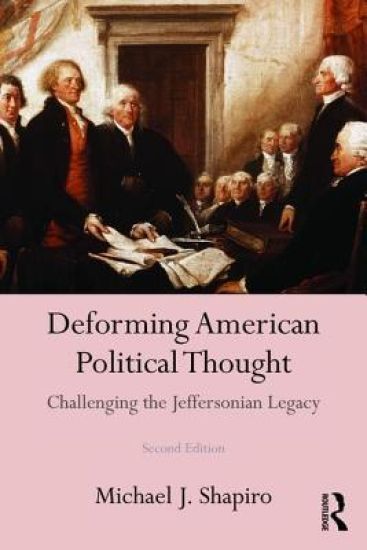
Deforming American Political Thought offers an alternative to the dominant American historical imagination, treating issues that range from the nature of Thomas Jefferson's vision of an egalitarian nation to the persistence of racial inequality. Presenting multifaceted arguments that transcend the myopic scope of traditional political discourses, Michael J. Shapiro summons disparate disciplines and genres – architecture, crime stories, novels, films, and jazz/blues music (among others) to provide approaches to the comprehension of diverse facets of American political thought from the founding to the present. The book’s various investigations disclose that there have always been dissenting voices, articulated in diverse genres of expression that cast doubt on the moral purpose and exceptionalism of the American mind. This highly anticipated updated second edition features a preface focusing on aesthetic theory and the contributions of artistic genres for political analysis, and a completely new chapter on critical thinking about the US western and urban encounters afforded by the two HBO series, Deadwood and The Wire respectively.
Deforming American Political Thought

Deforming American Political Thought

Michael J. Shapiro

Routledge
2016
nidottu
Deforming American Political Thought offers an alternative to the dominant American historical imagination, treating issues that range from the nature of Thomas Jefferson's vision of an egalitarian nation to the persistence of racial inequality. Presenting multifaceted arguments that transcend the myopic scope of traditional political discourses, Michael J. Shapiro summons disparate disciplines and genres – architecture, crime stories, novels, films, and jazz/blues music (among others) to provide approaches to the comprehension of diverse facets of American political thought from the founding to the present. The book’s various investigations disclose that there have always been dissenting voices, articulated in diverse genres of expression that cast doubt on the moral purpose and exceptionalism of the American mind. This highly anticipated updated second edition features a preface focusing on aesthetic theory and the contributions of artistic genres for political analysis, and a completely new chapter on critical thinking about the US western and urban encounters afforded by the two HBO series, Deadwood and The Wire respectively.
The Cinematic Political

The Cinematic Political

Michael J. Shapiro

Routledge
2019
sidottu
In this book, Michael J. Shapiro stages a series of pedagogical encounters between political theory, represented as a compositional challenge, and cinematic texts, emphasizing how to achieve an effective research paper/essay by heeding the compositional strategies of films. The text’s distinctiveness is its focus on the intermediation between two textual genres. It is aimed at providing both a conceptual introduction to the politics of aesthetics and a guide to writing strategies. In its illustrations of encounters between political theory and cinema, the book’s critical edge is its emphasis on how to intervene in cinematic texts with innovative conceptual frames in ways that challenge dominant understandings of life worlds. The Cinematic Political is designed as a teaching resource that introduces students to the relationship between film form and political thinking. With diverse illustrative investigations, the book instructs students on how to watch films with an eye toward writing a research paper in which a film (or set of films) constitutes the textual vehicle for political theorizing.
The Cinematic Political

The Cinematic Political

Michael J. Shapiro

Routledge
2019
nidottu
In this book, Michael J. Shapiro stages a series of pedagogical encounters between political theory, represented as a compositional challenge, and cinematic texts, emphasizing how to achieve an effective research paper/essay by heeding the compositional strategies of films. The text’s distinctiveness is its focus on the intermediation between two textual genres. It is aimed at providing both a conceptual introduction to the politics of aesthetics and a guide to writing strategies. In its illustrations of encounters between political theory and cinema, the book’s critical edge is its emphasis on how to intervene in cinematic texts with innovative conceptual frames in ways that challenge dominant understandings of life worlds. The Cinematic Political is designed as a teaching resource that introduces students to the relationship between film form and political thinking. With diverse illustrative investigations, the book instructs students on how to watch films with an eye toward writing a research paper in which a film (or set of films) constitutes the textual vehicle for political theorizing.
The Phenomenology of Religious Belief

The Phenomenology of Religious Belief

Michael J. Shapiro

Bloomsbury Academic
2021
sidottu
In The Phenomenology of Religious Belief, the renowned philosopher Michael J. Shapiro investigates how art – and in particular literature and film – can impact upon both traditional interpretations and critical studies of religious beliefs and experiences. In doing so, he examines the work of prolific and award-winning writers such as Toni Morrison, Philip K. Dick and Robert Coover. By placing their work in conjunction with critical analyses of media by the likes of Ingmar Bergman and Pier Paolo Pasolini and combining it with the work of groundbreaking thinkers such as George Canguilhem, Giorgio Agamben and Slavoj Žižek, Shapiro takes a truly interdisciplinary approach to the question of how life should be lived. His assessment of phenomenological subjectivity also leads him to question the nature of political theology and extend the criticism of Pauline theology.
The Phenomenology of Religious Belief

The Phenomenology of Religious Belief

Michael J. Shapiro

BLOOMSBURY PUBLISHING PLC
2022
nidottu
In The Phenomenology of Religious Belief, the renowned philosopher Michael J. Shapiro investigates how art – and in particular literature and film – can impact upon both traditional interpretations and critical studies of religious beliefs and experiences. In doing so, he examines the work of prolific and award-winning writers such as Toni Morrison, Philip K. Dick and Robert Coover. By placing their work in conjunction with critical analyses of media by the likes of Ingmar Bergman and Pier Paolo Pasolini and combining it with the work of groundbreaking thinkers such as George Canguilhem, Giorgio Agamben and Slavoj Žižek, Shapiro takes a truly interdisciplinary approach to the question of how life should be lived. His assessment of phenomenological subjectivity also leads him to question the nature of political theology and extend the criticism of Pauline theology.