Kirjojen hintavertailu. Mukana 11 699 587 kirjaa ja 12 kauppaa.

Kirjahaku

Etsi kirjoja tekijän nimen, kirjan nimen tai ISBN:n perusteella.

7 kirjaa tekijältä Michael J. Zimmerman

Ignorance and Moral Responsibility

Ignorance and Moral Responsibility

Michael J. Zimmerman

Oxford University Press
2022
sidottu
Michael J. Zimmerman investigates the relation between ignorance and moral responsibility. He begins with the presentation of a case in which a tragedy occurs, one to which many people have unwittingly contributed, and addresses the question of whether their ignorance absolves them of blame for what happened. Inspection of the case issues in the Argument from Ignorance, whose conclusion is that, to be blameworthy for one's behaviour and its consequences, one must at some time in the history of that behaviour have known that one was engaged in wrongdoing-a thesis that threatens to undermine many everyday ascriptions of responsibility. This argument is examined and refined in ensuing chapters by way of, first, a detailed inquiry into the nature of moral responsibility, ignorance, and control, all of which play a crucial role in the argument, and then an application of the fruits of this investigation to the question of whether and how someone might be to blame for behaviour that stems from either culpable ignorance, negligence, recklessness, or the kind of fundamental moral ignorance that often characterizes evildoers. The Argument from Ignorance implies that in a great many such cases the agent has an excuse for the wrongdoing in question. This is a disturbing verdict, and in the final chapter challenges to the argument are entertained. Despite the merits of some of these challenges, it is held that the argument, revised one last time, survives them.
Ignorance and Moral Obligation

Ignorance and Moral Obligation

Michael J. Zimmerman

Oxford University Press
2014
sidottu
Ignorance and Moral Obligation concerns whether and how our ignorance about ourselves and our circumstances affects what our moral obligations and moral rights are. Michael J. Zimmerman begins by distinguishing three well-established views about the nature of moral obligation: the Objective, Subjective, and Prospective Views. Some philosophers have attempted to reconcile the three views in question, but these attempts are shown to fail. The question thus arises: which of the three views ought to be accepted and which rejected? Zimmerman argues that, in light of the ignorance that besets us, the Objective and Subjective Views should be rejected and the Prospective View accepted. The argument is based on close consideration of a kind of case provided by Frank Jackson, one in which an agent has deficient evidence regarding the outcomes of his options. Many objections to this argument are entertained and rebutted, by means of which the Prospective View is itself elaborated and defended. Among those who accept the Prospective View, the primary motivation for doing so has often been that of finding a useful guide to action, but Zimmerman argues that the Prospective View can be only of strictly limited help in providing such a guide. Finally, he addresses some implications that the Prospective View has regarding the nature of moral rights. Our possession of moral rights is precarious, being dependent on the evidence possessed by others. Once again, several objections are entertained and rebutted. The distinction between rights and desert is stressed, and the relevance of risk to rights is explored.
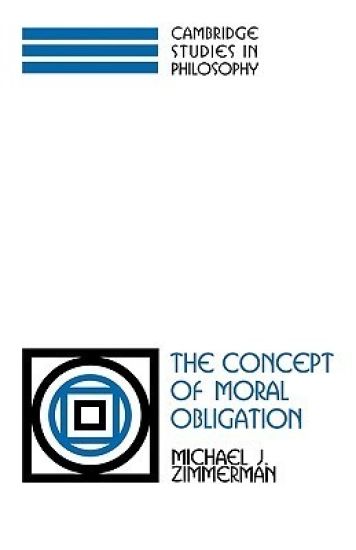
The Concept of Moral Obligation

The Concept of Moral Obligation

Michael J. Zimmerman

Cambridge University Press
2007
pokkari
The principal aim of this book is to develop and defend an analysis of the concept of moral obligation. The analysis is neutral regarding competing substantive theories of obligation, whether consequentialist or deontological in character. What it seeks to do is generate solutions to a range of philosophical problems concerning obligation and its application. Amongst these problems are deontic paradoxes, the supersession of obligation, conditional obligation, prima facie obligation, actualism and possibilism, dilemmas, supererogation, and cooperation. By virtue of its normative neutrality, the analysis provides a theoretical framework within which competing theories of obligation can be developed and assessed. This study is a major contribution to metaethics that will be of particular interest to all philosophers concerned with normative ethical theory.
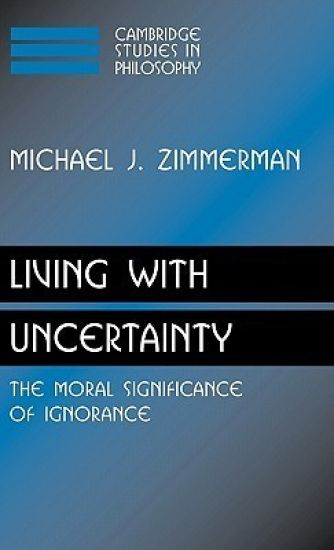
Living with Uncertainty

Living with Uncertainty

Michael J. Zimmerman

Cambridge University Press
2010
pokkari
Every choice we make is set against a background of massive ignorance about our past, our future, our circumstances, and ourselves. Philosophers are divided on the moral significance of such ignorance. Some say that it has a direct impact on how we ought to behave - the question of what our moral obligations are; others deny this, claiming that it only affects how we ought to be judged in light of the behaviour in which we choose to engage - the question of what responsibility we bear for our choices. Michael Zimmerman claims that our ignorance has an important bearing on both questions, and offers an account of moral obligation and moral responsibility that is sharply at odds with the prevailing wisdom. His book will be of interest to a wide range of readers in ethics.
The Concept of Moral Obligation

The Concept of Moral Obligation

Michael J. Zimmerman

Cambridge University Press
1996
sidottu
The principal aim of this book is to develop and defend an analysis of the concept of moral obligation. The analysis is neutral regarding competing substantive theories of obligation, whether consequentialist or deontological in character. What it seeks to do is generate new solutions to a range of philosophical problems concerning obligation and its application. Amongst these problems are deontic paradoxes, the supersession of obligation, conditional obligation, prima facie obligation, actualism and possibilism, dilemmas, supererogation, and cooperation. By virtue of its normative neutrality, the analysis provides a theoretical framework within which competing theories of obligation can be developed and assessed. This study is a major contribution to metaethics that will be of particular interest to all philosophers concerned with normative ethical theory.
Living with Uncertainty

Living with Uncertainty

Michael J. Zimmerman

Cambridge University Press
2008
sidottu
Every choice we make is set against a background of massive ignorance about our past, our future, our circumstances, and ourselves. Philosophers are divided on the moral significance of such ignorance. Some say that it has a direct impact on how we ought to behave - the question of what our moral obligations are; others deny this, claiming that it only affects how we ought to be judged in light of the behaviour in which we choose to engage - the question of what responsibility we bear for our choices. Michael Zimmerman claims that our ignorance has an important bearing on both questions, and offers an account of moral obligation and moral responsibility that is sharply at odds with the prevailing wisdom. His book will be of interest to a wide range of readers in ethics.
The Nature of Intrinsic Value

The Nature of Intrinsic Value

Michael J. Zimmerman

Rowman Littlefield Publishers
2001
nidottu
At the heart of ethics reside the concepts of good and bad; they are at work when we assess whether a person is virtuous or vicious, an act right or wrong, a decision defensible or indefensible, a goal desirable or undesirable. But there are many varieties of goodness and badness. At their core lie intrinsic goodness and badness, the sort of value that something has for its own sake. It is in virtue of intrinsic value that other types of value may be understood, and hence that we can begin to come to terms with questions of virtue and vice, right and wrong, and so on. This book investigates the nature of intrinsic value: just what it is for something to be valuable for its own sake, just what sort of thing can have such value, just how such a value is to be computed. In the final chapter, the fruits of this investigation are applied to a discussion of pleasure, pain, and displeasure and also of moral virtue and vice, in order to determine just what value lies within these phenomena.