Kirjojen hintavertailu. Mukana 11 518 949 kirjaa ja 12 kauppaa.

Kirjahaku

Etsi kirjoja tekijän nimen, kirjan nimen tai ISBN:n perusteella.

15 kirjaa tekijältä Michael Martone

Michael Martone

Michael Martone

Michael Martone

Fiction Collective Two
2005
nidottu
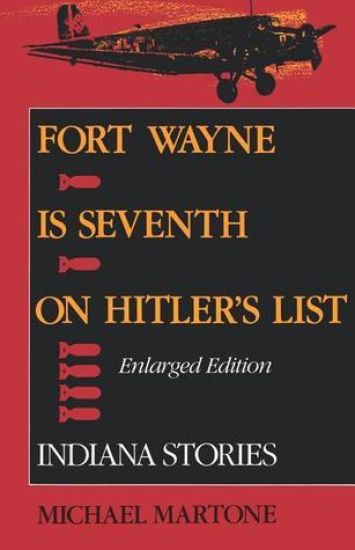
Michael Martone is its own appendix, comprising fifty ""contributors notes,"" each of which identifies in exorbitant biographical detail the author of the other forty-nine. It is full of fanciful anecdotes and preposterous reminiscences. Michael Martone's self-inventions include the multiple deaths of himself and all his family members, his Kafkaesque rebirth as a giant insect, and his stints as circus performer, assembly-line worker, photographer, and movie extra. Expect no autobiographical consistency here. A note revealing Martone's mother as the ghost-writer of all his books precedes the note beginning, ""Michael Martone, an orphan..."" We learn of Martone's university career and sketchy formal education, his misguided caretaking of his teacher John Barth's lawn, and his impersonation of a poor African republic in political science class, where Martone's population is allowed to starve as his more fortunate fellow republics fight over development and natural resource trading-cards. The author of ""Michael Martone"", whose other names include Missy, Dolly, Peanut, Bug, Gigi-tone, Tony's boy, Patty's boy, Junior's, Mickey, Monk, Mr Martone, and ""the contributor named in this note,"" proves as Protean as fiction itself, continuously transforming the past with every new attribution but never identifying himself by name. It is this missing personage who, from first note to last, constitutes the unformed subject of ""Michael Martone"".
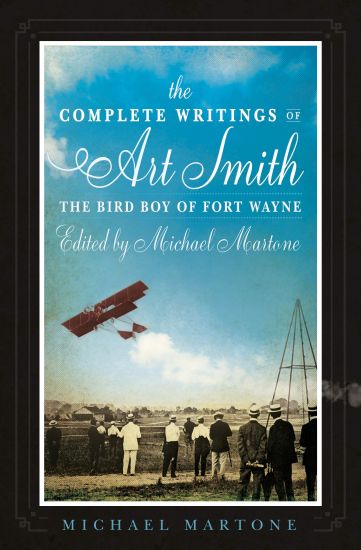
The Complete Writings of Art Smith, the Bird Boy of Fort Wayne, Edited by Michael Martone
Winner of the BOA Short Fiction Prize Finalist for the the Big Other Award for Fiction The Complete Writings of Art Smith, the Bird Boy of Fort Wayne, Edited by Michael Martone is a Midwestern mythology that celebrates facts, fiction, and the impermanence of art. Inspired by the real-life pioneer of early aviation who invented the art of skywriting, the brief stories in this collection by “editor” Michael Martone follow the adventures of Art Smith and his authorship in the sky. In the spirit of Kurt Vonnegut and Hayao Miyazaki, The Complete Writings of Art Smith, the Bird Boy of Fort Wayne, Edited by Michael Martone recreates the wonder of the early flying machines as it reimagines the unwritten stories we tell about the daredevils who flew them.
Double-wide

Double-wide

Michael Martone

Indiana University Press
2007
pokkari
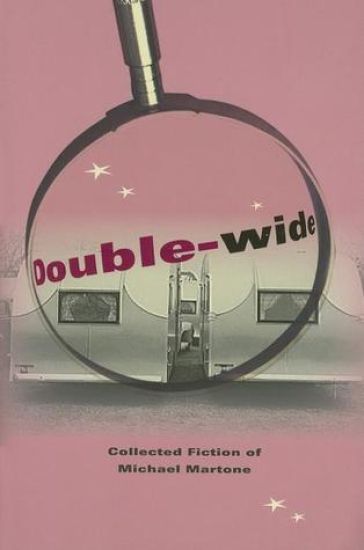
In this one volume, readers have access to the two decades of Hoosier mythology created by Michael Martone, one of Indiana's most recognized voices. This book collects work from Martone's first five books: Alive and Dead in Indiana, Safety Patrol, Fort Wayne Is Seventh on Hitler's List (IUP, 1990, 1992), Pensées: The Thoughts of Dan Quayle, and Seeing Eye. Virtually all of the stories in this "double-wide" collection speak to the Hoosier experience and imagination. Places like Martone's hometown of Fort Wayne, as well as Peru, Elkhart, and Indianapolis, and narrators such as Colonel Sanders, Alfred Kinsey, and James Dean's high school English teacher all come to life with the author's trademark blend of irreverent humor and incisive reality.
The Flatness and Other Landscapes

The Flatness and Other Landscapes

Michael Martone

University of Georgia Press
2003
pokkari
Seen from the air, the seemingly endless "flyover" spaces that form America's Midwest appear in rectangular variations of brown, green, and ochre, with what Michael Martone terms "the tended look of a train set." In these essays, the flatness of the region becomes the author's canvas for a richly textured, multidimensional exploration of its culture and history. In the tradition of the Greek myths that inspire him, Martone begins at the beginning—his beginning—as a child who "grew up" in his mother's high school English classroom. As the essays unfold, provocative accounts of his experiences lead us on a path toward discovery of the stories that build our own sense of place and color our understanding of the world.From depicting the details of mechanized cow-milking to relating the similarities between the Greek city of Sparta and Indianapolis, Martone subtly connects different cultures, times, and stories. "Stories We Tell Ourselves" characterizes the fluid, energetic writing that transforms a mundane small town into an intertwined, vibrant world shaped by the perceptions and memories of the people who live there. What begins in one classroom at Central High effortlessly builds into a discussion, by turns playful, serious, and poignant, that touches on myriad subjects. Before our eyes, Martone unites The Odyssey, Iowa farmers, a human genome map, American Gothic, and Dan Quayle into a saga equal to any from Classical mythology, showing us that a house, a farm, a town, a country, or a civilization has energy and dimension only through the stories of its inhabitants. The Flatness and Other Landscapes proves that our lives and the landscapes that surround us are only as flat as we perceive them to be.
Unconventions

Unconventions

Michael Martone

University of Georgia Press
2005
pokkari
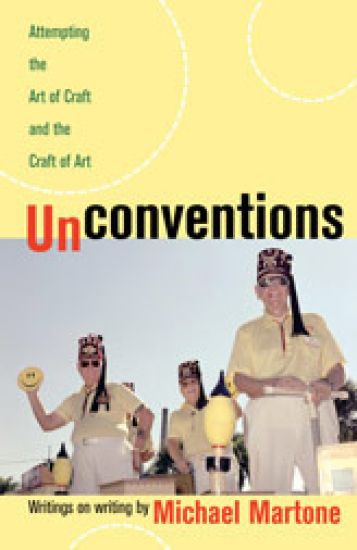
Unconventions is a quirky and provocative miscellany that reveals Michael Martone’s protean interests as a writer and a writing teacher. Martone has, shall we say, a problem with authority. His chief pleasure in knowing the rules of his vocation comes from trying out new ways to bend, blend, or otherwise defy them. The pieces gathered in Unconventions are drawn from a long career spent loosening the creative strictures on writing. Including articles, public addresses, essays, interviews, and even a eulogy, these writings vary greatly in form but are unified in addressing the many technical and artistic issues that face all writers, particularly those interested in experimental and nontraditional modes and forms.Martone’s approach has always been to synthesize, to understand and use any technique, formula, or style available. “I find myself, then,” he writes, “self-identifying as a formalist, both and neither an experimenter and/or a traditionalist.” In “I Love a Parade: An Afterword,” Martone writes about not fitting in—and loving it—as he recalls the time he marched alone in a local Labor Day parade, as a one-person delegation from the National Writers Union. Elsewhere, in writings formally, stylistically, purposely at odds with themselves, Martone’s expansive curiosity is on full display. We learn about camouflage techniques, how a baby acquires language, how to “read” a WPA-era post office mural, and why Martone sold his stock in the New Yorker and reinvested his money in the company that makes Etch A Sketch®.Unconventions, then, is Martone’s “Frankensteinian monster,” a kind of unruly, hybrid spawn of the mainstream writing enterprise. “Writing seems to me an intrinsic pleasure, an end in itself first,” says Martone. “The question for me is not whether my writing, or any piece of writing, is good or bad but what the writing is and what it is doing and how finally it is used or can be used by others.”
Racing in Place

Racing in Place

Michael Martone

University of Georgia Press
2008
pokkari
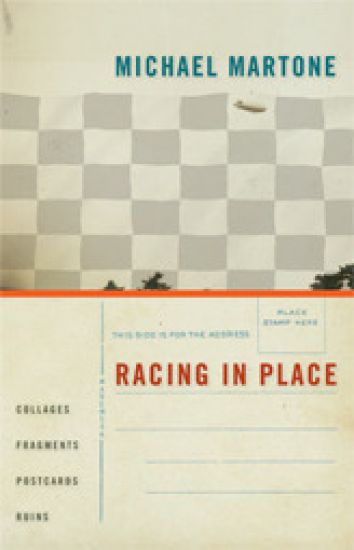
Is it truth or fiction? Memoir or essay? Narrative or associative? To a writer like Michael Martone, questions like these are high praise. Martone’s studied disregard of form and his unruffled embrace of the prospect that nothing—no story, no life—is ever quite finished have yielded some of today’s most splendidly unconventional writing. Add to that an utter weakness for pop Americana and what Louise Erdrich has called a “deep affection for the ordinary,” and you have one of the few writers who could pull off something like Racing in Place. Up the steps of the Washington Monument, down the home stretch at the Indy Speedway, and across the parking lot of the Moon Winx Lodge in Tuscaloosa, Alabama, Martone chases, and is chased by, memories—and memories of memories. He writes about his grandfather’s job as a meter reader, those seventies-era hotels with atrium lobbies and open glass elevators, and the legendary temper of basketball coach Bob Knight.Martone, as Peter Turchi has said, looks “under stones the rest of us leave unturned.” So, what is he really up to when he dwells on the make of Malcolm X’s eyeglasses or the runner-up names for Snow White’s seven dwarfs? In “My Mother Invents a Tradition,” Martone tells how his mom, as the dean of girls at a brand-new high school in Fort Wayne, Indiana, “constructed a nostalgic past out of nothing.” Sitting at their dining room table, she came up with everything from the school colors (orange and brown) to the yearbook title (Bear Tracks). Look, and then look again, Martone is saying. “You never know. I never know.”
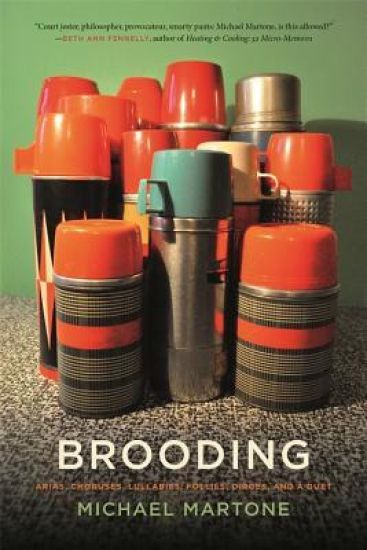
Brooding

Brooding

Michael Martone

University of Georgia Press
2018
pokkari
This collection of more than twenty-five essays, both meditative and formally inventive, considers all kinds of subjects: everyday objects such as keys and hats, plus concepts of time and place; the memoir; writing; the essay itself; and Michael Martone’s friendship with the writers David Foster Wallace, Jonathan Franzen, and Kurt Vonnegut. Throughout the essays, Martone’s style expands with the incorporation of new technological platforms. Several of the pieces were written specifically for online venues, while the essays on the death of Martone’s mother and father were written on Facebook while the events happened. One essay about using new technologies in the classroom was written solely in tweets.Brooding—the book’s title and the title of an essay—draws a parallel between the disappearance of early browsers and the emergence, after seventeen years, of a brood of cicadas. Throughout these essays Martone’s words inhabit spaces where the reconnection to people in the past and the metaphors of electronic memory converge.
The Scribner Anthology of Contemporary Short Fiction: 50 North American Stories Since 1970
Fifty remarkable short stories from a range of contemporary fiction authors including Junot Diaz, Amy Tan, Jamaica Kincaid, Jhumpa Lahiri, and more, selected from a survey of more than five hundred English professors, short story writers, and novelists. Contributors include Russell Banks, Donald Barthelme, Rick Bass, Richard Bausch, Charles Baxter, Amy Bloom, T.C. Boyle, Kevin Brockmeier, Robert Olen Butler, Sandra Cisneros, Peter Ho Davies, Janet Desaulniers, Junot Diaz, Anthony Doerr, Stuart Dybek, Deborah Eisenberg, Richard Ford, Mary Gaitskill, Dagoberto Gilb, Ron Hansen, A.M. Homes, Mary Hood, Denis Johnson, Edward P. Jones, Thom Jones, Jamaica Kincaid, Jhumpa Lahiri, David Leavitt, Kelly Link, Reginald McKnight, David Means, Susan Minot, Rick Moody, Bharati Mukherjee, Antonya Nelson, Joyce Carol Oates, Tim O'Brien, Daniel Orozco, Julie Orringer, ZZ Packer, Annie Proulx, Stacey Richter, George Saunders, Joan Silber, Leslie Marmon Silko, Susan Sontag, Amy Tan, Melanie Rae Thon, Alice Walker, and Steve Yarbrough.
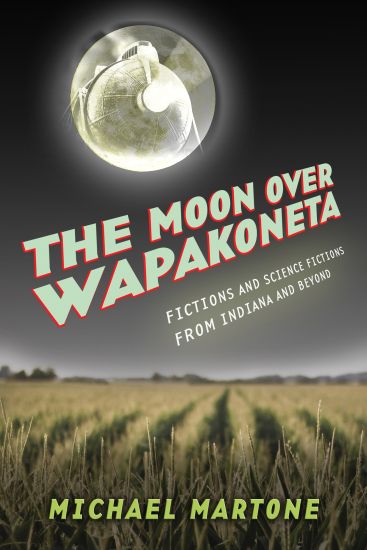
The Moon over Wapakoneta

The Moon over Wapakoneta

Michael Martone

Fiction Collective Two
2018
nidottu
Lyric fictions by a master fabulist of America's Midwest.The Moon over Wapakoneta is vintage Michael Martone, the visionary oracle of the American Midwest with the gift for discovering the marvelous in the mundane. In these stories Martone shows us how traveling across time zones from Ohio to Indiana is a form of time travel; how a beer bottle can serve as a kind of telescope, how Amish might power their spaceships with windmills as they travel through space and time. These stories capture the paradox of feeling that one is in the heart of the country while at the same time in the middle of nowhere, of natives who find themselves strangers in their once familiar, but now strange, lands.On display is a love of obsolete technologies, small-town whimsy, home movies of proms and birthday parties, steam engines and baseball games. If Italo Calvino lived in Indiana rather than Italy, these are the fictions he might have made.
Indiana

Indiana

Michael Martone

Fiction Collective Two
2001
nidottu
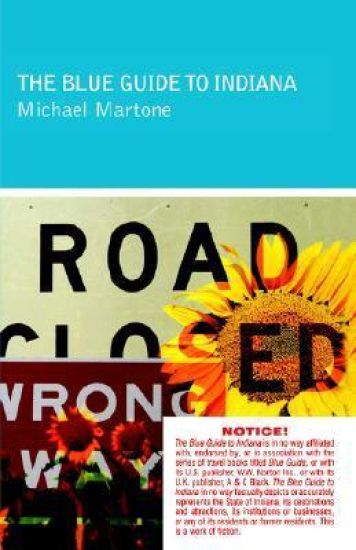
Michael Martone, whose trademark is the blurring of the lines between fact and fiction, has created an Indiana that almost is, a landscape marked by Lover's Lane-franchises and pharmaceutical drug theme parks. Passages from this book have been published in Indiana newspapers as feature articles on what to do this weekend or as suggestions for family vacations. Tourists have been directed to visit the Trans-Indiana Mayonnaise Pipeline and the Field of Lightbulbs. They have been told about Our Lady of the Big Hair and Feet and taught the history of the License Plate Insurrection of 1979. The book opens with a letter from the Lieutenant Governor of Indiana, inviting visitors to sample ""refreshing paw paw canapes and free glasses of buttermilk cider drawn from our state's native bison herds"" at state rest areas, and to considering working toward a Ph.D. within the state's picturesque borders. The book closes with a chilling Author's Note that epitomizes Martone's work: It is untrue but nearly believable; and it renders the mundane horrific and the tragic hilarious. The Blue Guide to Indiana is an extension of Martone's previous work, in which he often composed fake essays in the voices of real celebrities. Like Jorge Luis Borges and Flann O'Brien, Martone uses parody to reveal the deeper truths about our culture.
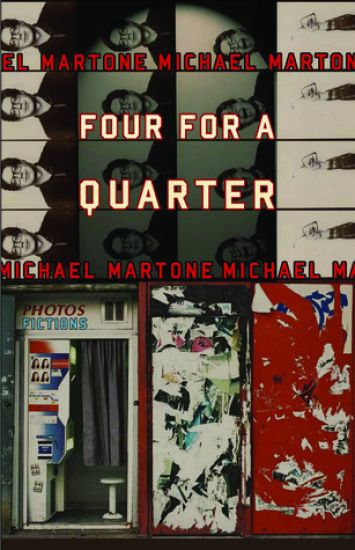
Four for a Quarter

Four for a Quarter

Michael Martone

Fiction Collective Two
2011
nidottu
Four is the magic number in Michael Martone's Four for a Quarter. In subject--four fifth Beatles, four tie knots, four retellings of the first Xerox, even the sex lives of the Fantastic Four--and in structure--the book is separated into four sections, with each section further divided into four chapterettes--Four for a Quarter returns again and again to its originating number, making chaos comprehensible and mystery out of the most ordinary.
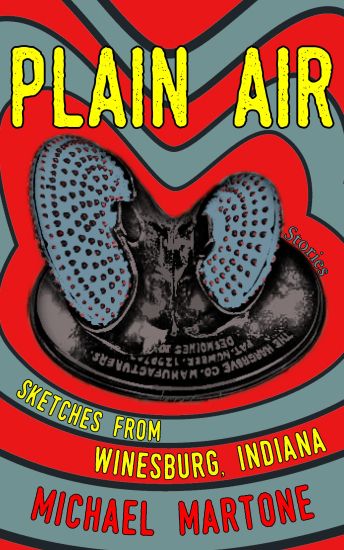
Plain Air: Sketches from Winesburg, Indiana

Plain Air: Sketches from Winesburg, Indiana

Michael Martone

Cameron Company Inc
2022
pokkari
A new story collection focused on the Heartland from Michael Martone, one of America's most prolific and important contemporary authors.In Plain Air: Sketches from Winesburg, Indiana, Michael Martone places steady fingers on the arrhythmic pulse of the Flyover as he conjures Winesburg, Indiana, a fictional town and all of its inhabitants’ lyric philosophies, tales of the mundane, and the sensation of being “lost” in the heart of the heart of the country. But here, in over one-hundred and thirty short fictions, even as there is much sadness, the citizens continue to tinker and create, marvel and wonder in the midst of ruin and rust. These stories may capture lives of quiet desperation, but in so doing, they create a kind of hobbled poetry in the spontaneous sketches of the ordinary made extraordinary, the regular irregularities, the familiar knocked off-balance with a glancing blow. From the overly overworked City Manager, to Margaret Wigg’s obsessively collected collection of library stamps, to Blanche’s air-filled aluminum ice cube tray, the town is a community of everyday odd-balls rife with isolation and idiosyncrasy. They are people trying to get by; that question loss as well as passion, devotedness, childhood wonder, and kinship in their observations and daily routines. With undeniable humor, intelligent quirk, and earnest longing for a pastoral passing into the annals of deep Midwestern time, Michael Martone crafts an unforgettable panoply of characters whose perspectives invite us to alternatively interpret our own commonplaces.
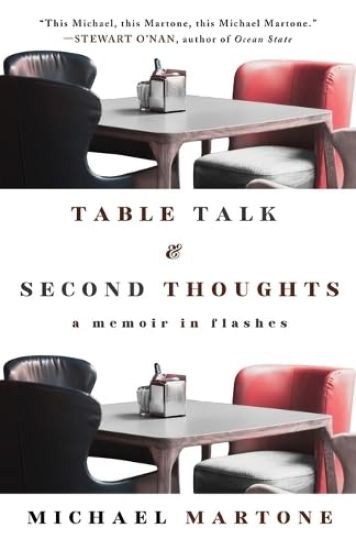
Table Talk & Second Thoughts

Table Talk & Second Thoughts

Michael Martone

CORNERSTONE PRESS
2025
pokkari
With wit and humor, Michael Martone writes his life as one of brief bites, effervescent episodes, and meaningful meals illuminated by the luminaries on the other side of the table. In many ways Martone's annotations of a life lived with words and writers, Table Talk & Second Thoughts surges with poignancy while recalling the little moments that make us human.