Kirjojen hintavertailu. Mukana 11 699 587 kirjaa ja 12 kauppaa.

Kirjahaku

Etsi kirjoja tekijän nimen, kirjan nimen tai ISBN:n perusteella.

5 kirjaa tekijältä Michael Perryman

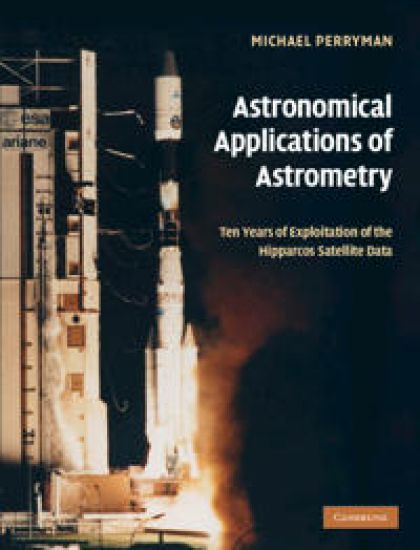
Astronomical Applications of Astrometry

Astronomical Applications of Astrometry

Michael Perryman

Cambridge University Press
2008
sidottu
The Hipparcos satellite, developed and launched by the European Space Agency (ESA) in 1989, was the first space mission dedicated to astrometry - the accurate measurement of positions, distances, and proper motions of stars. Amongst the key achievements of its measurements are refining the cosmic distance scale, characterising the large-scale kinematic motions in the Solar neighbourhood, providing precise luminosities for stellar modelling, and confirming Einstein's prediction of the effect of gravity on starlight. This authoritative account of the Hipparcos contributions over the following decade is an outstanding reference for astronomers, astrophysicists and cosmologists. It reviews the applications of the data in different areas, describing the subject and the state-of-the-art before Hipparcos, and summarising all major contributions to the topic made by Hipparcos. It contains a detailed overview of the Hipparcos and Tycho Catalogues, their annexes and their updates. Each chapter ends with comprehensive references to relevant literature.
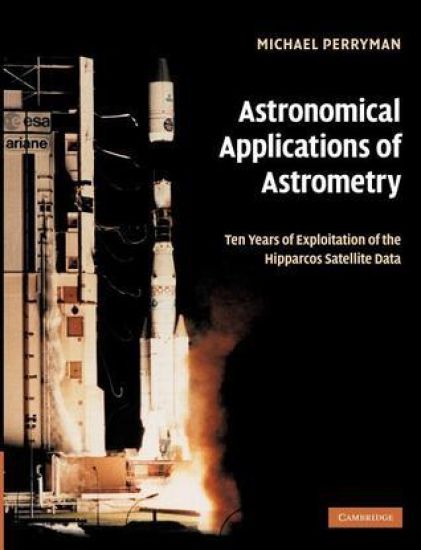
Astronomical Applications of Astrometry

Astronomical Applications of Astrometry

Michael Perryman

Cambridge University Press
2012
pokkari
The Hipparcos satellite, developed and launched by the European Space Agency (ESA) in 1989, was the first space mission dedicated to astrometry - the accurate measurement of positions, distances, and proper motions of stars. Amongst the key achievements of its measurements are refining the cosmic distance scale, characterising the large-scale kinematic motions in the Solar neighbourhood, providing precise luminosities for stellar modelling, and confirming Einstein's prediction of the effect of gravity on starlight. This authoritative account of the Hipparcos contributions over the following decade is an outstanding reference for astronomers, astrophysicists and cosmologists. It reviews the applications of the data in different areas, describing the subject and the state-of-the-art before Hipparcos, and summarising all major contributions to the topic made by Hipparcos. It contains a detailed overview of the Hipparcos and Tycho Catalogues, their annexes and their updates. Each chapter ends with comprehensive references to relevant literature.
The Exoplanet Handbook

The Exoplanet Handbook

Michael Perryman

Cambridge University Press
2018
sidottu
With the discovery of planets beyond our solar system 25 years ago, exoplanet research has expanded dramatically, with new state-of-the-art ground-based and space-based missions dedicated to their discovery and characterisation. With more than 3,500 exoplanets now known, the complexity of the discovery techniques, observations and physical characterisation have grown exponentially. This Handbook ties all these avenues of research together across a broad range of exoplanet science. Planet formation, exoplanet interiors and atmospheres, and habitability are discussed, providing in-depth coverage of our knowledge to date. Comprehensively updated from the first edition, it includes instrumental and observational developments, in-depth treatment of the new Kepler mission results and hot Jupiter atmospheric studies, and major updates on models of exoplanet formation. With extensive references to the research literature and appendices covering all individual exoplanet discoveries, it is a valuable reference to this exciting field for both incoming and established researchers.
The Making of History's Greatest Star Map

The Making of History's Greatest Star Map

Michael Perryman

Springer-Verlag Berlin and Heidelberg GmbH Co. K
2010
sidottu
From prehistoric times, mankind has looked up at the night sky, and puzzled at the changing positions of the stars. How far away they are is a question that has confounded scientists for centuries. Over the last few hundred years, many scientific careers – and considerable resources – have been devoted to measuring their positions and motions with ever increasing accuracy. And in the last two decades of the 20th century, the European Space Agency developed and launched the Hipparcos satellite, around which this account revolves, to carry out these exacting measurements from space.What has prompted these remarkable developments? Why have governments been persuaded to fund them? What are scientists learning from astronomy's equivalent of the Human Genome Project? This book traces the subject's history, explains why such enormous efforts are considered worthwhile, and interweaves these with a first-hand insight into the Hipparcos project, and how big science is conducted at an international level. The involvement of amateur astronomers, and the Hipparcos contributions to climate research, ‘death stars' passing close to the Sun, and the search for extra-solar planets and even intelligent life itself, are some of the surprising facets of this unusual space mission.
The Making of History's Greatest Star Map

The Making of History's Greatest Star Map

Michael Perryman

Springer-Verlag Berlin and Heidelberg GmbH Co. K
2012
nidottu
From prehistoric times, mankind has looked up at the night sky, and puzzled at the changing positions of the stars. How far away they are is a question that has confounded scientists for centuries. Over the last few hundred years, many scientific careers – and considerable resources – have been devoted to measuring their positions and motions with ever increasing accuracy. And in the last two decades of the 20th century, the European Space Agency developed and launched the Hipparcos satellite, around which this account revolves, to carry out these exacting measurements from space.What has prompted these remarkable developments? Why have governments been persuaded to fund them? What are scientists learning from astronomy's equivalent of the Human Genome Project? This book traces the subject's history, explains why such enormous efforts are considered worthwhile, and interweaves these with a first-hand insight into the Hipparcos project, and how big science is conducted at an international level. The involvement of amateur astronomers, and the Hipparcos contributions to climate research, ‘death stars' passing close to the Sun, and the search for extra-solar planets and even intelligent life itself, are some of the surprising facets of this unusual space mission.