Kirjojen hintavertailu. Mukana 11 244 527 kirjaa ja 12 kauppaa.

Kirjahaku

Etsi kirjoja tekijän nimen, kirjan nimen tai ISBN:n perusteella.

13 kirjaa tekijältä Michael Peter Smith

Musings of a Modern Romantic: Poetic Thoughts by Michael Peter Smith

Musings of a Modern Romantic: Poetic Thoughts by Michael Peter Smith

Michael Peter Smith

Createspace Independent Publishing Platform
2014
nidottu
In his second book, "Musings of a Modern Romantic", Michael Peter Smith shares his latest poetry, once again taking you into the mind of a man who is a hopelessly incurable romantic. His goal as a poet is to illicit a response or bring out feelings from within that will touch your heart and move your soul. He still believes in love, and giving you the male perspective in prose. From love and lust to heartache and pain, he shares even more depth than he did in the first book. These poems will open your eyes and show you what goes on inside the mind of a man that has been through more than his share of heartache, loss and challenges and yet still believes in the possibility of "Happily Ever After"
Transnational Urbanism

Transnational Urbanism

Michael Peter Smith

Blackwell Publishers
2000
nidottu
Transnational Urbanism is a profound work of theoretical synthesis by internationally renowned urban theorist Michael Peter Smith. Moving deftly across disciplines and discursive terrains, Smith forges original and stimulating connections between urban studies and the emerging field of transnational studies. With original and extraordinary insight, he addresses the central question of how and why immigrants, refugees, political activists, and institutions locate and maintain social relations in light of transnational urbanism. Brings a concrete, historically informed discussion of globalization and transnationalism applied to urban studies. Offers a blueprint for reconstructing urban theory itself . Forges stimulating connections between the field of urban studies and the emerging field of transnational studies .
Explorations in Urban Theory

Explorations in Urban Theory

Michael Peter Smith

Routledge
2017
nidottu
For over three decades, urban theorist Michael Peter Smith has engaged in constructing innovative theories on central research questions in urban studies. This book brings together his views on the state of urban theory, sorting out the changing strengths and weaknesses in the field. Smith refocuses attention on the cultural, social, and political practices of urban inhabitants, particularly the way in which their everyday activities have contributed to the social construction of new ethnic identities and new meanings of urban citizenship. Combining the methods of political economy and transnational ethnography, he encourages us to think about new political spaces for practicing "urban citizenship" by analyzing the connections linking cities to the web of relations to other localities in which they are embedded. Smith systematically analyzes the dynamics of "community power" and "urban change" under new globalizing trends and increased transnational mobility. Expanding on his original conceptualization of "transnational urbanism," he frames urban political life within a wider transnational context of political practice, in which an endless interplay of distinctly situated networks, social practices, and power relations are fought out at multiple scales, in an inexorable politics of inclusion and exclusion.
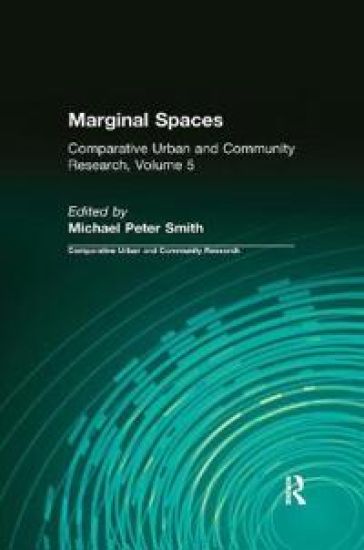
Marginal Spaces

Marginal Spaces

Michael Peter Smith

Routledge
2018
sidottu
The literature on modernist and postmodernist urban development is abundant, yet few researchers have taken up the challenge of studying the areas hi which marginalized people live as sources of resistance to continued modernization. In Marginal Spaces, Michael Smith has assembled case studies combining structural and historical analyses of the moves of powerful social interests to dominate social space, and the tactics and strategies various marginalized social groups employ to reclaim dominated space for their own use. The marginal spaces embodied in the title of this fifth volume of the Comparative Urban and Community Research series include five sites of domination and resistance. A squatters' movement in Ann Arbor, Michigan, resists the adverse consequences of four decades of urban development. A homeless encampment in Chicago engages hi "guerilla architecture" and other moves designed to reconstitute prevailing social constructions of the problem of "homelessness." An antigentrification movement hi the East Village of New York engages hi an ongoing struggle to resist efforts by developers to market their neighborhood as space for luxury condominium development. There is a Public Housing Council organized by African American women hi New Orleans that is resisting both the material regulation of their daily lives and the dominant social construction of public housing as a racially gendered space suitable only for "dependent" women and children of color. Finally, there is a subordinate labor market niche hi California agriculture where indigenous Mixtec peasants from Oaxaca are displacing the more traditional mestizo farm workers, but who are also politically organizing as a transnational grassroots movement, pursuing a binational strategy to alleviate then- economic, political, and cultural marginality. Contributions and contributors include: "House People, Not Cars!" by Corey Dolgon, Michael Kline, and Laura Dresser; "Tranquillity City" by Tahnadge Wright; "Private Redevelopment and the Changing Forms of Displacement hi the East Village of New York" by Christopher Mele; "Resisting Racially Gendered Space" by Alma Young and Jyaphia Christos-Rodgers; and "Mixtecs and Mestizos hi California Agriculture" by Carol Zabin. This volume will be of interest to urban planners, sociologists, and political scientists, especially those with strong interests hi local ethnography and concrete policy.
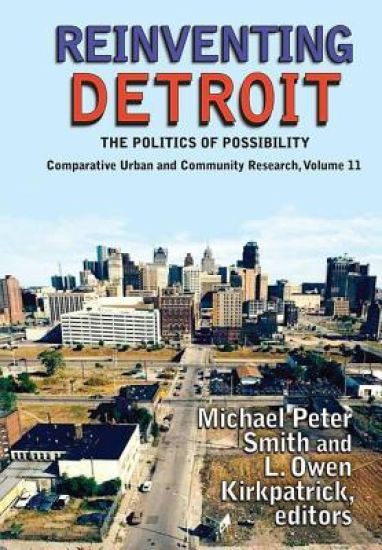
Reinventing Detroit

Reinventing Detroit

Michael Peter Smith

Routledge
2017
sidottu
This book addresses the questions of what went wrong with Detroit and what can be done to reinvent the Motor City. Various answers to the former deindustrialization, white flight, and a disappearing tax base are now well understood. Less discussed are potential paths forward, stemming from alternative explanations of Detroit's long-term decline and reconsideration of the challenges the city currently faces.Urban crisis‘socioeconomic, fiscal, and political has seemingly narrowed the range of possible interventions. Growth-oriented redevelopment strategies have not reversed Detroit's decline, but in the wake of crisis, officials have increasingly funnelled limited public resources into the city's commercial core via an implicit policy of "urban triage." The crisis has also led to the emergency management of the city by extra-democratic entities. As a disruptive historical event, Detroit's crisis is a moment teeming with political possibilities.The critical rethinking of Detroit's past, present, and future is essential reading for both urban studies scholars and the general public.
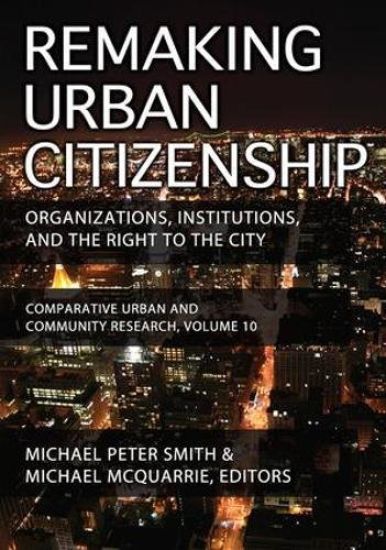
Remaking Urban Citizenship

Remaking Urban Citizenship

Michael Peter Smith

Routledge
2017
sidottu
Due to heightened global migration and transnational mobility, many residents of the world's cities lack national citizenship in the places to which they have moved for work, refuge, or retirement. The disjuncture between citizenship and daily life has led to devolution of claims from national to urban space. Within nation-states characterized by structured inequalities, citizens have not reduced their social differences. This leads increasingly to calls for greater direct involvement of marginalized classes in reshaping the institutions and spaces directly affecting their lives.These concerns cities without citizenship and people without political power inform the agendas of organizations that seek to restructure urban citizenship in more democratic directions. Remaking Urban Citizenship focuses on the uses and limits of such political organizations and coalitions, shows the various ways they pursue expanded rights within the city, and describes the institutional changes necessary to empower global migrants and popular classes as urban citizens.Offering individual or comparative case studies of cities in the United States, Europe, and China, contributions to this volume describe the development of actual practices of organizations working to reinvigorate citizenship at the urban scale. Collectively, they locate institutional forms that help migrants lay claim to their cities, show how migrants can become politically empowered, and identify how they can expand their rights or find other ways to belong.
Transnational Ties

Transnational Ties

Michael Peter Smith

Routledge
2017
sidottu
Cities are key sites of the transnational ties that increasingly connect people, places, and projects across the globe. They provide opportunities and constraints within which transnational actors and networks operate and nodes linking wider social formations traverse national borders. This book brings together a series of richly textured ethnographic studies that suggest new ways to situate and historicize transnationalism, identify new pathways to transnational urbanism, and map the contours of translocal, interregional, and diasporic connections not previously studied. The transnational ties treated in this book truly span the globe, giving concrete meaning to the phrase "globalization from below."How have the contributors to this book conceptualized the wider context informing the conduct of their ethnographically grounded, multi-sited research on the relationship between cities, migration, and transnationalism? Several interrelated contextual dimensions have been singled out as affecting the opportunities and constraints experienced by transnational migrant subjects. Socio-spatially, in several of these chapters, the political economic context now called neoliberal globalization is shown to be a key driving force creating conditions that necessitate, facilitate, or impede migration, foster trans-local economic ties, and create new inter-regional interdependencies--e.g., new South-South and East-East transnational ties.The changing historical context of both migrating groups and the cities and regions they move across are central to the study of the interplay of urban change and migrant transnationalism. The historical particularities of migrant recruitment, migration histories, migratory narratives, and changing gender and class relations all affect the character and geography of transnational migration with an impact on the social structures of community formation. This is a pioneering effort in the Comparative Urban and Community Research series.
Transnational Ties

Transnational Ties

Michael Peter Smith

AldineTransaction
2008
nidottu
Cities are key sites of the transnational ties that increasingly connect people, places, and projects across the globe. They provide opportunities and constraints within which transnational actors and networks operate and nodes linking wider social formations traverse national borders. This book brings together a series of richly textured ethnographic studies that suggest new ways to situate and historicize transnationalism, identify new pathways to transnational urbanism, and map the contours of translocal, interregional, and diasporic connections not previously studied. The transnational ties treated in this book truly span the globe, giving concrete meaning to the phrase "globalization from below."How have the contributors to this book conceptualized the wider context informing the conduct of their ethnographically grounded, multi-sited research on the relationship between cities, migration, and transnationalism? Several interrelated contextual dimensions have been singled out as affecting the opportunities and constraints experienced by transnational migrant subjects. Socio-spatially, in several of these chapters, the political economic context now called neoliberal globalization is shown to be a key driving force creating conditions that necessitate, facilitate, or impede migration, foster trans-local economic ties, and create new inter-regional interdependencies--e.g., new South-South and East-East transnational ties.The changing historical context of both migrating groups and the cities and regions they move across are central to the study of the interplay of urban change and migrant transnationalism. The historical particularities of migrant recruitment, migration histories, migratory narratives, and changing gender and class relations all affect the character and geography of transnational migration with an impact on the social structures of community formation. This is a pioneering effort in the Comparative Urban and Community Research series.
Remaking Urban Citizenship

Remaking Urban Citizenship

Michael Peter Smith

AldineTransaction
2012
nidottu
Due to heightened global migration and transnational mobility, many residents of the world's cities lack national citizenship in the places to which they have moved for work, refuge, or retirement. The disjuncture between citizenship and daily life has led to devolution of claims from national to urban space. Within nation-states characterized by structured inequalities, citizens have not reduced their social differences. This leads increasingly to calls for greater direct involvement of marginalized classes in reshaping the institutions and spaces directly affecting their lives.These concerns—cities without citizenship and people without political power—inform the agendas of organizations that seek to restructure urban citizenship in more democratic directions. Remaking Urban Citizenship focuses on the uses and limits of such political organizations and coalitions, shows the various ways they pursue expanded rights within the city, and describes the institutional changes necessary to empower global migrants and popular classes as urban citizens.Offering individual or comparative case studies of cities in the United States, Europe, and China, contributions to this volume describe the development of actual practices of organizations working to reinvigorate citizenship at the urban scale. Collectively, they locate institutional forms that help migrants lay claim to their cities, show how migrants can become politically empowered, and identify how they can expand their rights or find other ways to belong.
Reinventing Detroit

Reinventing Detroit

Michael Peter Smith

AldineTransaction
2015
nidottu
This book addresses the questions of what went wrong with Detroit and what can be done to reinvent the Motor City. Various answers to the former—deindustrialization, white flight, and a disappearing tax base—are now well understood. Less discussed are potential paths forward, stemming from alternative explanations of Detroit's long-term decline and reconsideration of the challenges the city currently faces.Urban crisis—socioeconomic, fiscal, and political—has seemingly narrowed the range of possible interventions. Growth-oriented redevelopment strategies have not reversed Detroit's decline, but in the wake of crisis, officials have increasingly funnelled limited public resources into the city's commercial core via an implicit policy of "urban triage." The crisis has also led to the emergency management of the city by extra-democratic entities. As a disruptive historical event, Detroit's crisis is a moment teeming with political possibilities.The critical rethinking of Detroit's past, present, and future is essential reading for both urban studies scholars and the general public.
Explorations in Urban Theory

Explorations in Urban Theory

Michael Peter Smith

AldineTransaction
2017
sidottu
For over three decades, urban theorist Michael Peter Smith has engaged in constructing innovative theories on central research questions in urban studies. This book brings together his views on the state of urban theory, sorting out the changing strengths and weaknesses in the field. Smith refocuses attention on the cultural, social, and political practices of urban inhabitants, particularly the way in which their everyday activities have contributed to the social construction of new ethnic identities and new meanings of urban citizenship. Combining the methods of political economy and transnational ethnography, he encourages us to think about new political spaces for practicing "urban citizenship" by analyzing the connections linking cities to the web of relations to other localities in which they are embedded. Smith systematically analyzes the dynamics of "community power" and "urban change" under new globalizing trends and increased transnational mobility. Expanding on his original conceptualization of "transnational urbanism," he frames urban political life within a wider transnational context of political practice, in which an endless interplay of distinctly situated networks, social practices, and power relations are fought out at multiple scales, in an inexorable politics of inclusion and exclusion.
After Modernism

After Modernism

Michael Peter Smith

Transaction Publishers
1992
nidottu
Michael Peter Smith is distinguished research professor in Community Studies at the University of California, Davis. He is co-author of the award-winning book Citizenship across Borders, and is the series editor of Transaction’s Comparative Urban and Community Research book series.
Marginal Spaces

Marginal Spaces

Michael Peter Smith

Transaction Publishers
1995
nidottu
The literature on modernist and postmodernist urban development is abundant, yet few researchers have taken up the challenge of studying the areas hi which marginalized people live as sources of resistance to continued modernization. In Marginal Spaces, Michael Smith has assembled case studies combining structural and historical analyses of the moves of powerful social interests to dominate social space, and the tactics and strategies various marginalized social groups employ to reclaim dominated space for their own use. The marginal spaces embodied in the title of this fifth volume of the Comparative Urban and Community Research series include five sites of domination and resistance. A squatters' movement in Ann Arbor, Michigan, resists the adverse consequences of four decades of urban development. A homeless encampment in Chicago engages hi "guerilla architecture" and other moves designed to reconstitute prevailing social constructions of the problem of "homelessness." An antigentrification movement hi the East Village of New York engages hi an ongoing struggle to resist efforts by developers to market their neighborhood as space for luxury condominium development. There is a Public Housing Council organized by African American women hi New Orleans that is resisting both the material regulation of their daily lives and the dominant social construction of public housing as a racially gendered space suitable only for "dependent" women and children of color. Finally, there is a subordinate labor market niche hi California agriculture where indigenous Mixtec peasants from Oaxaca are displacing the more traditional mestizo farm workers, but who are also politically organizing as a transnational grassroots movement, pursuing a binational strategy to alleviate then- economic, political, and cultural marginality. Contributions and contributors include: "House People, Not Cars!" by Corey Dolgon, Michael Kline, and Laura Dresser; "Tranquillity City" by Tahnadge Wright; "Private Redevelopment and the Changing Forms of Displacement hi the East Village of New York" by Christopher Mele; "Resisting Racially Gendered Space" by Alma Young and Jyaphia Christos-Rodgers; and "Mixtecs and Mestizos hi California Agriculture" by Carol Zabin. This volume will be of interest to urban planners, sociologists, and political scientists, especially those with strong interests hi local ethnography and concrete policy.