Kirjojen hintavertailu. Mukana 11 417 157 kirjaa ja 12 kauppaa.

Kirjahaku

Etsi kirjoja tekijän nimen, kirjan nimen tai ISBN:n perusteella.

15 kirjaa tekijältä Michael W. Apple

Education and Power

Education and Power

Michael W. Apple

Routledge
2011
nidottu
First published in 1982, Education and Power remains an important volume for those committed to critical education. In this text Michael Apple first articulated his theory on educational institutions and the reproduction of and resistance to unequal power relations, and provided a thorough examination of the ways in which race-gender-class dynamics are embedded in, and reflected through, curricular issues. While many of the theories set forward in this book are now taken for granted by the left in education, they were nothing short of revolutionary when first proposed. In this newly reissued classic edition, Apple suggests that we need to take seriously the complicated and contradictory economic, political and cultural structures that provide for some of the most important limits on, and possibilities for, critical education. He re-examines his earlier arguments and reflects on what has happened over the intervening years. Education and Power is a vital example of the call to challenge the assumptions that underpin so much of what happens in education.
Can Education Change Society?

Can Education Change Society?

Michael W. Apple

Routledge
2012
sidottu
Despite the vast differences between the Right and the Left over the role of education in the production of inequality one common element both sides share is a sense that education can and should do something about society, to either restore what is being lost or radically alter what is there now. The question was perhaps put most succinctly by the radical educator George Counts in 1932 when he asked "Dare the School Build a New Social Order?", challenging entire generations of educators to participate in, actually to lead, the reconstruction of society. Over 70 years later, celebrated educator, author and activist Michael Apple revisits Counts’ now iconic works, compares them to the equally powerful voices of minoritized people, and again asks the seemingly simply question of whether education truly has the power to change society. In this groundbreaking work, Apple pushes educators toward a more substantial understanding of what schools do and what we can do to challenge the relations of dominance and subordination in the larger society. This touchstone volume is both provocative and honest about the ideological and economic conditions that groups in society are facing and is certain to become another classic in the canon of Apple’s work and the literature on education more generally.
Can Education Change Society?

Can Education Change Society?

Michael W. Apple

Routledge
2012
nidottu
Despite the vast differences between the Right and the Left over the role of education in the production of inequality one common element both sides share is a sense that education can and should do something about society, to either restore what is being lost or radically alter what is there now. The question was perhaps put most succinctly by the radical educator George Counts in 1932 when he asked "Dare the School Build a New Social Order?", challenging entire generations of educators to participate in, actually to lead, the reconstruction of society. Over 70 years later, celebrated educator, author and activist Michael Apple revisits Counts’ now iconic works, compares them to the equally powerful voices of minoritized people, and again asks the seemingly simply question of whether education truly has the power to change society. In this groundbreaking work, Apple pushes educators toward a more substantial understanding of what schools do and what we can do to challenge the relations of dominance and subordination in the larger society. This touchstone volume is both provocative and honest about the ideological and economic conditions that groups in society are facing and is certain to become another classic in the canon of Apple’s work and the literature on education more generally.
Official Knowledge

Official Knowledge

Michael W. Apple

Routledge
2014
sidottu
This third edition of Official Knowledge, a classic text from one of education’s most distinguished scholars, challenges readers to critically examine how certain knowledge comes to be “official,” and whose agendas this knowledge represents. A probing and award-winning study, this new edition builds on the tradition of its predecessors to question the rightist resurgence in education while substantive updates throughout show how such policies continue to define our commonsense notions about what counts as a good school. A new preface and two full, new chapters address current controversies over curriculum and textbooks, and extend the discussion of previous editions to reflect on some of the most important pressures being placed on higher education as well. Apple also considers the recent conversion of some prominent neoliberal, neoconservative, and managerial thinkers to more critical understandings of educational policies, proving that progressive change is possible if we examine the roots of these ideologies in the first place. As insightful as it is thorough, Official Knowledge is a refreshing call to challenge the dominant forces within education today, as Apple powerfully illustrates how larger social movements are only possible if we purposefully and inclusively deepen our understanding of the existing body of knowledge about education.
Official Knowledge

Official Knowledge

Michael W. Apple

Routledge
2014
nidottu
This third edition of Official Knowledge, a classic text from one of education’s most distinguished scholars, challenges readers to critically examine how certain knowledge comes to be “official,” and whose agendas this knowledge represents. A probing and award-winning study, this new edition builds on the tradition of its predecessors to question the rightist resurgence in education while substantive updates throughout show how such policies continue to define our commonsense notions about what counts as a good school. A new preface and two full, new chapters address current controversies over curriculum and textbooks, and extend the discussion of previous editions to reflect on some of the most important pressures being placed on higher education as well. Apple also considers the recent conversion of some prominent neoliberal, neoconservative, and managerial thinkers to more critical understandings of educational policies, proving that progressive change is possible if we examine the roots of these ideologies in the first place. As insightful as it is thorough, Official Knowledge is a refreshing call to challenge the dominant forces within education today, as Apple powerfully illustrates how larger social movements are only possible if we purposefully and inclusively deepen our understanding of the existing body of knowledge about education.
The State and the Politics of Knowledge
The State and the Politics of Knowledge extends the insightful arguments Michael Apple provided in Educatingthe "Right" Way in new and truly international directions. Arguing that schooling is, by definition, political, Apple and his co-authors move beyond a critical analysis to describe numerous ways of interrupting dominance and creating truly democratic and realistic alternatives to the ways markets, standards, testing, and a limited vision of religion are now being pressed into schools.
The State and the Politics of Knowledge
The State and the Politics of Knowledge extends the insightful arguments Michael Apple provided in Educatingthe "Right" Way in new and truly international directions. Arguing that schooling is, by definition, political, Apple and his co-authors move beyond a critical analysis to describe numerous ways of interrupting dominance and creating truly democratic and realistic alternatives to the ways markets, standards, testing, and a limited vision of religion are now being pressed into schools.
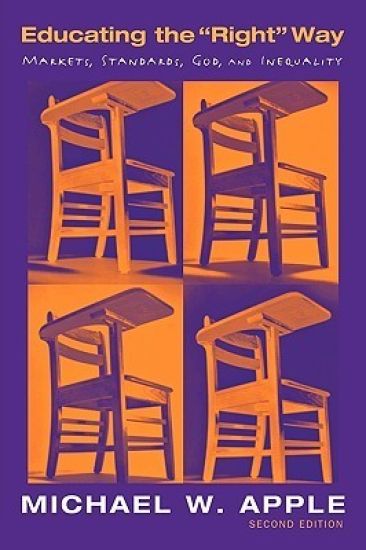
Educating the Right Way

Educating the Right Way

Michael W. Apple

Routledge
2006
sidottu
In this book Apple explores the 'conservative restoration' - the rightward turn of a broad-based coalition that is making successful inroads in determining American and international educational policy. It takes a pragmatic look at what critical educators can do to build alternative coalitions and policies that are more democratic. Apple urges this group to extricate itself from its reliance on the language of possibility in order to employ pragmatic analyses that address the material realities of social power.
Educating the Right Way

Educating the Right Way

Michael W. Apple

Routledge
2006
nidottu
Presents a critical analysis of the increasing power of conservative movements in educational policy, examining how these movements have affected the practices, ideologies, structures, and assumptions of education.
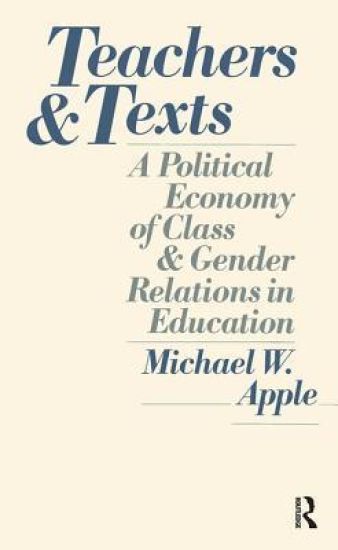
Teachers and Texts

Teachers and Texts

Michael W. Apple

Routledge
1986
sidottu
First published in 1987, this research provides insight on the political economy of schooling and includes an analysis of power as they operate both within and outside of schools in the construction of class and gender relations. This is part of a series of volumes that have begun to enquire into the relationship between the curriculum and teaching that is found in our formal institutions of education, and unequal power in society.
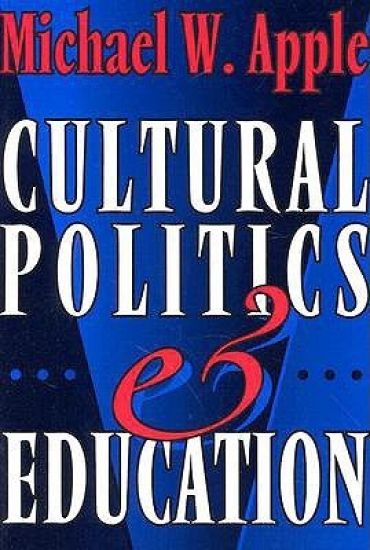
Cultural Politics and Education

Cultural Politics and Education

Michael W. Apple

TEACHERS' COLLEGE PRESS
1996
nidottu
Many are convinced that ""liberal"" solutions have failed and that answers to social problems lie in a return to conservative policies and values. As this conservative offensive grows increasingly powerful in education, public schooling itself has come under attack. Michael Apple offers a powerful analysis of current debates and a compelling indictment of rightist proposals for change. Apple presents the causes and effects of integrating schools into the corporate agenda and demonstrates who will be the winners and losers as the conservative restoration gains in strength. Far from defending the status quo, Apple argues that the unresponsive and bureau-cratic nature of many school systems has actually pushed people toward the right. ""Yet,"" he writes, ""during an era when...we face the massive dismantling of the gains that have been made in social welfare, in women's control of their bodies, in relations of race, gender, and sexuality, and in whose knowledge is taught in schools, it is equally important to make certain that these gains are defended."" With this dual focus, this book provides an eloquent defense of the possibility of a more democratic public education.
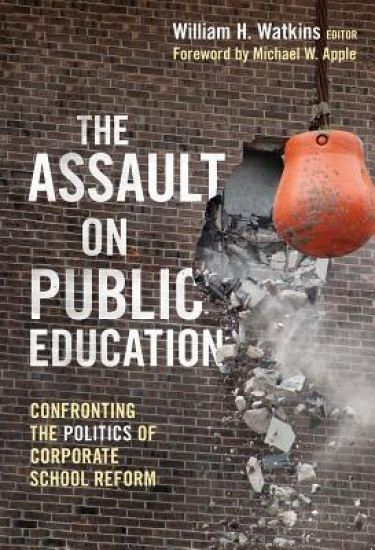
The Assault on Public Education

The Assault on Public Education

Michael W. Apple

Teachers' College Press
2011
nidottu
In this timely interdisciplinary volume, William Watkins has brought together leading scholars and activists to address some of the most urgent issues facing public education. What is underneath and behind the language of choice, efficiency, and improvement in current neoliberal discourse? How will urban and poor populations be affected? Will privatization lead to increased stratification in our schools? How can public education not only be saved but re-imagined? In accessible language, renowned contributors explore and critique corporate school reform to both inform and serve as an organizing tool for teachers, parents, students, and citizens committed to genuine public education. Book Features: A comprehensive critique of how corporate power is disrupting universal public education. An illumination of how corporate school reform threatens unions, racial progress, and democracy. An illustration of how private wealth forges public policy. A case study of the public school system in New Orleans.
Power, Meaning, and Identity

Power, Meaning, and Identity

Michael W. Apple

Peter Lang Publishing Inc
2002
nidottu
Michael W. Apple's critical writings have been influential throughout the world. This collection brings together many of his essays on curriculum, evaluation, and critical educational and cultural theory. In clear and unmystified prose, these essays enhance our understanding of how thoroughly political educational policies and practices actually are. In the process, he illuminates the histories and realities of class, race, and gender in education. Combining work written for a broad and general audience with that aimed at those who are already grounded in the multiple traditions of critical educational studies, Apple's unique voice - nuanced, passionate, and clear - comes through.
Education and Power

Education and Power

Michael W. Apple

Routledge
2015
sidottu
First published in 1982, Education and Power remains an important volume for those committed to critical education. In this text Michael Apple first articulated his theory on educational institutions and the reproduction of and resistance to unequal power relations, and provided a thorough examination of the ways in which race-gender-class dynamics are embedded in, and reflected through, curricular issues. While many of the theories set forward in this book are now taken for granted by the left in education, they were nothing short of revolutionary when first proposed. In this newly reissued classic edition, Apple suggests that we need to take seriously the complicated and contradictory economic, political and cultural structures that provide for some of the most important limits on, and possibilities for, critical education. He re-examines his earlier arguments and reflects on what has happened over the intervening years. Education and Power is a vital example of the call to challenge the assumptions that underpin so much of what happens in education.
Late to Class

Late to Class

Michael W. Apple

State University of New York Press
2007
pokkari
Looks at the educational experiences of poor, working class, and middle class students against the backdrop of complicated class stratification in a shifting global economy. Winner of the 2007 Critics' Choice Award presented by the American Educational Studies Association Late to Class presents theoretical, empirical, and pedagogical perspectives on social class and schooling in the United States. Grounding their analyses at the intersections of class, ethnicity, gender, geography, and schooling, the contributors examine the educational experiences of poor, working class, and middle class students against the backdrop of complicated class stratification in a shifting global economy. Together, they explore the salience of class in understanding the social, economic, and cultural landscapes within which young people in the United States come to understand the meaning of their formal education in times of changing opportunity.