Kirjojen hintavertailu. Mukana 11 627 491 kirjaa ja 12 kauppaa.

Kirjahaku

Etsi kirjoja tekijän nimen, kirjan nimen tai ISBN:n perusteella.

3 kirjaa tekijältä Michael W. Bruening

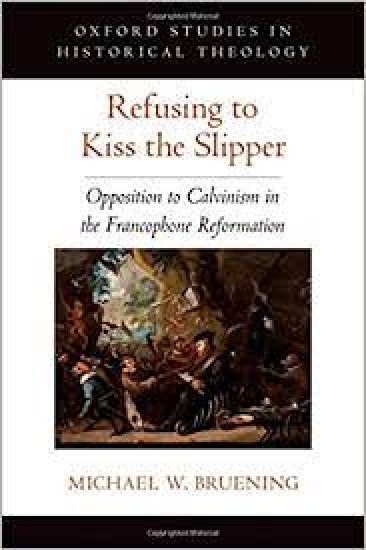
Refusing to Kiss the Slipper

Refusing to Kiss the Slipper

Michael W. Bruening

Oxford University Press Inc
2021
sidottu
History has long viewed French Protestants as Calvinists. Refusing to Kiss the Slipper re-examines the Reformation in francophone Europe, presenting for the first time the perspective of John Calvin's evangelical enemies and revealing that the French Reformation was more complex and colorful than previously recognized. Michael Bruening brings together a cast of Calvin's opponents from various French-speaking territories to show that opposition to Calvinism was stronger and better organized than has been recognized. He examines individual opponents, such as Pierre Caroli, Jerome Bolsec, Sebastian Castellio, Charles Du Moulin, and Jean Morély, but more importantly, he explores the anti-Calvinist networks that developed around such individuals. Each group had its own origins and agenda, but all agreed that Calvin's claim to absolute religious authority too closely echoed the religious sovereignty of the pope. These oft-neglected opponents refused to offer such obeisance-to kiss the papal slipper-arguing instead for open discussion of controversial doctrines. They believed Calvin's self-appointed leadership undermined the bedrock principle of the Reformation that the faithful be allowed to challenge religious authorities. This book shows that the challenge posed by these groups shaped the way the Calvinists themselves developed their reform strategies. Bruening's work demonstrates that the breadth and strength of the anti-Calvinist networks requires us to abandon the traditional assumption that Huguenots and other francophone Protestants were universally Calvinist.

Calvinism's First Battleground

Calvinism's First Battleground

Michael W. Bruening

Springer-Verlag New York Inc.
2005
sidottu
"Calvinism's First Battleground" sheds new light on the origin of Calvinism and the Reformed faith through a detailed examination of the Reformation in the Pays de Vaud. A specifically Calvinist identity and theology emerged out of two key conflicts in the region: first, the fight to turn away from Catholic practices and traditions a population that had been forced to convert to Protestantism by the Bernese after their conquest of Vaud in 1536; second, the struggle against the Zwinglian political and theological ideas that dominated the Swiss Confederation and differed from the Calvinists' understanding of ecclesiastical discipline, the Eucharist, and predestination. The Pays de Vaud was central to this struggle, for it was subject politically to Zwinglian, German-speaking Bern, but many of its ministers were more strongly influenced by Calvin. Calvin himself was initially excited about the prospects for reform in the region, but frustrations with the Swiss led him and the Genevans increasingly to focus their efforts on France. This history helps us to understand the broader contours of the Reformation in French-speaking Europe, as its center of gravity shifted from Meaux to Vaud and Geneva, and back to France again on the eve of the Wars of Religion.
Calvinism's First Battleground

Calvinism's First Battleground

Michael W. Bruening

Springer
2010
nidottu
"Calvinism's First Battleground" sheds new light on the origin of Calvinism and the Reformed faith through a detailed examination of the Reformation in the Pays de Vaud. A specifically Calvinist identity and theology emerged out of two key conflicts in the region: first, the fight to turn away from Catholic practices and traditions a population that had been forced to convert to Protestantism by the Bernese after their conquest of Vaud in 1536; second, the struggle against the Zwinglian political and theological ideas that dominated the Swiss Confederation and differed from the Calvinists' understanding of ecclesiastical discipline, the Eucharist, and predestination. The Pays de Vaud was central to this struggle, for it was subject politically to Zwinglian, German-speaking Bern, but many of its ministers were more strongly influenced by Calvin. Calvin himself was initially excited about the prospects for reform in the region, but frustrations with the Swiss led him and the Genevans increasingly to focus their efforts on France. This history helps us to understand the broader contours of the Reformation in French-speaking Europe, as its center of gravity shifted from Meaux to Vaud and Geneva, and back to France again on the eve of the Wars of Religion.