Kirjojen hintavertailu. Mukana 11 717 486 kirjaa ja 12 kauppaa.

Kirjahaku

Etsi kirjoja tekijän nimen, kirjan nimen tai ISBN:n perusteella.

4 kirjaa tekijältä Michael W. Fitzgerald

The Union League Movement in the Deep South

The Union League Movement in the Deep South

Michael W. Fitzgerald

Louisiana State University Press
2000
nidottu
Led by a coalition of blacks and whites with funding from congressional radicals, the Union League was a secret society whose express purpose was to bring freedmen into the political arena after the Civil War. Angry and resentful of the lingering vestiges of the plantation system, freedmen responded to the League's appeals with alacrity, and hundreds of thousands joined local chapters, speaking and acting collectively to undermine the residual trappings of slavery in plantation society. League actions nurtured instability in the work force, which eventually compelled white planters to relinquish direct control over blacks, encouraging the evolution from gang labor to decentralized tenancy in the southern agricultural system as well as the emergence of the Ku Klux Klan. In this impressive work- the first full-scale study of the effect the Union League had on the politicization of black freedmen- Michael W. Fitzgerald explores the League's influence in Alabama and Mississippi and offers a fresh and original treatment of an important and heretofore largely misunderstood aspect of Reconstruction history.
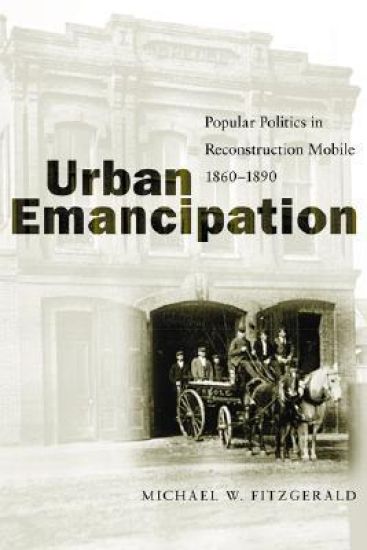
Urban Emancipation

Urban Emancipation

Michael W. Fitzgerald

Louisiana State University Press
2002
nidottu
Scholars of Reconstruction have generally described Republican party factional conflicts in racial terms, as if the Radical agenda evoked unified black support. As Michael W. Fitzgerald shows in the first major study of black popular politics in the urban South in the years surrounding the Civil War, that depiction oversimplifies a contentious and often overlooked intraracial dynamic. Republican political power, he argues, heightened divisions within the African American community, divisions that were ultimately a major factor in the failure of Reconstruction.Focusing on Mobile, the Confederacy's fourth largest city, Fitzgerald traces how the rivalry between longtime black residents and destitute freedmen fleeing the countryside yielded a startlingly antagonistic political scene. He demonstrates that the Republican factionalism that helped doom Reconstruction went beyond competing cliques of white officeholders. Boldly challenging reigning theories about the nature of post- Civil War politics, Urban Emancipation will spark historical debate for years to come.
Reconstruction in Alabama

Reconstruction in Alabama

Michael W. Fitzgerald

Louisiana State University Press
2017
sidottu
The civil rights revolutions of the 1950s and 1960s transformed the literature on Reconstruction in America by emphasizing the social history of emancipation and the hopefulness that reunification would bring equality. Much of this revisionist work served to counter and correct the racist and pro-Confederate accounts of Reconstruction written in the early twentieth century. While there have been modern scholarly revisions of individual states, most are decades old, and Michael W. Fitzgerald's Reconstruction in Alabama is the first comprehensive reinterpretation of that state's history in over a century.Fitzgerald's work not only revises the existing troubling histories of the era, it also offers a compelling and innovative new look at the process of rebuilding Alabama following the war. Attending to an array of issues largely ignored until now, Fitzgerald's history begins by analyzing the differences over slavery, secession, and war that divided Alabama's whites, mostly along the lines of region and class. He examines the economic and political implications of defeat, focusing particularly on how freed slaves and their former masters mediated the postwar landscape. For a time, he suggests, whites and freedpeople coexisted mostly peaceably in some parts of the state under the Reconstruction government, as a recovering cotton economy bathed the plantation belt in profit. Later, when charting the rise and fall of the Republican Party, Fitzgerald shows that Alabama's new Republican government implemented an ambitious program of railroad subsidy, characterized by substantial corruption that eventually bankrupted the state and helped end Republican rule. He shows, however, that the state's freedpeople and their preferred leaders were not the major players in this arena: they had other issues that mattered to them far more, like public education, civil rights, voting rights, and resisting the Klan's terrorist violence.After Reconstruction ended, Fitzgerald suggests that white collective memory of the era fixated on black voting, big government, high taxes, and corruption, all of which buttressed the Jim Crow order in the state. This misguided understanding of the past encouraged Alabama's intransigence during the later civil rights era. Despite the power of faulty interpretations that united segregationists, Fitzgerald demonstrates that it was class and regional divisions over economic policy, as much as racial tension, that shaped the complex reality of Reconstruction in Alabama.
Splendid Failure

Splendid Failure

Michael W. Fitzgerald

Ivan R Dee, Inc
2008
pokkari
Since the civil rights era of the 1960s, revisionist historians have been sympathetic to the racial justice motivations of the Radical Republican Reconstruction policies that followed the Civil War. But this emphasis on positive goals and accomplishments has obscured the role of the Republicans in the overthrow of their own program. Rich with insight, Michael W. Fitzgerald's new interpretation of Reconstruction shows how the internal dynamics of this first freedom movement played into the hands of white racist reactionaries in the South. Splendid Failure recounts how postwar financial missteps and other governance problems quickly soured idealistic Northerners on the practical consequences of the Radical Republican plan, and set the stage for the explosion that swept Southern Republicans from power and resulted in Northern acquiescence to the bloody repression of voting rights. The failed strategy offers a chastening example to present-day proponents of racial equality.