Kirjojen hintavertailu. Mukana 12 404 969 kirjaa ja 12 kauppaa.

Kirjahaku

Etsi kirjoja tekijän nimen, kirjan nimen tai ISBN:n perusteella.

5 kirjaa tekijältä Michel Anteby

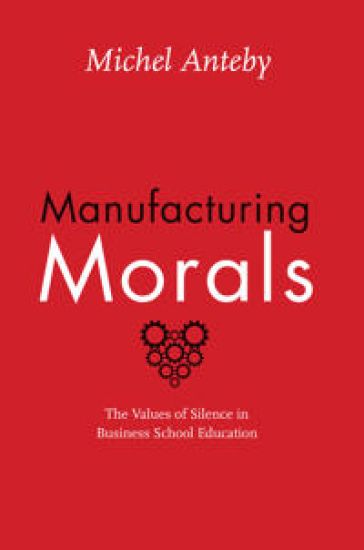
Manufacturing Morals

Manufacturing Morals

Michel Anteby

University of Chicago Press
2013
sidottu
Corporate accountability is never far from the front page, and as the world's most elite institution for business education, Harvard Business School trains many of the future leaders of Fortune 500 companies. But how does HBS formally and informally ensure faculty and students embrace proper business standards? Making unprecedented use of his position as a Harvard Business School faculty member, Michel Anteby takes readers inside HBS in order to draw vivid parallels between the socialization of faculty and of students. In an era when many organizations are focused on principles of responsibility, Harvard Business School has long tried to promote better business standards. Anteby's rich account reveals the surprising role of silence and ambiguity in HBS' process of codifying morals and business values. As Anteby describes, at HBS specifics are often left unspoken; for example, teaching notes given to faculty provide much guidance on how to teach but are largely silent on what to teach. Manufacturing Morals demonstrates how faculty and students are exposed to a system that operates on open-ended directives that require significant decision-making on the part of those involved, with little overt guidance from the hierarchy. Anteby suggests that this model - which tolerates moral complexity - is perhaps one of the few that can adapt and endure over time. Manufacturing Morals is a perceptive must-read for anyone looking for insight into the moral decision-making of today's business leaders and those influenced by and working for them.
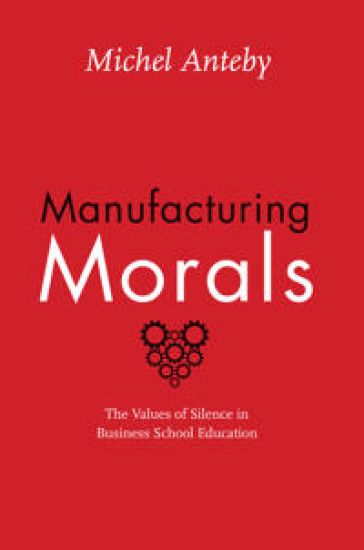
Manufacturing Morals

Manufacturing Morals

Michel Anteby

University of Chicago Press
2015
nidottu
Corporate accountability is never far from the front page, and as one of the world's most elite business schools, Harvard Business School trains many of the future leaders of Fortune 500 companies. But how does HBS formally and informally ensure faculty and students embrace proper business standards? Relying on his first-hand experience as a Harvard Business School faculty member, Michel Anteby takes readers inside HBS in order to draw vivid parallels between the socialization of faculty and of students. In an era when many organizations are focused on principles of responsibility, Harvard Business School has long tried to promote better business standards. Anteby's rich account reveals the surprising role of silence and ambiguity in HBS's process of codifying morals and business values. As Anteby describes, at HBS specifics are often left unspoken; for example, teaching notes given to faculty provide much guidance on how to teach but are largely silent on what to teach. Manufacturing Morals demonstrates how faculty and students are exposed to a system that operates on open-ended directives that require significant decision-making on the part of those involved, with little overt guidance from the hierarchy. Anteby suggests that this model—which tolerates moral complexity—is perhaps one of the few that can adapt and endure over time. Manufacturing Morals is a perceptive must-read for anyone looking for insight into the moral decision-making of today's business leaders and those influenced by and working for them.

Moral Gray Zones

Moral Gray Zones

Michel Anteby

PRINCETON UNIVERSITY PRESS
2008
sidottu
Anyone who has been employed by an organization knows not every official workplace regulation must be followed. When management consistently overlooks such breaches, spaces emerge in which both workers and supervisors engage in officially prohibited, yet tolerated practices--gray zones. When discovered, these transgressions often provoke disapproval; when company materials are diverted in the process, these breaches are quickly labeled theft. Yet, why do gray zones persist and why are they unlikely to disappear? In Moral Gray Zones, Michel Anteby shows how these spaces function as regulating mechanisms within workplaces, fashioning workers' identity and self-esteem while allowing management to maintain control. The book provides a unique window into gray zones through its in-depth look at the manufacture and exchange of illegal goods called homers, tolerated in a French aeronautic plant. Homers such as toys for kids, cutlery for the kitchen, or lamps for homes, are made on company time with company materials for a worker's own purpose and use. Anteby relies on observations at retirees' homes, archival data, interviews, and surveys to understand how plant workers and managers make sense of this tacit practice. He argues that when patrolled, gray zones like the production of homers offer workplaces balanced opportunities for supervision as well as expression. Cautioning against the hasty judgment that gray zone practices are simply wrong, Moral Gray Zones contributes to a deeper understanding of the culture, group dynamics, and deviance found in organizations.
The Interloper

The Interloper

Michel Anteby

PRINCETON UNIVERSITY PRESS
2024
sidottu
A practical and theoretical guide for field researchers struggling with accessResistance is the bane of all field researchers, who are often viewed as interlopers when they enter a community and start asking questions. People obstruct investigations and hide evidence. They shelve complaints, silence dissent, and even forget their own past and deny having done so. How can we learn about a community when its members resist so strongly? The answer is that the resistance itself is sometimes the key.Michel Anteby explains how community members often disclose more than intended when they close ranks and create obstacles. He draws insights from diverse stories of resistance by uncooperative participants—from Nazi rocket scientists and Harvard professors to Disney union busters and people who secure cadavers for medical school dissection—to reveal how field resistance manifests itself and how researchers can learn from it. He argues that many forms of resistance are retrospectively telling, and that these forms are the routine products, not by-products, of the field. That means that resistance mechanisms are not only indicative of something else happening; instead, they often are the very data points that can shed light on how participants make sense of their worlds.An essential guide for ethnographers, sociologists, and all field researchers seeking access, The Interloper shares practical and theoretical insights into the value of having the door slammed in your face.
The Interloper

The Interloper

Michel Anteby

PRINCETON UNIVERSITY PRESS
2024
pokkari
A practical and theoretical guide for field researchers struggling with accessResistance is the bane of all field researchers, who are often viewed as interlopers when they enter a community and start asking questions. People obstruct investigations and hide evidence. They shelve complaints, silence dissent, and even forget their own past and deny having done so. How can we learn about a community when its members resist so strongly? The answer is that the resistance itself is sometimes the key.Michel Anteby explains how community members often disclose more than intended when they close ranks and create obstacles. He draws insights from diverse stories of resistance by uncooperative participants—from Nazi rocket scientists and Harvard professors to Disney union busters and people who secure cadavers for medical school dissection—to reveal how field resistance manifests itself and how researchers can learn from it. He argues that many forms of resistance are retrospectively telling, and that these forms are the routine products, not by-products, of the field. That means that resistance mechanisms are not only indicative of something else happening; instead, they often are the very data points that can shed light on how participants make sense of their worlds.An essential guide for ethnographers, sociologists, and all field researchers seeking access, The Interloper shares practical and theoretical insights into the value of having the door slammed in your face.