Kirjojen hintavertailu. Mukana 12 392 367 kirjaa ja 12 kauppaa.

Kirjahaku

Etsi kirjoja tekijän nimen, kirjan nimen tai ISBN:n perusteella.

12 kirjaa tekijältä Michel Meyer

What is Rhetoric?

What is Rhetoric?

Michel Meyer

Oxford University Press
2019
nidottu
This book offers a new approach to the principles and functioning of rhetoric. In everyday life, we often debate issues or simply discuss questions. Rhetoric is the way in which we answer questions in an interpersonal context, when we want to have an effect on those with whom we are communicating. They can be convinced or charmed, persuaded or influenced, and the language used can range from reasoning to the sharing of narratives, literary or otherwise. What is Rhetoric? provides a breakthrough in the field, offering a systematic and unified view of the topic. The book combines the social aspects of rhetoric, such as the negotiation of distance between speakers, with the theory of emotions. All the principal authors from Plato and Aristotle to contemporary theorists are integrated into Michel Meyer's "problematological" conception of rhetoric, based on the primacy of questioning and answering in language and thought.
What is Rhetoric?

What is Rhetoric?

Michel Meyer

Oxford University Press
2017
sidottu
This book offers a new approach to the principles and functioning of rhetoric. In everyday life, we often debate issues or simply discuss questions. Rhetoric is the way in which we answer questions in an interpersonal context, when we want to have an effect on those with whom we are communicating. They can be convinced or charmed, persuaded or influenced, and the language used can range from reasoning to the sharing of narratives, literary or otherwise. What is Rhetoric? provides a breakthrough in the field, offering a systematic and unified view of the topic. The book combines the social aspects of rhetoric, such as the negotiation of distance between speakers, with the theory of emotions. All the principal authors from Plato and Aristotle to contemporary theorists are integrated into Michel Meyer's 'problematological' conception of rhetoric, based on the primacy of questioning and answering in language and thought.
Of Problematology

Of Problematology

Michel Meyer

University of Chicago Press
1995
sidottu
This text offers a new beginning for philosophy rooted in a theory of questioning which the author calls "problematology." He argues that a new beginning is necessary in order to resituate philosophy, science and linguistic analysis. For Meyer, philosophy does not solve problems or give answers but instead shows how propositions are related to a whole field of questions that give them meaning. Reason is identified not with answers but with the question-answer process. Meyer pursues this theory of reason and meaning in a critique of Western philosophy from Socrates, Plato and Aristotle through Heidegger, Wittgenstein and Foucault. He provides an analysis of Descartes' notion of radical doubt and demonstrates its implications for the subsequent philosophical tradition. Meyer argues that recent work in rhetoric points toward a theory of radical questioning and claims that the methods of rhetoric and argumentation must be turned back on philosophy itself in order to recover the original significance of metaphysics as the science of ultimate questions.
Of Problematology

Of Problematology

Michel Meyer

University of Chicago Press
1995
nidottu
This text offers a new beginning for philosophy rooted in a theory of questioning which the author calls "problematology." He argues that a new beginning is necessary in order to resituate philosophy, science and linguistic analysis. For Meyer, philosophy does not solve problems or give answers but instead shows how propositions are related to a whole field of questions that give them meaning. Reason is identified not with answers but with the question-answer process. Meyer pursues this theory of reason and meaning in a critique of Western philosophy from Socrates, Plato and Aristotle through Heidegger, Wittgenstein and Foucault. He provides an analysis of Descartes' notion of radical doubt and demonstrates its implications for the subsequent philosophical tradition. Meyer argues that recent work in rhetoric points toward a theory of radical questioning and claims that the methods of rhetoric and argumentation must be turned back on philosophy itself in order to recover the original significance of metaphysics as the science of ultimate questions.
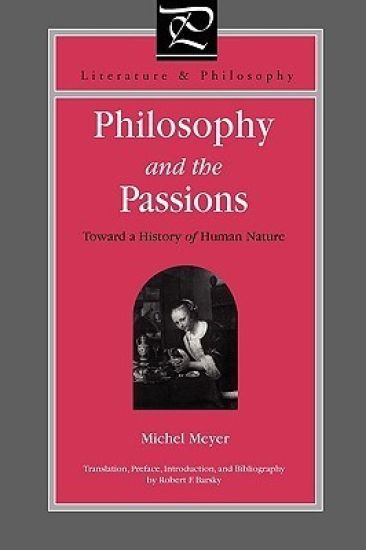
Philosophy and the Passions

Philosophy and the Passions

Michel Meyer

Pennsylvania State University Press
2000
sidottu
The subject of the passions has always haunted Western philosophy and, more often than not, aroused harsh judgments. For the passions represent a force of excess and lawlessness in humanity that produces troubling, confusing paradoxes.Michel Meyer provides new insight into an age-old dilemma: Does passion torture people because it blinds them, or, on the contrary, does it permit them to apprehend who and what we really are?
Philosophy and the Passions

Philosophy and the Passions

Michel Meyer

Pennsylvania State University Press
2000
pokkari
The subject of the passions has always haunted Western philosophy and, more often than not, aroused harsh judgments. For the passions represent a force of excess and lawlessness in humanity that produces troubling, confusing paradoxes.Michel Meyer provides new insight into an age-old dilemma: Does passion torture people because it blinds them, or, on the contrary, does it permit them to apprehend who and what we really are?
Rhetoric, Language, and Reason

Rhetoric, Language, and Reason

Michel Meyer

Pennsylvania State University Press
1994
pokkari
Contemporary or postmodern thought is based on the lack of foundation. The impossibility of having a principle for philosophy has become a position of principle. As a result, rhetoric has taken over. Content has given way to the priority of form. Michel Meyer's book aims at showing that philosophy as foundational is possible and necessary, and that rhetoric can flourish alongside, but the conception of reason must be changed. Questioning rather than answering must be considered as the guiding principle. What the author calls "problematology" is not only the study of questioning but also the analysis of the reasons why it has been repressed throughout the history of philosophy. Since Socrates, philosophers and scientists have reasoned by asking questions and by trying to solve them. Questioning has been the unthematized foundation of philosophy and thought at large. Philosophers, however, have preferred another norm, granting privilege to the answers and thereby repressing the questions into the realm of the preliminary and unessential. They have not considered their discursive practice as being based upon some question-answer (or problem-solution) complex, but exclusively on the results they call propositions. Meyer argues that propositions ensue from corresponding questions, and not the other way around.Anthropology, ontology, reasoning, and language thus receive a new interpretation in the problematological conception of philosophy, a conception in which questions and problems are thematized afresh. The theory of language in everyday use, in argumentation, or in literary analysis receives a full and decisive treatment here, making Meyer's question-view one of the leading theories in contemporary thought, alongside his rhetoric for which he is already well known.
De la problématologie

De la problématologie

Michel Meyer

Mardaga Fonds
1986
pokkari
De Socrate et Descartes Heidegger, de Platon et Aristote Wittgenstein, de l'analyse du discours la litt rature, du savoir classique l' pist mologie contemporaine, la probl matologie s'inscrit comme la r ponse philosophique qui maintient l'interrogativit initiale, parce qu'elle la prend r ellement pour ce qu'elle est, sans la rabattre sur un un a priori qui emp cherait une fois encore d'apprendre ce que questionner veut dire. Michel Meyer est un philosophe belge, Professeur l'Universit libre de Bruxelles. Sa r flexion porte principalement sur la rh torique laquelle il a largement contribu par l'introduction d'une approche de l'argumentation qu'il nomme la probl matologie .
Qu'est-Ce Que L'Argumentation?

Qu'est-Ce Que L'Argumentation?

Michel Meyer

Librarie Philosophique J. Vrin
2005
nidottu
L'auteur se propose ici d'etudier la notion d'argumentation, a la fois dans sa defnition propre et dans ses rapports avec des concepts connexes. Il s'agit en consequence de determiner le domaine d'application que cette notion recouvre: doit-on la considerer exclusivement comme un phenomene langagier? Ou, au contraire, s'applique-t-elle a champ d'experiences plus vaste, lequel recouvre aussi bien les mecanismes cognitifs que les attitudes propositionnelles qui accompagnent toute enonciation? L'ouvrage s'attache ainsi a etablir les liens de distinction autant que de ressemblance qui existent entre l'argumentation, le raisonnement et la rhetorique, de sorte a determiner la place qu'occupe cette notion dans une communaute non seulement langagiere mais aussi politique ou culturelle. De meme, il envisage les comprtements et les valeurs de cette communaute, que sont les passions, l'art de seduire et de convaincre, ou encore celui de persuader et d'emouvoir, comme autant de modes argumentatifs possibles.
Qu'est-Ce Que Le Theatre?

Qu'est-Ce Que Le Theatre?

Michel Meyer

Librarie Philosophique J. Vrin
2014
nidottu
English summary: Theater allows people to examine important problems with sufficient distance in order to judge fairly without feeling directly implicated. Michel Meyer offers a much needed history of theater, from its earliest Greek beginnings, through the Middle Ages, Enlightenment, to the absurd works of Beckett or Sartre, while remembering the context of other supporting arts. French description: Le theatre est, avec l'epopee, la plus ancienne forme de litterature en Occident. Son but est de creer de la distance avec des situations problematiques, liees au pouvoir, au divin, aux dilemmes moraux, afin de permettre au spectateur de faire le bon jugement sans se sentir directement implique. Michel Meyer envisage toutes les theories du theatre, a commencer par celle d'Aristote, qui se sont succede jusqu'a aujourd'hui et les confronte a l'histoire meme du theatre. Eschyle, Sophocle, Euripide, Aristophane, Marlowe, Machiavel, Shakespeare, Racine et le theatre classique francais, le theatre baroque espagnol, le romantisme, le realisme, d'Ibsen a Tchekhov et a Pirandello, comme le theatre de l'absurde, avec Ionesco, Beckett ou Sartre, tout est etudie, articule, et remis en perspective. La rationalite dans l'histoire du theatre est clairement mise en evidence, sans jamais negliger ce que le theatre doit ou apporte aux autres arts les plus proches, comme l'opera. Michel Meyer offre ici une synthese spectaculaire et une erudition sans precedent sur le phenomene "theatre" en un ouvrage court et percutant, plein d'idees nouvelles.
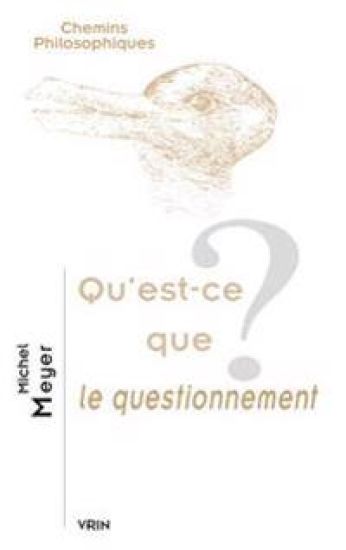
Qu'est-Ce Que Le Questionnement?

Qu'est-Ce Que Le Questionnement?

Michel Meyer

Librarie Philosophique J. Vrin
2017
nidottu
Le questionnement est le propre de toute demarche animee par une quete de savoir. Mais seule la philosophie pratique un questionnement radical avec, pour questions ultimes, Soi, le Monde et Autrui. Le questionnement devient ainsi pour elle son propre objet, son fondement, son point de depart, laissant de cote Dieu, l'Etre ou le Sujet, des fondements traditionnels au cours de l'Histoire, mais qui sont deja des reponses, et qui presupposent a ce titre le questionnement, qu'elles nient, ce qui a permis a ces "reponses" de s'imposer, tour a tour, de l'Antiquite a l'epoque moderne. Pourtant, seul le questionnement peut etre le reel point de depart de la pensee, car quoi de plus premier dans la question de ce qui est premier que le questionnement, lui-meme, toute autre reponse le presupposerait d'ailleurs en tant que reponse. Pourquoi ne l'a-t-on pas vu jusqu'ici? Qu'est-ce qui a preside a son refoulement? Sans doute l'obsession positiviste de trouver des reponses, et aujourd'hui, le sentiment nihiliste qu'on est arrive au bout du parcours et des possibilites offertes par un propositionnalisme, qui avale les questions et les reponses dans une indifferenciation qui ne permet plus de progresser. Michel Meyer entreprend d'exposer ici comment il parvient a depasser les impasses de la philosophie traditionnelle, grace a cette reflexion du questionnement sur lui-meme qui est la sienne ici. Il en decoule une nouvelle approche de la philosophie, appelee problematologie. en adoptant cette nouvelle maniere de penser, le questionnement du monde, de l'homme, des hommes dans leurs rapports mutuels, parfois conflictuels, recoit un nouvel eclairage, auquel le propositionnalisme, par son indifference au questionnement, ne pouvait acceder. Michel Meyer nous emmene ce faisant sur les chemins des grandes philosophies du passe, d'Aristote a Heidegger en passant par Descartes et Kant, qu'il reinterprete en montrant comment ils ont effectue un questionnement radical, meme s'ils n'ont pu le penser comme tel et il nous explique pourquoi. Au travers de ce petit livre passionnant et novateur, Michel Meyer nous offre ainsi une nouvelle maniere de concevoir la philosophie.