Kirjojen hintavertailu. Mukana 11 342 296 kirjaa ja 12 kauppaa.

Kirjahaku

Etsi kirjoja tekijän nimen, kirjan nimen tai ISBN:n perusteella.

45 kirjaa tekijältä Michel Tremblay

Michel Tremblay: Plays in Scots

Michel Tremblay: Plays in Scots

Michel Tremblay

ASSOCIATION FOR SCOTTISH LITERARY STUDIES
2023
nidottu
“The greatest playwright Scotland never had.” – Mark Fisher, The Guardian Michel Tremblay is considered the most important playwright in Quebec theatre history. His ground-breaking work for theatre presents Montreal’s working class speaking the city’s vernacular French. Tremblay’s plays and novels create a family saga where many characters appear in more than one work. Bill Findlay, a Scot, and Martin Bowman, a Montrealer of Scottish descent, translated eight Tremblay plays into Scots. The energy, versatility, and range of the Scots language capture the essence of Tremblay’s drama. These critically acclaimed translations, produced professionally in Scotland from 1989 to 2003, constitute an important body of work in modern Scottish theatre. This volume’s four translations premiered at Glasgow’s Tron Theatre, during Michael Boyd’s tenure as artistic director. They include three of Tremblay’s early masterpieces: The Guid Sisters, Hosanna, and Forever Yours, Marie-Lou. The fourth play, The Real Wurld?, shares Tremblay’s devastating critique of family life. These plays confront topics such as domestic and sexual abuse. These are strong plays, as relevant today as when first produced. Besides playtexts, both volumes of Michel Tremblay: Plays in Scots contain a foreword and introductions to each volume as well as to each play, including historical background material.

Michel Tremblay: Plays in Scots

Michel Tremblay: Plays in Scots

Michel Tremblay

ASSOCIATION FOR SCOTTISH LITERARY STUDIES
2023
nidottu
“The greatest playwright Scotland never had.” – Mark Fisher, The Guardian Michel Tremblay is considered the most important playwright in Quebec theatre history. His ground-breaking work for theatre presents Montreal’s working class speaking the city’s vernacular French. Tremblay’s plays and novels create a family saga where many characters appear in more than one work. Bill Findlay, a Scot, and Martin Bowman, a Montrealer of Scottish descent, translated eight Tremblay plays into Scots. The energy, versatility, and range of the Scots language capture the essence of Tremblay’s drama. These critically acclaimed translations, produced professionally in Scotland from 1989 to 2003, constitute an important body of work in modern Scottish theatre. Three of this volume’s translations premiered in Edinburgh: The House among the Stars and Solemn Mass for a Full Moon in Summer at the Traverse and If Only... at the Royal Lyceum. Albertine, in Five Times premiered at Glasgow’s Tron, touring to eight Scottish cities. In them, Tremblay – without diminishing the intensity of his dissection of family life – considers possible acceptance and reconciliation in the face of the difficulties and challenges confronting his characters. Besides playtexts, both volumes of Michel Tremblay: Plays in Scots contain a foreword and introductions to each volume as well as to each play, including historical background material.
En Pieces Detachees

En Pieces Detachees

Michel Tremblay

Talonbooks
1975
pokkari
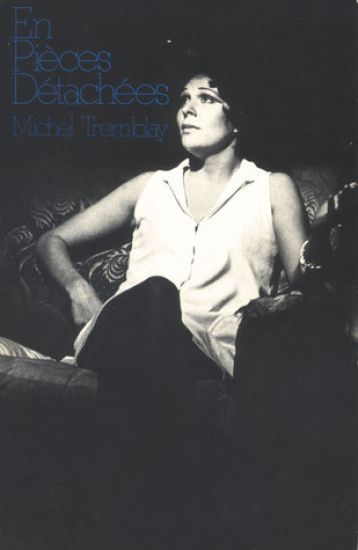
En Pieces Detachees is Michel Tremblay's look at "The Main" in Montreal. The play concerns Helene, a waitress who used to work in a bar called the Coconut Inn, but who now works slinging smoked meat in a joint on Papineau Street. She is married to Henri, who sits around all day watching Captain Cartoons on television. They live in a tenement in the East End with their daughter, Francine, and Helene's mother, Robertine. During the course of the play, Helene's retarded brother, Claude, who has been "sent away" and who wears "sunglasses and speaks English" as his passport to the world, runs away from the brothers at the sanitorium and returns home for a little visit. En Pieces Detachees was first performed in Montreal in 1969. It was broadcast over French language CBC-TV in 1971 and 1972, drawing the largest audience in Quebec for a televised dramatization of a play. Cast of four women and two men.
Duchesse de Langeais & Other Plays

Duchesse de Langeais & Other Plays

Michel Tremblay

Talonbooks
1976
pokkari
La Duchesse de Langeais and Other Plays is a collection of five short plays by Quebec's best known playwright, Michel Tremblay -- "La Duchesse de Langeais," "Berthe," "Johnny Mangano and His Astonishing Dogs," "Gloria Star" and "Surprise, Surprise."
Sainte-Carmen of the Main

Sainte-Carmen of the Main

Michel Tremblay

Talonbooks
1981
pokkari
In Sainte-Carmen of the Main, Carmen--a character who appeared previously in Forever Yours, Marie-Lou--returns to the Rodeo from Nashville, where she has been sent to "improve her technique" in yodelling. But not only does she improve her technique, she also begins to write her own songs whose lyrics speak directly to the people about their problems, in words they understand. This challenging and profound play poses the question: "It's fine to wake people up, but once they're awake, what do you do with them?"
Damnee Manon Sacree Sandra

Damnee Manon Sacree Sandra

Michel Tremblay

Talonbooks
1981
pokkari
In Damnee Manon, Sacree Sandra, Michel Tremblay examines the sacred and the profane--their similarities and differences; how they merge and become one another. The play consists of two interweaving monologues on religion and sex spoken by Manon (from Forever Yours, Marie-Lou) and Sandra (from Hosanna). In the end, both characters realize that they have been "invented" by the author.
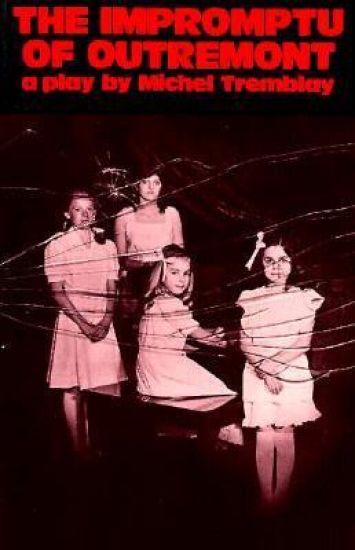
The Impromptu of Outremont

The Impromptu of Outremont

Michel Tremblay

Talonbooks
1981
pokkari
Each year, the Beaugrand sisters meet for their sister Yvette's birthday party--and to have a little "impromptu"--at which they lash out at each other's personal failures and at the failure of society to support them in their opinions about the world. The four sisters represent the French-Canadian intelligentsia of the fifties, whose interest in art, music, dance and literature is an adopted pose, not their life's blood. Only one of the Beaugrand siters, Lorraine, has escaped her fate, running off with the Italian gardener to start a family in St. Leonard. The others remain in Outremont, trapped by time; by the choices they have not dared to make; by the position that society has foisted upon them--a position they have accepted, not fought for.
The Fat Woman Next Door Is Pregnant

The Fat Woman Next Door Is Pregnant

Michel Tremblay

Talonbooks
1981
pokkari
It is the glorious second day of May, 1942. The sun is drawing the damp from earth still heavy with the end of a long Quebec winter, the budding branches of the trees along rue Fabre and in Parc Lafontaine of the Plateau Mont Royal ache to release their leaves into the warm, clear air heralding the approach of summer. Seven women in this raucous Francophone working-class Montreal neighbourhood are pregnant--only one of them, "the fat woman," is bearing a child of true love and affection. Next door to the home that is by times refuge, asylum, circus-arena, confessional and battleground to her extended family, with ancient roots in both rural Quebec and the primordial land of the Saskatchewan Cree, stands an immaculately kept but seemingly empty house where the fates, Rose, Mauve, Violet and their mother Florence, only ever fleetingly and uncertainly glimpsed by those in a state of emotional extremis, are knitting the booties of what will become the children of a whole new nation.In this first of six novels that became his Chronicles of the Plateau Mont Royal, Tremblay allows his imagination free reign, fictionalizing the lives of his beloved characters, dramatized so brilliantly in his plays and remembered so poignantly in his memoirs."The fat woman" both is and is not Michel Tremblay's mother--her extended family and neighbours more than a symbol of a colonized people: abandoned and mocked by France; conquered and exploited by England; abused and terrorized by the Church; and forced into a war by Canada supporting the very powers that have crushed their spirit and twisted their souls since time immemorial. This is a "divine comedy" of the extraordinary triumphs and tragedies of ordinary people caught up by circumstances that span the range of the ridiculous to the sublime.
Therese and Pierrette and the Little Hanging Angel
This is the second of five novels in Michel Tremblay's Plateau Mont-Royal series, an evocative, magical retelling of the author's own birth, childhood, and adolescence in a working-class Montreal neighbourhood populated by eccentrics, dreamers and imaginary characters of mythic proportions. Three schoolgirls, "Therese 'n' Pierrette" and their friend Simone, are caught up in the dark mysteries of their rites of passage: innocence moving into experience; life into birth. Circling around their uncertainties are cold, merciless predators, ready to strike at the slightest sign of weakness--the vicious hypocrisy of the Church, the cruel ignorance of the petty bourgeoisie, and the burning lust of the child molester.
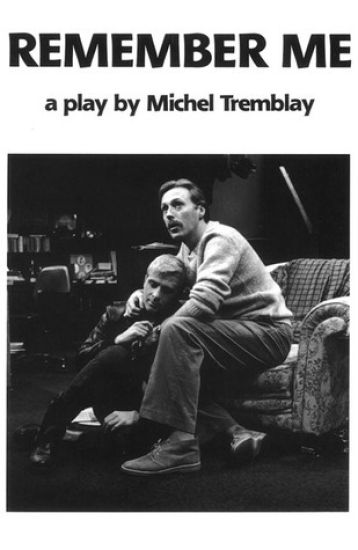
Remember Me

Remember Me

Michel Tremblay

Talonbooks
1984
pokkari
It has been some time since Luc, a 32-year-old actor and Jean-Marc, a 38-year-old French teacher, have seen each other, but the wounds from their seven year love affair are only partially healed. Each of them has current worries as well: Jean-Marc, apparently secure and well off, is tired of the endless procession of insensitive and seductive students; he has also realized that he will never be the great novelist he had hoped to become. He feels, in a word, mediocre. Luc, after years as an obscure stage actor, has found popular success playing "a nut case with a lisp" on a TV sitcom, but along with fame has come an unexpected and unwelcome loss of privacy and a struggle for self-respect. To make matters worse, Luc's father is dying. During this evening at Jean-Marc's house, the two men dredge up the good and the bad memories; they confront each other about past injustices; they examine each other's grey hairs; finally, they confess their fears and disillusionments and they comfort each other.
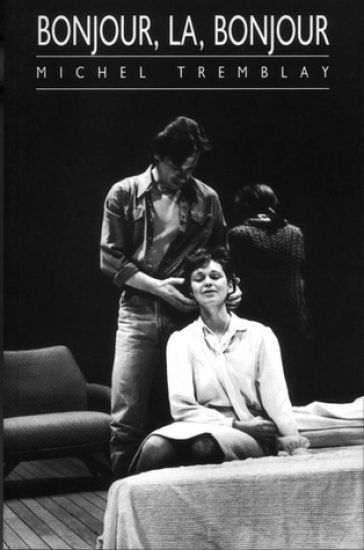
Bonjour, L, Bonjour

Bonjour, L, Bonjour

Michel Tremblay

Talonbooks
1990
pokkari
Michel Tremblay considers Bonjour, La, Bonjour to be the best of all his works. "In Bonjour, La, Bonjour, I apprehended the most of what I wanted to do in the theatre--to take out everything that is not strictly necessary." This new substantially revised translation by John Van Burek and Bill Glassco updates their original English translation of Bonjour, La, Bonjour which has been available from Talonbooks since 1975.
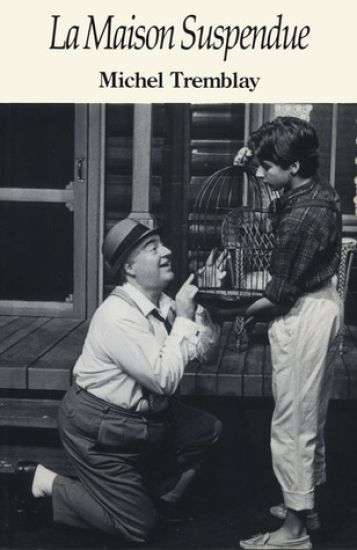
La Maison Suspendue

La Maison Suspendue

Michel Tremblay

Talonbooks
1991
pokkari
A rich, emotional, sweeping drama of anger and sorrow spanning three generations. The family house in the country is the setting for the story of Victoire and her descendants through her husband and through her true love--who also happens to be her brother. It is Victoire's anger at being forced away from the family home and her sorrow at being separated from her dreamy, impractical, fiddle playing brother that fuel the machinery of 80 years of family relationships.
Belles Soeurs, Les

Belles Soeurs, Les

Michel Tremblay

Talonbooks
1992
pokkari
Germaine Lauzon has won a million trading stamps from a department store. Her head swimming with dreams of refurbishing and redecorating her working-class home from top to bottom with catalogue selections ranging from new kitchen appliances to "real Chinese paintings on velvet," she invites fourteen of her friends and relatives in the neighbourhood over to help her paste the stamps into booklets. Raucous, reckless and rude, the women shamelessly share their most secret hopes and fears, complain stridently about their friends and relatives, fantasize wistfully about escaping the misogynist drudgery of their lives and surreptitiously tuck most of the stamps into their purses and clothing, self-righteously appropriating what they consider to be Germaine's "illegitimate" good fortune. While earlier attempts had been made to stage the realities of Quebecois life using colloquial language and a realist backdrop of working-class Montreal, these populist hits were considered rustic and anomalous, while "real" (Parisian) French continued to dominate theatre and "high culture" until the end of the 1950s.As Quebec searched for a new socio-political identity and a language that could articulate its rapidly emerging post-colonial reality throughout the "quiet revolution," Michel Tremblay struggled to find an authentic Quebecois voice. Written in 1965, it took three years for him get a first production of Les Belles Soeurs in 1968. Premiering at the Theatre du Rideau-Vert in the same year that Rene Levesque founded the nationalist Parti Quebecois, this first of what was to become more than a dozen plays in Tremblay's Cycle of Les Belles Soeurs became an overnight success. In one fell stroke, Joual, the distinctive Quebec vernacular that had evolved over centuries since the end of French colonial rule had been legitimized, and Michel Tremblay, much like Chaucer in English and Dante in Italian, had become "the father of the Quebecois language."
Marcel Pursued by the Hounds

Marcel Pursued by the Hounds

Michel Tremblay

Talonbooks
1996
pokkari
An extended tour de force with no act or scene breaks, Marcel Pursued by the Hounds examines how our "innocent" childhood games and fantasies can come back to haunt us in adult life, full of the dangers and realities that were invisible to us as children. An extended dialogue between the characters Marcel (one of the main characters in Tremblay's novel The First Quarter of the Moon) and Therese (one of the main characters in the novel Therese and Pierrette and the Little Hanging Angel), illuminated by a chorus of the fates, it is Michel Tremblay's toughest, most uncompromising play to date. Cast of 4 women and 1 adolescent male.
The First Quarter of the Moon

The First Quarter of the Moon

Michel Tremblay

Talonbooks
1994
pokkari
It is June 20, 1952, a decade after the events described in The Fat Woman Next Door Is Pregnant, the first volume of Michel Tremblay's series of autobiographical fiction. The mystic, yet palpable instant of summer's arrival is experienced simultaneously by the fat woman's son (who is never named) and Marcel. These moving, profoundly different epiphanies of a transforming world, seen through the memories of the characters, set the stage for the action of the novel which takes place in the space of this single, evocative day. The fat woman's son experiences this moment as an episode of profound personal objectification--he sees himself as in a photo of that larger, inclusive moment. Marcel, on the other hand, literally seizes the moment, and stores it in his school bag as a physical thing. It is also the day of final exams at the Ecole Saint-Stanislas where the fat woman's son, a boy who lives inside the books he loves, is in the "gifted" class, and his cousin Marcel, the "mad" family terror, is in the class for "slow learners."Racked by envy at what he sees as Marcel's genius--his ability to create and function in another dimension of reality--the gifted child blanks out during the French exam. The first quarter of the moon--which rises over the final scenes of the novel in which the fat woman's son recognizes and acknowledges his cousin Marcel's genius--is an exquisitely crafted and resonant metaphor for the symbiotic relation between the imaginary and the real, the privileged "educated elite" and the "great unwashed," innocence and experience, sanity and madness.
Bambi and Me

Bambi and Me

Michel Tremblay

Talonbooks
1997
pokkari
Bambi and Me consists of 12 autobiographical pieces about how movies shaped the young life of Michel Tremblay, one of their biggest fans. Among others, he talks about Twenty Thousand Leagues Under the Sea, Cinderella, Snow White and the Seven Dwarves, Parade of the Wooden Soldiers, Orphee and the Night Visitors and about how each led to his discovery of his emerging emotional sensibilities as a child and an adolescent. In the piece that gives the book its title, he writes: "Did you cry as much as I did at the death of Bambi's mother? Personally, I've never got over it." Bursting with wit, charm, and the profound resonance of youthful self-discovery, Bambi and Me provides Tremblay's many fans with a clear sense of the origins of the talent which has made Michel Tremblay one of the most important and fascinating playwrights and novelists of the 20th century.
For the Pleasure of Seeing Her Again

For the Pleasure of Seeing Her Again

Michel Tremblay

Talonbooks
1998
pokkari
For the Pleasure of Seeing Her Again is Tremblay's homage to his mother, who nurtured his imagination, his reclusive reading habits and his love for the theatre and the arts, yet who did not live to witness the performance of Les Belles Soeurs--the first successful play written in joual with which Tremblay legitimized the Quebecois vernacular in the arts--and the world-wide acclaim for her son's artistic genius. In a compelling balance of humour and poignancy, Tremblay offers glimpses of himself and his mother at five different stages of their lives together, culminating in his reassurance of his dying mother's concern for him immediately prior to his spectacular success.
A Thing of Beauty

A Thing of Beauty

Michel Tremblay

Talonbooks
1998
pokkari
March, 1963. Winter has launched its final assault on Montreal. The Fat Woman, Therese, Edouard, Pierrette, Marcel, all the star-crossed characters of Tremblay's Chronicles of Plateau Mont-Royal are here again, 20 years later. Marcel, now 23, learns that his Auntie Nana--The Fat Woman who is here finally named--is gravely ill and her days are numbered. How will he, with his exaggerated sensitivity, his visions, his ongoing struggle with "reality" pit his fertile imagination against this inexorable march of death? In five epiphanic visions that take us from a nineteenth-century London pub to a reworking of Michelangelo's Last Judgement, Marcel uses his gift of the creative imagination to break the eternal spiral of new beginnings, and to thumb his nose at despair and resignation. Presented here, side by side, is Tremblay's fictionalized account of the death of his own mother, so lovingly enacted in his new play, For the Pleasure of Seeing Her Again. In what becomes a coda to his great Chronicles of the Plateau Mont-Royal cycle of novels, Tremblay creates, with grace and tenderness, a redemption and transcendent grandeur for these familiar and beloved characters: A Thing of Beauty.