Kirjojen hintavertailu. Mukana 11 244 527 kirjaa ja 12 kauppaa.

Kirjahaku

Etsi kirjoja tekijän nimen, kirjan nimen tai ISBN:n perusteella.

7 kirjaa tekijältä Michelle Baddeley

Behavioural Economics

Behavioural Economics

Michelle Baddeley

Oxford University Press
2017
nidottu
Traditionally economists have based their economic predictions on the assumption that humans are super-rational creatures, using the information we are given efficiently and generally making selfish decisions that work well for us as individuals. Economists also assume that we're doing the very best we can possibly do - not only for today, but over our whole lifetimes too. But increasingly the study of behavioural economics is revealing that our lives are not that simple. Instead, our decisions are complicated by our own psychology. Each of us makes mistakes every day. We don't always know what's best for us and, even if we do, we might not have the self-control to deliver on our best intentions. We struggle to stay on diets, to get enough exercise and to manage our money. We misjudge risky situations. We are prone to herding: sometimes peer pressure leads us blindly to copy others around us; other times copying others helps us to learn quickly about new, unfamiliar situations. This Very Short Introduction explores the reasons why we make irrational decisions; how we decide quickly; why we make mistakes in risky situations; our tendency to procrastination; and how we are affected by social influences, personality, mood and emotions. The implications of understanding the rationale for our own financial behaviour are huge. Behavioural economics could help policy-makers to understand the people behind their policies, enabling them to design more effective policies, while at the same time we could find ourselves assaulted by increasingly savvy marketing. Michelle Baddeley concludes by looking forward, to see what the future of behavioural economics holds for us. ABOUT THE SERIES: The Very Short Introductions series from Oxford University Press contains hundreds of titles in almost every subject area. These pocket-sized books are the perfect way to get ahead in a new subject quickly. Our expert authors combine facts, analysis, perspective, new ideas, and enthusiasm to make interesting and challenging topics highly readable.

Copycats and Contrarians

Copycats and Contrarians

Michelle Baddeley

Yale University Press
2018
sidottu
A multidisciplinary exploration of our human inclination to herd and why our instinct to copy others can be dangerous in today’s interlinked world Rioting teenagers, tumbling stock markets, and the spread of religious terrorism appear to have little in common, but all are driven by the same basic instincts: the tendency to herd, follow, and imitate others. In today’s interconnected world, group choices all too often seem maladaptive. With unprecedented speed, information flashes across the globe and drives rapid shifts in group opinion. Adverse results can include speculative economic bubbles, irrational denigration of scientists and other experts, seismic political reversals, and more. Drawing on insights from across the social, behavioral, and natural sciences, Michelle Baddeley explores contexts in which behavior is driven by the herd. She analyzes the rational vs. nonrational and cognitive vs. emotional forces involved, and she investigates why herding only sometimes works out well. With new perspectives on followers, leaders, and the pros and cons of herd behavior, Baddeley shines vivid light on human behavior in the context of our ever-more-connected world.
Investment

Investment

Michelle Baddeley

Red Globe Press
2003
sidottu
Investment provides an examination of the key macroeconomic theories which underpin fixed asset investment. It would make ideal reading for an intermediate level macroeconomics course or a module on fixed asset investment taking an applied macroeconomic perspective.
Investment

Investment

Michelle Baddeley

Red Globe Press
2003
nidottu
Investment provides an examination of the key macroeconomic theories which underpin fixed asset investment. It would make ideal reading for an intermediate level macroeconomics course or a module on fixed asset investment taking an applied macroeconomic perspective.
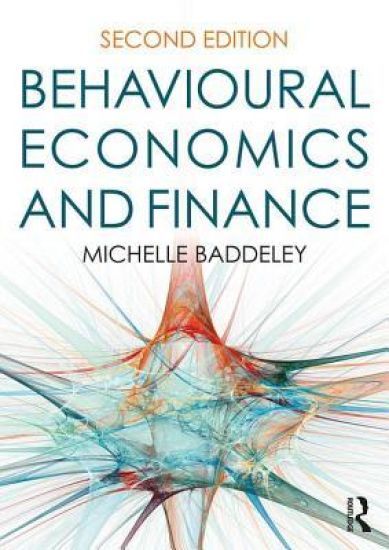
Behavioural Economics and Finance

Behavioural Economics and Finance

Michelle Baddeley

Routledge
2018
sidottu
Behavioural economics and behavioural finance are rapidly expanding fields that are continually growing in prominence. While orthodox economic models are built upon restrictive and simplifying assumptions about rational choice and efficient markets, behavioural economics offers a robust alternative using insights and evidence that rest more easily with our understanding of how real people think, choose and decide. This insightful textbook introduces the key concepts from this rich, interdisciplinary approach to real-world decision-making.This new edition of Behavioural Economics and Finance is a thorough extension of the first edition, including updates to the key chapters on prospect theory; heuristics and bias; time and planning; sociality and identity; bad habits; personality, moods and emotions; behavioural macroeconomics; and well-being and happiness. It also includes a number of new chapters dedicated to the themes of incentives and motivations, behavioural public policy and emotional trading. Using pedagogical features such as chapter summaries and revision questions to enhance reader engagement, this text successfully blends economic theories with cutting-edge multidisciplinary insights.This second edition will be indispensable to anyone interested in how behavioural economics and finance can inform our understanding of consumers’ and businesses’ decisions and choices. It will appeal especially to undergraduate and graduate students but also to academic researchers, public policy-makers and anyone interested in deepening their understanding of how economics, psychology and sociology interact in driving our everyday decision-making.
Behavioural Economics and Finance

Behavioural Economics and Finance

Michelle Baddeley

Routledge
2018
nidottu
Behavioural economics and behavioural finance are rapidly expanding fields that are continually growing in prominence. While orthodox economic models are built upon restrictive and simplifying assumptions about rational choice and efficient markets, behavioural economics offers a robust alternative using insights and evidence that rest more easily with our understanding of how real people think, choose and decide. This insightful textbook introduces the key concepts from this rich, interdisciplinary approach to real-world decision-making.This new edition of Behavioural Economics and Finance is a thorough extension of the first edition, including updates to the key chapters on prospect theory; heuristics and bias; time and planning; sociality and identity; bad habits; personality, moods and emotions; behavioural macroeconomics; and well-being and happiness. It also includes a number of new chapters dedicated to the themes of incentives and motivations, behavioural public policy and emotional trading. Using pedagogical features such as chapter summaries and revision questions to enhance reader engagement, this text successfully blends economic theories with cutting-edge multidisciplinary insights.This second edition will be indispensable to anyone interested in how behavioural economics and finance can inform our understanding of consumers’ and businesses’ decisions and choices. It will appeal especially to undergraduate and graduate students but also to academic researchers, public policy-makers and anyone interested in deepening their understanding of how economics, psychology and sociology interact in driving our everyday decision-making.
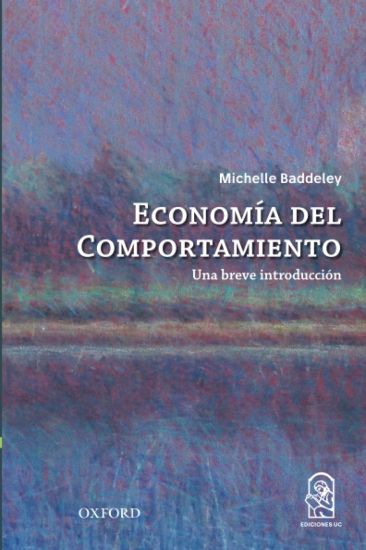
La economía del comportamiento

La economía del comportamiento

Michelle Baddeley

Ediciones Ucsh
2021
nidottu
Este libro introduce el campo de la econom a del comportamiento, analizando las motivaciones que subyacen tras las decisiones econ micas, y muestra su relevancia en nuestras vidas. Su autora explora las razones por las que tomamos decisiones irracionales, c mo decidimos r pidamente, por qu cometemos errores en situaciones riesgosas y nuestra tendencia a la postergaci n y planificaci n a corto plazo. Asimismo, c mo nos vemos afectados por las influencias sociales, la personalidad, el estado de nimo y las emociones. Las implicancias de comprender el fundamento de nuestro comportamiento financiero son enormes. La econom a del comportamiento puede ayudar a los actores pol ticos a comprender a las personas que est n detr s de sus pol ticas, permiti ndoles un dise o m s efectivo y, al mismo tiempo, mejorar su imagen p blica.