Kirjojen hintavertailu. Mukana 12 083 983 kirjaa ja 12 kauppaa.

Kirjahaku

Etsi kirjoja tekijän nimen, kirjan nimen tai ISBN:n perusteella.

28 kirjaa tekijältä Milton Friedman

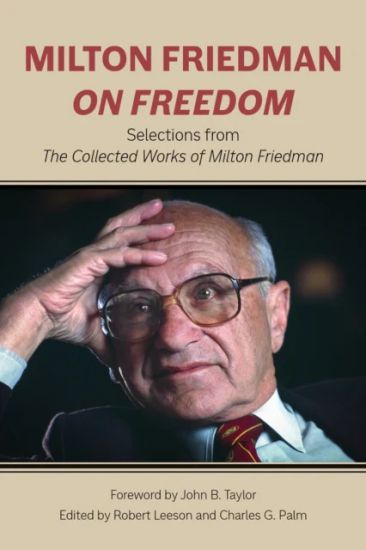
Milton Friedman on Freedom

Milton Friedman on Freedom

Milton Friedman

Hoover Institution Press,U.S.
2024
pokkari
Milton Friedman, recipient of the both the Presidential Medal of Freedom and the Nobel Prize in Economics, was one of the most influential thinkers of his time and among the nation’s most energetic and thoughtful exponents of freedom. This volume of fifteen essays offers a complete picture the economist’s thinking about freedom, the value that formed the moral foundation of his intellectual life.
Keynes, Chicago and Friedman

Keynes, Chicago and Friedman

Milton Friedman

Pickering Chatto (Publishers) Ltd
2003
muu
These two volumes present essays on the subdiscipline of Chicago Monetarism in economics. Some of the issues under dispute can be regarded as resolved, while others are still being debated. The contibutors include Friedman, Patinkin, Harry Johnson and James Tobin.
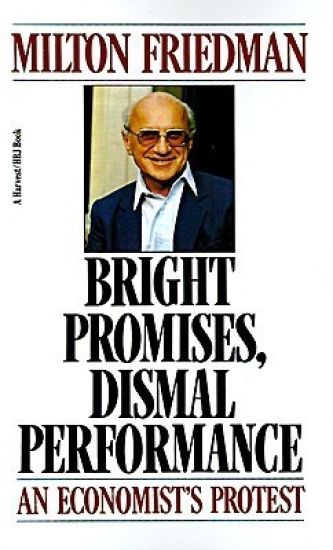
Bright Promises, Dismal Performance

Bright Promises, Dismal Performance

Milton Friedman

CENGAGE LEARNING, INC
1983
pokkari
The noted Nobel Prize-winning economist, Milton Friedman, writes here on current issues of prevailing concern to every American citizen and taxpayer -- including inflation, its causes, and how to arrest it: monetary policy and the disappointing performance of the Federal Reserve Board: the recessions that continue to plague us: and the constraints that are placed upon the workings of a free market.In more than 70 short essays, most of them written for his regular column in Newsweek magazine. Professor Friedman displays the powers of analysis and expression that have made him both the most widely respected economist in America today and a trusted advisor to our nation's leaders.These short commentaries address six major themes, from issues of economic and political freedom, to governmental regulation and fiscal policy, to international economics. They reveal the dynamics behind many of our most pressing current problems, as well as Friedman's affirmation of America's most cherished ideals.
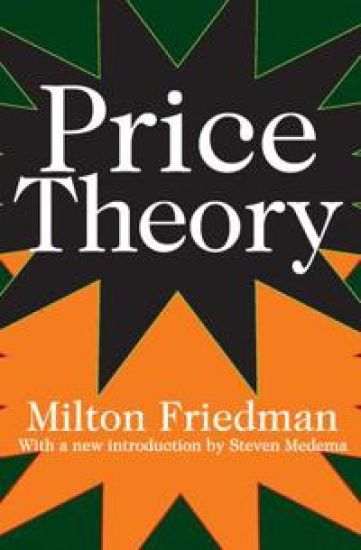
Price Theory

Price Theory

Milton Friedman

AldineTransaction
2007
nidottu
Economics is sometimes divided into two parts: positive economics and normative economics. The former deals with how the economic problem is solved, while the latter deals with how the economic problem should be solved. The effects of price or rent control on the distribution of income are problems of positive economics. The desirability of these effects on income distribution is a problem of normative economics.Within economics, the major division is between monetary theory and price theory. Monetary theory deals with the level of prices in general, with cyclical and other fluctuations in total output, total employment, and the like. Price theory deals with the allocation of resources among different uses, the price of one item relative to another.Prices do three kinds of things. They transmit information, they provide an incentive to users of resources to be guided by this information, and they provide an incentive to owners of resources to follow this information. Milton Friedman's classic book provides the theoretical underpinning for and understanding of prices.Economics is not concerned solely with economic problems. It is a social science, and is therefore concerned primarily with those economic problems whose solutions involve the cooperation and interaction of different individuals. It is concerned with problems involving a single individual only insofar as the individual's behavior has implications for or effects upon other individuals. Price Theory is concerned not with economic problems in the abstract, but with how a particular society solves its economic problems.
Essays in Positive Economics

Essays in Positive Economics

Milton Friedman

University of Chicago Press
1966
nidottu
"Stimulating, provocative, often infuriating, but well worth reading."—Peter Newman, Economica"His critical blast blows like a north wind against the more pretentious erections of modern economics. It is however a healthy and invigorating blast, without malice and with a sincere regard for scientific objectivity."—K.E. Boulding, Political Science Quarterly"Certainly one of the most engrossing volumes that has appeared recently in economic theory."—William J. Baumol, Review of Economics and Statistics
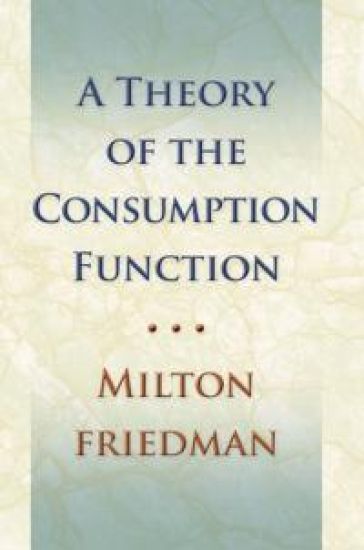
Theory of the Consumption Function

Theory of the Consumption Function

Milton Friedman

Princeton University Press
2008
pokkari
What is the exact nature of the consumption function? Can this term be defined so that it will be consistent with empirical evidence and a valid instrument in the hands of future economic researchers and policy makers? In this volume a distinguished American economist presents a new theory of the consumption function, tests it against extensive statistical J material and suggests some of its significant implications. Central to the new theory is its sharp distinction between two concepts of income, measured income, or that which is recorded for a particular period, and permanent income, a longer-period concept in terms of which consumers decide how much to spend and how much to save. Milton Friedman suggests that the total amount spent on consumption is on the average the same fraction of permanent income, regardless of the size of permanent income. The magnitude of the fraction depends on variables such as interest rate, degree of uncertainty relating to occupation, ratio of wealth to income, family size, and so on. The hypothesis is shown to be consistent with budget studies and time series data, and some of its far-reaching implications are explored in the final chapter.
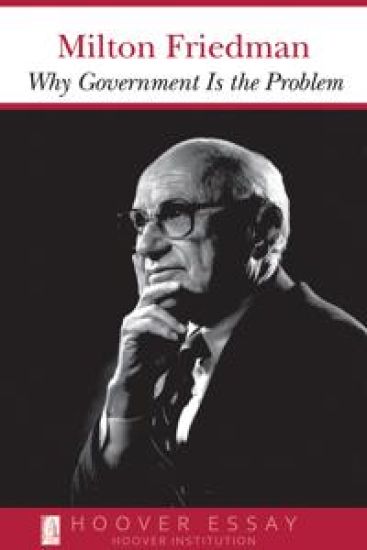
Why Government Is the Problem

Why Government Is the Problem

Milton Friedman

Hoover Institution Press,U.S.
1993
pokkari
The major social problems of the United States—deteriorating education, lawlessness and crime, homelessness, the collapse of family values, the crisis in medical care—have been produced by well-intended actions of government. That is easy to document. The difficult task is understanding why government is the problem. The power of special interests arising from the concentrated benefits of most government actions and their dispersed costs is only part of the answer. A more fundamental part is the difference between the self-interest of individuals when they are engaged in the private sector and the self-interest of the same individuals when they are engaged in the government sector. The result is a government system that is no longer controlled by "we, the people." Instead of Lincoln's government "of the people, by the people, and for the people," we now have a government "of the people, by the bureaucrats, for the bureaucrats," including the elected representatives who have become bureaucrats. At the moment, term limits apear to be the reform that promises to be most effective in curbing Leviathan.
A Program for Monetary Stability

A Program for Monetary Stability

Milton Friedman

Fordham University Press
1983
pokkari
"[T]he only really sure way to beat inflation is to cut off inflation at the root. . . Milton Friedman [presents his strategy against] inflation in his penetrating . . . book . . . This is controversial stuff, and Professor Friedman . . . doesn't blanch at what he feels is his call of duty. And many a banker will just see red . . . [This book] can be recommended for a good look at the real roots of inflation—the look that thus far has not been widespread enough, among enough people."—The Wall Street Journal
Price Theory

Price Theory

Milton Friedman

Routledge
2017
sidottu
Economics is sometimes divided into two parts: positive economics and normative economics. The former deals with how the economic problem is solved, while the latter deals with how the economic problem should be solved. The effects of price or rent control on the distribution of income are problems of positive economics. The desirability of these effects on income distribution is a problem of normative economics.Within economics, the major division is between monetary theory and price theory. Monetary theory deals with the level of prices in general, with cyclical and other fluctuations in total output, total employment, and the like. Price theory deals with the allocation of resources among different uses, the price of one item relative to another.Prices do three kinds of things. They transmit information, they provide an incentive to users of resources to be guided by this information, and they provide an incentive to owners of resources to follow this information. Milton Friedman's classic book provides the theoretical underpinning for and understanding of prices.Economics is not concerned solely with economic problems. It is a social science, and is therefore concerned primarily with those economic problems whose solutions involve the cooperation and interaction of different individuals. It is concerned with problems involving a single individual only insofar as the individual's behavior has implications for or effects upon other individuals. Price Theory is concerned not with economic problems in the abstract, but with how a particular society solves its economic problems.
A Theory of the Consumption Function

A Theory of the Consumption Function

Milton Friedman

Literary Licensing, LLC
2011
sidottu
A Theory of the Consumption Function is a seminal work of economic theory by Nobel laureate Milton Friedman. In this book, Friedman presents his theory of how individuals and households make decisions about consumption, and how these decisions affect the overall economy. Friedman argues that consumption is determined primarily by individuals' permanent income, rather than their current income. Permanent income is the income that individuals expect to earn over their lifetime, and it is influenced by a variety of factors including education, skills, and family background. Friedman also introduces the concept of the marginal propensity to consume (MPC), which measures the proportion of additional income that is spent on consumption. He argues that the MPC is higher for individuals with lower permanent income, as they are more likely to spend any additional income they receive. Throughout the book, Friedman provides empirical evidence to support his theory, drawing on data from a range of sources including surveys and national income accounts. He also discusses the implications of his theory for government policy, arguing that policies aimed at stimulating consumption are less effective than policies aimed at increasing permanent income. Overall, A Theory of the Consumption Function is a highly influential work that has had a significant impact on economic theory and policy. It remains an important reference for economists and policymakers interested in understanding the determinants of consumption and their implications for the broader economy.This scarce antiquarian book is a facsimile reprint of the old original and may contain some imperfections such as library marks and notations. Because we believe this work is culturally important, we have made it available as part of our commitment for protecting, preserving, and promoting the world's literature in affordable, high quality, modern editions, that are true to their original work.
The Interpolation of Time Series by Related Series

The Interpolation of Time Series by Related Series

Milton Friedman

Literary Licensing, LLC
2011
sidottu
The book ""The Interpolation of Time Series by Related Series"" by Milton Friedman is a comprehensive guide to the mathematical techniques used in time series analysis. The book covers topics such as interpolation, regression, and correlation, as well as more advanced topics like spectral analysis and autoregression. The author explains how these techniques can be used to analyze and predict trends in time series data, and provides numerous examples and case studies to illustrate their practical applications. The book is aimed at advanced students and professionals in the fields of economics, statistics, and finance, but is also accessible to anyone with a basic understanding of mathematical concepts. Overall, ""The Interpolation of Time Series by Related Series"" is an invaluable resource for anyone interested in understanding and analyzing time series data.This scarce antiquarian book is a facsimile reprint of the old original and may contain some imperfections such as library marks and notations. Because we believe this work is culturally important, we have made it available as part of our commitment for protecting, preserving, and promoting the world's literature in affordable, high quality, modern editions, that are true to their original work.
Price Theory: A Provisional Text

Price Theory: A Provisional Text

Milton Friedman

Literary Licensing, LLC
2013
sidottu
Price Theory: A Provisional Text is a book written by the renowned economist Milton Friedman. The book is a comprehensive guide to the principles of microeconomics and price theory. The book is designed to provide students with a clear understanding of the concepts and principles of economics.The book covers a wide range of topics, including demand and supply, consumer behavior, production, market structure, and pricing. The author uses a combination of theoretical analysis and real-world examples to explain the concepts and principles of economics.The book is written in a clear and concise manner, making it easy for students to understand complex economic concepts. The author also includes numerous exercises and examples to help students apply the principles of economics to real-world situations.Overall, Price Theory: A Provisional Text is an excellent resource for students of economics who want to gain a deep understanding of microeconomics and price theory. The book is suitable for both undergraduate and graduate students and is an essential read for anyone interested in economics.This is a new release of the original 1962 edition.This scarce antiquarian book is a facsimile reprint of the old original and may contain some imperfections such as library marks and notations. Because we believe this work is culturally important, we have made it available as part of our commitment for protecting, preserving, and promoting the world's literature in affordable, high quality, modern editions, that are true to their original work.

The Demand for Money: Some Theoretical and Empirical Results
""The Demand for Money: Some Theoretical and Empirical Results"" is a book written by Nobel Prize-winning economist Milton Friedman. The book explores the concept of the demand for money and its role in the economy. Friedman argues that the demand for money is not simply a matter of convenience or preference, but rather a key factor in determining economic activity. He presents both theoretical and empirical evidence to support his argument, drawing on a range of data from different countries and time periods. The book is aimed at economists, policymakers, and anyone interested in understanding the workings of the economy. It is considered a classic in the field of monetary economics and has had a significant impact on economic theory and policy.This is a new release of the original 1959 edition.This scarce antiquarian book is a facsimile reprint of the old original and may contain some imperfections such as library marks and notations. Because we believe this work is culturally important, we have made it available as part of our commitment for protecting, preserving, and promoting the world's literature in affordable, high quality, modern editions, that are true to their original work.