Kirjojen hintavertailu. Mukana 11 244 527 kirjaa ja 12 kauppaa.

Kirjahaku

Etsi kirjoja tekijän nimen, kirjan nimen tai ISBN:n perusteella.

62 kirjaa tekijältä Moses Mendelssohn

Moses Mendelssohn: Philosophical Writings

Moses Mendelssohn: Philosophical Writings

Moses Mendelssohn

Cambridge University Press
1997
sidottu
Mendelssohn’s Philosophical Writings, published in 1761, bring the metaphysical tradition to bear on the topic of ‘sentiments’ (defined as knowledge or awareness by way of the senses). Mendelssohn offers a nuanced defence of Leibniz’s theodicy and conception of freedom, an examination of the ethics of suicide, an account of the ‘mixed sentiments’ so central to the tragic genre, a hypothesis about weakness of will, an elaboration of the main principles and types of art, a definition of sublimity and analysis of its basic forms, and, lastly, a brief tract on probability theory, aimed at rebutting Hume’s scepticism. This volume also includes the essay ‘On Evidence in Metaphysical Sciences’, selected in 1763 by the Berlin Royal Academy of Sciences over all other submitted essays, including one by Kant, as the best answer to the question of whether metaphysical sciences are capable of the same sort and degree of evidence as mathematics.
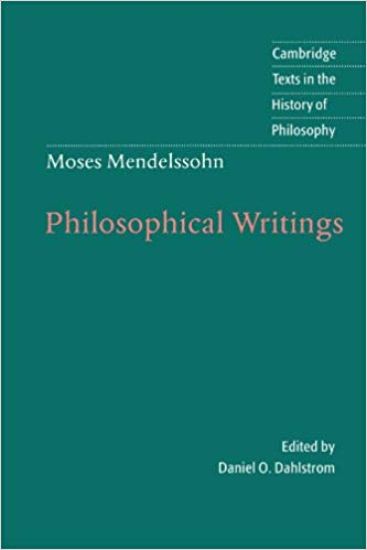
Moses Mendelssohn: Philosophical Writings

Moses Mendelssohn: Philosophical Writings

Moses Mendelssohn

Cambridge University Press
1997
pokkari
Mendelssohn’s Philosophical Writings, published in 1761, bring the metaphysical tradition to bear on the topic of ‘sentiments’ (defined as knowledge or awareness by way of the senses). Mendelssohn offers a nuanced defence of Leibniz’s theodicy and conception of freedom, an examination of the ethics of suicide, an account of the ‘mixed sentiments’ so central to the tragic genre, a hypothesis about weakness of will, an elaboration of the main principles and types of art, a definition of sublimity and analysis of its basic forms, and, lastly, a brief tract on probability theory, aimed at rebutting Hume’s scepticism. This volume also includes the essay ‘On Evidence in Metaphysical Sciences’, selected in 1763 by the Berlin Royal Academy of Sciences over all other submitted essays, including one by Kant, as the best answer to the question of whether metaphysical sciences are capable of the same sort and degree of evidence as mathematics.
Phædon; or, the Death of Socrates. By Moses Mendelssohn, ... Translated From the German
The 18th century was a wealth of knowledge, exploration and rapidly growing technology and expanding record-keeping made possible by advances in the printing press. In its determination to preserve the century of revolution, Gale initiated a revolution of its own: digitization of epic proportions to preserve these invaluable works in the largest archive of its kind. Now for the first time these high-quality digital copies of original 18th century manuscripts are available in print, making them highly accessible to libraries, undergraduate students, and independent scholars.The Age of Enlightenment profoundly enriched religious and philosophical understanding and continues to influence present-day thinking. Works collected here include masterpieces by David Hume, Immanuel Kant, and Jean-Jacques Rousseau, as well as religious sermons and moral debates on the issues of the day, such as the slave trade. The Age of Reason saw conflict between Protestantism and Catholicism transformed into one between faith and logic -- a debate that continues in the twenty-first century.++++The below data was compiled from various identification fields in the bibliographic record of this title. This data is provided as an additional tool in helping to insure edition identification: ++++British LibraryT106920Translated by Charles Cullen. With a half-title.London: printed for the author, by J. Cooper, 1789. viii, lix, 1]
Phædon; or, the Death of Socrates. By Moses Mendelssohn, ... Translated From the German
The 18th century was a wealth of knowledge, exploration and rapidly growing technology and expanding record-keeping made possible by advances in the printing press. In its determination to preserve the century of revolution, Gale initiated a revolution of its own: digitization of epic proportions to preserve these invaluable works in the largest archive of its kind. Now for the first time these high-quality digital copies of original 18th century manuscripts are available in print, making them highly accessible to libraries, undergraduate students, and independent scholars.The Age of Enlightenment profoundly enriched religious and philosophical understanding and continues to influence present-day thinking. Works collected here include masterpieces by David Hume, Immanuel Kant, and Jean-Jacques Rousseau, as well as religious sermons and moral debates on the issues of the day, such as the slave trade. The Age of Reason saw conflict between Protestantism and Catholicism transformed into one between faith and logic -- a debate that continues in the twenty-first century.++++The below data was compiled from various identification fields in the bibliographic record of this title. This data is provided as an additional tool in helping to insure edition identification: ++++Cambridge University LibraryN054707Translated by Charles Cullen. With a half-title. In this issue, p.lx is numbered.London: printed for the author, by J. Cooper, 1789. viii, lx,212p.; 8
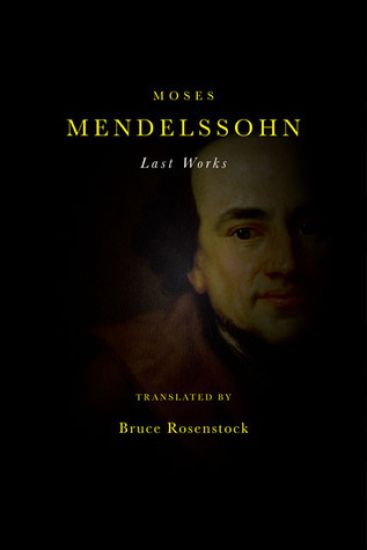
Last Works

Last Works

Moses Mendelssohn

University of Illinois Press
2012
sidottu
Moses Mendelssohn (1729–1786) was the central figure in the emancipation of European Jewry. His intellect, judgment, and tact won the admiration and friendship of contemporaries as illustrious as Johann Gottfried Herder, Gotthold Ephraim Lessing, and Immanuel Kant. His enormously influential Jerusalem (1783) made the case for religious tolerance, a cause he worked for all his life. Last Works includes, for the first time complete and in a single volume, the English translation of Morning Hours: Lectures on the Existence of God (1785) and To the Friends of Lessing (1786). Bruce Rosenstock has also provided an historical introduction and an extensive philosophical commentary to both texts. At the center of Mendelssohn's last works is his friendship with Lessing. Mendelssohn hoped to show that he, a Torah-observant Jew, and Lessing, Germany's leading dramatist, had forged a life-long friendship that held out the promise of a tolerant and enlightened culture in which religious strife would be a thing of the past. Lessing's death in 1781 was a severe blow to Mendelssohn. Mendelssohn wrote his last two works to commemorate Lessing and to carry on the work to which they had dedicated much of their lives. Morning Hours treats a range of major philosophical topics: the nature of truth, the foundations of human knowledge, the basis of our moral and aesthetic powers of judgment, the reality of the external world, and the grounds for a rational faith in a providential deity. It is also a key text for Mendelssohn's readings of Spinoza. In To the Friends of Lessing, Mendelssohn attempts to unmask the individual whom he believes to be the real enemy of the enlightened state: the Schwärmer, the religious fanatic who rejects reason in favor of belief in suprarational revelation.
Phaedon, or On the Immortality of the Soul

Phaedon, or On the Immortality of the Soul

Moses Mendelssohn

Peter Lang Publishing Inc
2006
nidottu
This is the first modern translation of Moses Mendelssohn's classic work of 1767, the Ph don. It includes Mendelssohn's own introduction and appendix, as well as footnotes and explanatory introduction by David Shavin. (Charles Cullen's translation of 1789 is the only other extant translation.) The modern Socrates of the German classical period, Mendelssohn has created a beautiful translation and elaboration of Plato's Ph do led to a revolution in thought, and a subsequent renaissance in Germany. The debt of the German classical period to ancient Greece is embodied in Mendelssohn's Ph don, as is the promise of the American Revolution. The translation and accompanying notes recapture Mendelssohn's unique marriage of depth of thought and breadth of appeal.
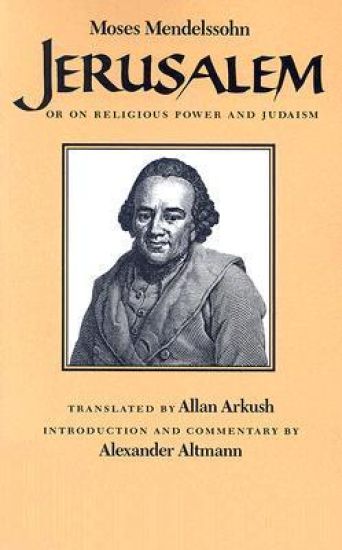
Jerusalem

Jerusalem

Moses Mendelssohn

Dartmouth College Press
1983
nidottu
A classic text of enduring significance, Moses Mendelssohn's Jerusalem (1783) stands as a powerful plea for the separation of church and state and also as the first attempt to present Judaism as a religion eminently compatible with the ideas of the Enlightenment. Allan Arkush's new translation, drawing upon the great strides made by Mendelssohn research in recent decades, does full justice to contemporary insights into the subject while authentically reflecting a distinguished eighteenth-century text. Alexander Altmann's learned introduction opens up the complex structure and background of Mendelssohn's ideas. His detailed commentary, keyed to the text, provides references to literary sources and interpretations of the philosopher's intent.
Philosophische Gespräche / Betrachtungen über die Quellen und die Verbindungen der schönen Künste und Wissenschaften
Moses Mendelssohn: Philosophische Gespr che / Betrachtungen ber die Quellen und die Verbindungen der sch nen K nste und Wissenschaften Edition Holzinger. Taschenbuch Berliner Ausgabe, 2013 Vollst ndiger, durchgesehener Neusatz mit einer Biographie des Autors bearbeitet und eingerichtet von Michael Holzinger Philosophische Gespr che: Erstdruck: Berlin (Christian Friedrich Vo ) 1755. Betrachtungen ber die Quellen und die Verbindungen der sch nen K nste und Wissenschaften: Erstdruck in: Bibliothek der sch nen Wissenschaften und der freyen K nste (Leipzig), 1. Band, 2. St ck 1757, S. 231-268. Textgrundlage ist die Ausgabe: Moses Mendelssohn. Gesammelte Schriften. Jubil umsausgabe. In Gemeinschaft mit F. Bamberger, H. Borodianski, S. Rawidowicz, B. Strauss, L. Strauss herausgegeben von I. Elbogen, J. Guttmann, E. Mittwoch. Fortgesetzt von Alexander Altmann, Berlin: Akademie-Verlag, 1929 ff. ab 1974: Stuttgart - Bad Cannstatt: Friedrich Frommann Verlag (G nther Holzboog)]. Herausgeber der Reihe: Michael Holzinger Reihengestaltung: Viktor Harvion Umschlaggestaltung unter Verwendung des Bildes: Moses Mendelssohn (1771, Portr t von Anton Graff, Kunstbesitz der Universit t Leipzig) Gesetzt aus Minion Pro, 10 pt