Kirjojen hintavertailu. Mukana 11 342 296 kirjaa ja 12 kauppaa.

Kirjahaku

Etsi kirjoja tekijän nimen, kirjan nimen tai ISBN:n perusteella.

4 kirjaa tekijältä N. J. Allen

Arjuna–Odysseus

Arjuna–Odysseus

N. J. Allen

Routledge India
2019
sidottu
Bringing together the study of the Greek classics and Indology, Arjuna–Odysseus provides a comparative analysis of the shared heritage of the Mahabharata and early Greek traditions presented in the texts of Homer and Hesiod. Building on the ethnographic theories of Durkheim, Mauss, and Dumont, the volume explores the convergences and rapprochements between the Mahabharata and the Greek texts. In exploring the networks of similarities between the two epic traditions, it also reformulates the theory of Georges Dumézil regarding Indo-European cultural comparativism. It includes a detailed comparison between journeys undertaken by the two epic heroes – Odysseus and Arjuna – and more generally, it ranges across the philosophical ideas of these cultures, and the epic traditions, metaphors, and archetypes that define the cultural ideology of ancient Greece and India. This book will be useful to scholars and researchers of Indo-European comparativism, social and cultural anthropology, classical literature, Indology, cultural and post-colonial studies, philosophy and religion, as well as to those who love the Indian and Greek epics.
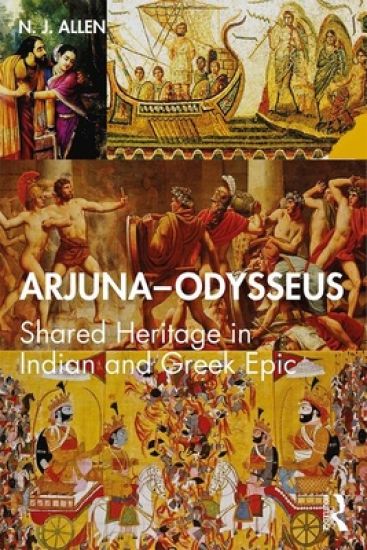
Arjuna–Odysseus

Arjuna–Odysseus

N. J. Allen

Routledge India
2019
nidottu
Bringing together the study of the Greek classics and Indology, Arjuna–Odysseus provides a comparative analysis of the shared heritage of the Mahabharata and early Greek traditions presented in the texts of Homer and Hesiod. Building on the ethnographic theories of Durkheim, Mauss, and Dumont, the volume explores the convergences and rapprochements between the Mahabharata and the Greek texts. In exploring the networks of similarities between the two epic traditions, it also reformulates the theory of Georges Dumézil regarding Indo-European cultural comparativism. It includes a detailed comparison between journeys undertaken by the two epic heroes – Odysseus and Arjuna – and more generally, it ranges across the philosophical ideas of these cultures, and the epic traditions, metaphors, and archetypes that define the cultural ideology of ancient Greece and India. This book will be useful to scholars and researchers of Indo-European comparativism, social and cultural anthropology, classical literature, Indology, cultural and post-colonial studies, philosophy and religion, as well as to those who love the Indian and Greek epics.
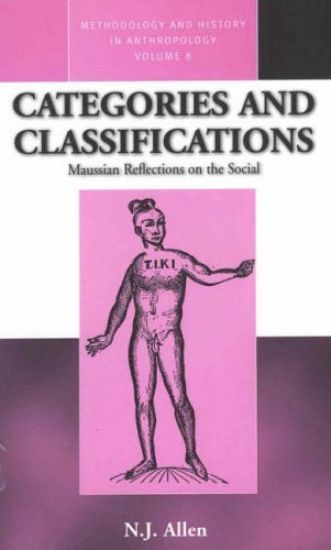
Categories and Classifications

Categories and Classifications

N. J. Allen

Berghahn Books, Incorporated
2001
sidottu
Marcel Mauss (1872-1950), Durkheim's nephew, was a key figure among Durkheimians and helped to found the distinctive French tradition in the social sciences at the start of the 20th century. He dominated the teaching of social anthropology in Paris between the Wars, and his Essay on the Gift (1925) is a well established classic. However, it is only recently that the breadth and freshness of his oeuvre as a whole is being reassessed and is gaining wider appreciation. Having found inspiration in Mauss's texts for over twenty years, the author here explores not only what he thought but also how his ideas can be developed and applied in new ways. Thus Durkheim and Mauss's notion of "primitive classification," often misunderstood, is well exemplified by Indo-European ideology as analysed by Georges Dumezil and current comparativists, and it is argued that this ancient ideology influenced the Durkheimian classification of "social facts." Mauss's reflections on kinship and social aggregation point us towards aspects of proto-human societies that are underemphasized by contemporary palaeoanthropology, and his vision of world history in terms of emic categories - fundamental ideas such as person, space, totality, substance - casts new light on much we take for granted, as well as on The Gift. Mauss specialized in religion, and his treatment of the rubric goes beyond his uncle's unitary definition in terms of the sacred. In assembling and presenting his essays on this intellectual giant, the author tries both to convey the range and quality of Mauss's mind and to take further his scattered and partial insights.
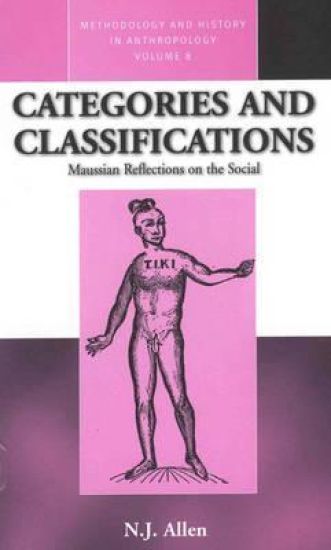
Categories and Classifications

Categories and Classifications

N. J. Allen

Berghahn Books, Incorporated
2000
pokkari
Marcel Mauss (1872-1950), Durkheim's nephew, was a key figure among Durkheimians and helped to found the distinctive French tradition in the social sciences at the start of the 20th century. He dominated the teaching of social anthropology in Paris between the Wars, and his Essay on the Gift (1925) is a well established classic. However, it is only recently that the breadth and freshness of his oeuvre as a whole is being reassessed and is gaining wider appreciation. Having found inspiration in Mauss's texts for over twenty years, the author here explores not only what he thought but also how his ideas can be developed and applied in new ways. Thus Durkheim and Mauss's notion of "primitive classification," often misunderstood, is well exemplified by Indo-European ideology as analysed by Georges Dumezil and current comparativists, and it is argued that this ancient ideology influenced the Durkheimian classification of "social facts." Mauss's reflections on kinship and social aggregation point us towards aspects of proto-human societies that are underemphasized by contemporary palaeoanthropology, and his vision of world history in terms of emic categories - fundamental ideas such as person, space, totality, substance - casts new light on much we take for granted, as well as on The Gift. Mauss specialized in religion, and his treatment of the rubric goes beyond his uncle's unitary definition in terms of the sacred. In assembling and presenting his essays on this intellectual giant, the author tries both to convey the range and quality of Mauss's mind and to take further his scattered and partial insights.