Kirjojen hintavertailu. Mukana 11 699 587 kirjaa ja 12 kauppaa.

Kirjahaku

Etsi kirjoja tekijän nimen, kirjan nimen tai ISBN:n perusteella.

9 kirjaa tekijältä Natalie L. M. Petesch

Duncan's Colony

Duncan's Colony

Natalie L. M. Petesch

Swallow Press
1982
sidottu
“During the nineteen sixties, following the missile crisis and during the Vietnam War, communitarian societies began to reappear in the United States. Those who were of an invincibly optimistic nature gathered together in agrarian or utopian communes reminiscent of the nineteenth century. Others who believed that these crises and wars augured the end of modern civilization by nuclear warfare, gathered together for a brief season of love in colonies where they hoped to survive the destruction of the world. This is the story of eight people who lived together for nearly a year in such a colony: Duncan's Colony…" - From the Introduction Duncan's Colony is the story of four men and four women, strangers who have joined together, in the desert of the American Southwest, in the hope of surviving a nuclear holocaust they fear is inevitable. Though they have come together to survive the world's destruction, they seem to be dying, one by one, picked off by their emotions. And so, as they rehearse the death of the planet, the colonist learn also the rage to live.
Duncan's Colony

Duncan's Colony

Natalie L. M. Petesch

Swallow Press
1982
pokkari
“During the nineteen sixties, following the missile crisis and during the Vietnam War, communitarian societies began to reappear in the United States. Those who were of an invincibly optimistic nature gathered together in agrarian or utopian communes reminiscent of the nineteenth century. Others who believed that these crises and wars augured the end of modern civilization by nuclear warfare, gathered together for a brief season of love in colonies where they hoped to survive the destruction of the world. This is the story of eight people who lived together for nearly a year in such a colony: Duncan's Colony…" - From the Introduction Duncan's Colony is the story of four men and four women, strangers who have joined together, in the desert of the American Southwest, in the hope of surviving a nuclear holocaust they fear is inevitable. Though they have come together to survive the world's destruction, they seem to be dying, one by one, picked off by their emotions. And so, as they rehearse the death of the planet, the colonist learn also the rage to live.
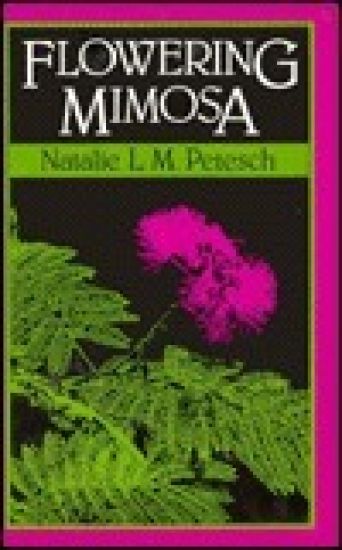
Flowering Mimosa

Flowering Mimosa

Natalie L. M. Petesch

Swallow Press
1987
sidottu
Flowering Mimosa is a story of lost innocence and coming of age among the disinherited of America in the 1980s. Against a backdrop of social and economic disruption in the American southwest, Petesch traces the fates of the Wingfield family, who have lost their Texas farm and moved to a mining town in Silver Valley, Idaho. As various tensions threaten to break the family apart, Tamsen Wingfield reacts most strongly. She cannot accept her new stepmother, married too soon after her mother's death. She cannot accept the new life of her father--once a strong, confident Texas farmer, now a lead miner working miles below the surface in a strange territory her high school textbooks cannot explain. Her flight from family and country is both an illusory attempt to recapture her youth and a courageous act of survival. Flowering Mimosa has the scope of all truly great fiction, combining a sense of history with a vision of the future. Petesch's acute sense of place and detail bring the small towns of Silver Valley (Idaho), of Texas, and of central Mexico alive, and her strong lyric gifts create, especially in Tamsen and her precarious escape with a lover, perhaps the most memorable of what the Chicago Sun-Times has called “her Steinbeck-like children.” In Tamsen, Petesch dramatizes those political and social concerns which led the Times Literary Supplement to comment, “what is impressive is Petesch's ability … to give a sense of what it was like, how it felt, to be an American … .”
Flowering Mimosa

Flowering Mimosa

Natalie L. M. Petesch

Swallow Press
1987
pokkari
Flowering Mimosa is a story of lost innocence and coming of age among the disinherited of America in the 1980s. Against a backdrop of social and economic disruption in the American southwest, Petesch traces the fates of the Wingfield family, who have lost their Texas farm and moved to a mining town in Silver Valley, Idaho. As various tensions threaten to break the family apart, Tamsen Wingfield reacts most strongly. She cannot accept her new stepmother, married too soon after her mother's death. She cannot accept the new life of her father--once a strong, confident Texas farmer, now a lead miner working miles below the surface in a strange territory her high school textbooks cannot explain. Her flight from family and country is both an illusory attempt to recapture her youth and a courageous act of survival. Flowering Mimosa has the scope of all truly great fiction, combining a sense of history with a vision of the future. Petesch's acute sense of place and detail bring the small towns of Silver Valley (Idaho), of Texas, and of central Mexico alive, and her strong lyric gifts create, especially in Tamsen and her precarious escape with a lover, perhaps the most memorable of what the Chicago Sun-Times has called “her Steinbeck-like children.” In Tamsen, Petesch dramatizes those political and social concerns which led the Times Literary Supplement to comment, “what is impressive is Petesch's ability … to give a sense of what it was like, how it felt, to be an American … .”
Justina of Andalusia and Other Stories

Justina of Andalusia and Other Stories

Natalie L. M. Petesch

Swallow Press
1991
sidottu
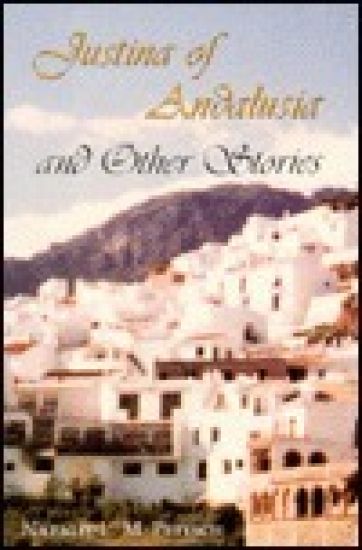
This collection of stories is, like Petesch’s previous work, distinguished by its brilliant lyrical intensity and by characters who are stunningly alive. It is a powerful collection about impassioned cultural conflicts in present-day Spain and Mexico; it is also a book about ourselves—how we have failed to love the Earth and have squandered our resources. In the title story, it is Justina Olivia who breaks the moral law of her village in an unforgettable love story. In “Senior Coloma’s Class,” a mother of grown children learns to read, and learns, too, that the Tree of Knowledge bears unpredictable fruit. In a story set in Monterrey, Mexico, Dr. Melindez Gutierrez dedicates his life to the barrios of the poor, while in another story also set in Monterrey, “Manolo’s Secret,” an Indian street beggar shares her life with a young immigrant from Spain. These remarkable characters can only add to Petesch’s wide reputation not only for creating people out of pathos and courage, but also for a prose style throughout that is luminous and captivating. Justina of Andalusia and Other Stories is well suited to American literature classes, to Women’s Studies courses, Latin American Studies programs, and to American Studies programs in the United States and abroad. It would be particularly useful as a text in cross-cultural programs.
The Immigrant Train

The Immigrant Train

Natalie L. M. Petesch

Swallow Press
1996
sidottu
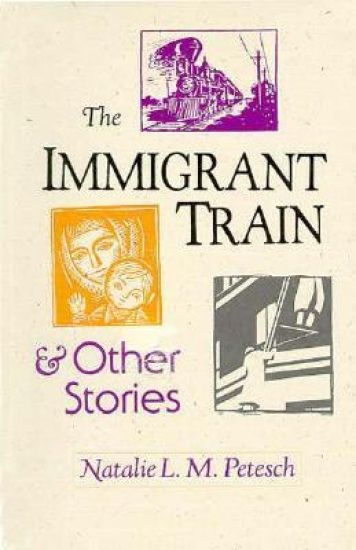
In this short story collection, acclaimed author Natalie Petesch reaffirms for us our enduring debt to millions of immigrants who helped build America. Inspired by her own parents' journey at the turn of the century, Petesch spins these tales of immigration in a spare and lyrical prose that assures our involvement: a political fugitive threatened with imprisonment reaches a long-sought mining town in Minnesota; as Polish immigrant Witold Dobrynski realizes his dream of owning a farm in Texas, a spiritual crisis changes his life; fourteen-year-old Stasio Wolski quickly becomes a man in the underworld of a big city but is haunted by the loss of his Polish identity: a beekeeping bachelor's pre-occupation with the social life of the hive is seamlessly interwoven with the colorful tapestry of early twentieth-century Pittsburgh. This visionary collection sustains Petesch's well-established reputation as one of the country's finest writers.
The Immigrant Train

The Immigrant Train

Natalie L. M. Petesch

Swallow Press
1996
pokkari
In this short story collection, acclaimed author Natalie Petesch reaffirms for us our enduring debt to millions of immigrants who helped build America. Inspired by her own parents' journey at the turn of the century, Petesch spins these tales of immigration in a spare and lyrical prose that assures our involvement: a political fugitive threatened with imprisonment reaches a long-sought mining town in Minnesota; as Polish immigrant Witold Dobrynski realizes his dream of owning a farm in Texas, a spiritual crisis changes his life; fourteen-year-old Stasio Wolski quickly becomes a man in the underworld of a big city but is haunted by the loss of his Polish identity: a beekeeping bachelor's pre-occupation with the social life of the hive is seamlessly interwoven with the colorful tapestry of early twentieth-century Pittsburgh. This visionary collection sustains Petesch's well-established reputation as one of the country's finest writers.
The Confessions of Señora Francesca Navarro and Other Stories
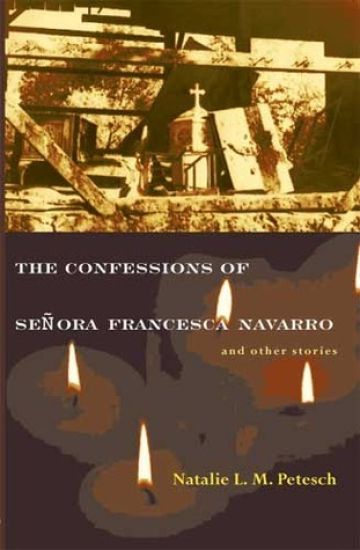
"Memory, of course, is sometimes like a bucking horse, sometimes a runaway one, and one must control the reins until finally it stops, snorting with exhausted relief," writes Natalie L. M. Petesch in her haunting new collection, The Confessions of Señora Francesca Navarro and Other Stories. Petesch immerses readers in the lives of people caught up in the 1936–39 Spanish Civil War, which left more than five hundred thousand dead. She captures the hand-to-mouth existence on the streets of Madrid of two war orphans; an old soldier's memories of a fallen militiawoman; the dilemma of Franco's laundress as she seeks to duplicate a stolen religious icon she finds in his home; and a man's struggle to find his bride among thousands of Republican refugees waiting for ships to evacuate them before Franco's Fascists arrive to kill them. In the title novella, an elderly woman describes to her granddaughter how the families of Franco's officers fighting against Republican militiamen endured hunger, filth, and danger in an underground fortress. Petesch conveys the humiliating details of war through the sensibility of a cultured woman who recalls only too vividly latrines made of laundry tubs, the smell of unwashed humans, and the stench of death. Brilliant in its imaginative power and heartbreaking in its access to the bottomless well of human tears, The Confessions of Señora Francesca Navarro and Other Stories is the work of a mature artist able to convey a particular world so vividly that we know these people as our own.
The Confessions of Señora Francesca Navarro and Other Stories
"Memory, of course, is sometimes like a bucking horse, sometimes a runaway one, and one must control the reins until finally it stops, snorting with exhausted relief," writes Natalie L. M. Petesch in her haunting new collection, The Confessions of Señora Francesca Navarro and Other Stories. Petesch immerses readers in the lives of people caught up in the 1936–39 Spanish Civil War, which left more than five hundred thousand dead. She captures the hand-to-mouth existence on the streets of Madrid of two war orphans; an old soldier's memories of a fallen militiawoman; the dilemma of Franco's laundress as she seeks to duplicate a stolen religious icon she finds in his home; and a man's struggle to find his bride among thousands of Republican refugees waiting for ships to evacuate them before Franco's Fascists arrive to kill them. In the title novella, an elderly woman describes to her granddaughter how the families of Franco's officers fighting against Republican militiamen endured hunger, filth, and danger in an underground fortress. Petesch conveys the humiliating details of war through the sensibility of a cultured woman who recalls only too vividly latrines made of laundry tubs, the smell of unwashed humans, and the stench of death. Brilliant in its imaginative power and heartbreaking in its access to the bottomless well of human tears, The Confessions of Señora Francesca Navarro and Other Stories is the work of a mature artist able to convey a particular world so vividly that we know these people as our own.