Kirjojen hintavertailu. Mukana 11 244 527 kirjaa ja 12 kauppaa.

Kirjahaku

Etsi kirjoja tekijän nimen, kirjan nimen tai ISBN:n perusteella.

7 kirjaa tekijältä Nathan Ross

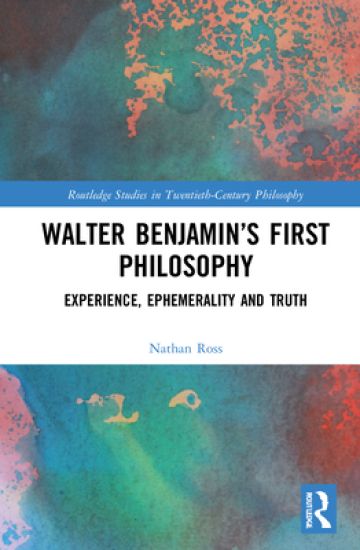
Walter Benjamin’s First Philosophy
This book provides a study of Walter Benjamin’s first philosophy in two senses: it focuses on his early philosophy as a source of insight into his later works, and it explores his thinking about the nature of truth, method, experience, the relation of body and mind, and the limits of human knowledge.While most attention is paid to Benjamin’s later works, his writings from roughly 1914-1925 explore philosophical themes and develop a critical method. This book argues that this early work founds a series of original and lasting questions and insights. Benjamin understands experience as a broken continuum of diverse forms of spiritual expression, each of which is ephemeral. This leads Benjamin to a series of thought figures: the notion of language as a medium of experience; a philosophy of perception based in the natural history of the human body; an emphasis on mimesis as a faculty of creative assimilation; and a discovery of memory as a power for excavation of meaning in past experience. This book demonstrates that the need for a new understanding of the metaphysical structure of experience, as well as a new conception of truth, play a special role in shaping Benjamin’s subsequent work.Walter Benjamin’s First Philosophy will be of interest to scholars and advanced students working on the thought of Walter Benjamin, 20th-century Continental philosophy, comparative literature, and modern German thought.
Walter Benjamin’s First Philosophy

Walter Benjamin’s First Philosophy

Nathan Ross

TAYLOR FRANCIS LTD
2023
nidottu
This book provides a study of Walter Benjamin’s first philosophy in two senses: it focuses on his early philosophy as a source of insight into his later works, and it explores his thinking about the nature of truth, method, experience, the relation of body and mind, and the limits of human knowledge.While most attention is paid to Benjamin’s later works, his writings from roughly 1914-1925 explore philosophical themes and develop a critical method. This book argues that this early work founds a series of original and lasting questions and insights. Benjamin understands experience as a broken continuum of diverse forms of spiritual expression, each of which is ephemeral. This leads Benjamin to a series of thought figures: the notion of language as a medium of experience; a philosophy of perception based in the natural history of the human body; an emphasis on mimesis as a faculty of creative assimilation; and a discovery of memory as a power for excavation of meaning in past experience. This book demonstrates that the need for a new understanding of the metaphysical structure of experience, as well as a new conception of truth, play a special role in shaping Benjamin’s subsequent work.Walter Benjamin’s First Philosophy will be of interest to scholars and advanced students working on the thought of Walter Benjamin, 20th-century Continental philosophy, comparative literature, and modern German thought.
On Mechanism in Hegel's Social and Political Philosophy
On Mechanism in Hegel's Social and Political Philosophy examines the role of the concept of mechanism in Hegel’s thinking about political and social institutions. It counters as overly simplistic the notion that Hegel has an ‘organic concept of society’. It examines the thought of Hegel’s peers and predecessors who critique modern political intuitions as ‘machine-like’, focusing on J.G. Herder, Friedrich Schlegel and Novalis. From here it examines the early writings of Hegel, in which Hegel makes a break with the Romantic way of thinking about ethical community. Ross argues that in this period, Hegel devises a new way of thinking about the integration of mechanistic and organic features within an organizational whole. This allows Hegel to offer an innovative theory of modern civil society as a component in ethical life. The second half of the book examines how Hegel develops this thought in his later works. It offers an in depth commentary on the chapter on mechanism in the Science of Logic, and it demonstrates the role of these thoughts in Hegel’s Philosophy of Right. On Mechanism in Hegel's Social and Political Philosophy offers a critical response to debates over communitarianism by arguing against one of the central figures used by scholars to associate Hegel with communitarian thought, namely the notion that society is organic. In addition, it argues that Hegel political theory is deeply informed by his formal ontology, as developed in the Science of Logic.
On Mechanism in Hegel's Social and Political Philosophy
On Mechanism in Hegel's Social and Political Philosophy examines the role of the concept of mechanism in Hegel’s thinking about political and social institutions. It counters as overly simplistic the notion that Hegel has an ‘organic concept of society’. It examines the thought of Hegel’s peers and predecessors who critique modern political intuitions as ‘machine-like’, focusing on J.G. Herder, Friedrich Schlegel and Novalis. From here it examines the early writings of Hegel, in which Hegel makes a break with the Romantic way of thinking about ethical community. Ross argues that in this period, Hegel devises a new way of thinking about the integration of mechanistic and organic features within an organizational whole. This allows Hegel to offer an innovative theory of modern civil society as a component in ethical life. The second half of the book examines how Hegel develops this thought in his later works. It offers an in depth commentary on the chapter on mechanism in the Science of Logic, and it demonstrates the role of these thoughts in Hegel’s Philosophy of Right. On Mechanism in Hegel's Social and Political Philosophy offers a critical response to debates over communitarianism by arguing against one of the central figures used by scholars to associate Hegel with communitarian thought, namely the notion that society is organic. In addition, it argues that Hegel political theory is deeply informed by his formal ontology, as developed in the Science of Logic.
Mourning After the Storm

Mourning After the Storm

Nathan Ross

Independently Published
2019
nidottu
A harrowing story about the secret life of a Kansas City family and the events that made national news. A vulnerable and compelling account of the inner thoughts of an abuse survivor and the journey to find forgiveness, strength and healing- while challenging the foster care system to improve the lives of the children it is charged with protecting.
The Philosophy and Politics of Aesthetic Experience

The Philosophy and Politics of Aesthetic Experience

Nathan Ross

Springer International Publishing AG
2017
sidottu
This book develops a philosophy of aesthetic experience through two socially significant philosophical movements: early German Romanticism and early critical theory. In examining the relationship between these two closely intertwined movements, we see that aesthetic experience is not merely a passive response to art—it is the capacity to cultivate true personal autonomy, and to critique the social and political context of our lives. Art is political for these thinkers, not only when it paints a picture of society, but even more when it makes us aware of our deeply ingrained forms of experience in a transformative way. Ultimately, the book argues that we have to think of art as a form of truth that is not reducible to communicative rationality or scientific knowledge, and from which philosophy and politics can learn valuable lessons.
The Philosophy and Politics of Aesthetic Experience

The Philosophy and Politics of Aesthetic Experience

Nathan Ross

Springer International Publishing AG
2018
nidottu
This book develops a philosophy of aesthetic experience through two socially significant philosophical movements: early German Romanticism and early critical theory. In examining the relationship between these two closely intertwined movements, we see that aesthetic experience is not merely a passive response to art—it is the capacity to cultivate true personal autonomy, and to critique the social and political context of our lives. Art is political for these thinkers, not only when it paints a picture of society, but even more when it makes us aware of our deeply ingrained forms of experience in a transformative way. Ultimately, the book argues that we have to think of art as a form of truth that is not reducible to communicative rationality or scientific knowledge, and from which philosophy and politics can learn valuable lessons.