The 18th century was a wealth of knowledge, exploration and rapidly growing technology and expanding record-keeping made possible by advances in the printing press. In its determination to preserve the century of revolution, Gale initiated a revolution of its own: digitization of epic proportions to preserve these invaluable works in the largest archive of its kind. Now for the first time these high-quality digital copies of original 18th century manuscripts are available in print, making them highly accessible to libraries, undergraduate students, and independent scholars.Rich in titles on English life and social history, this collection spans the world as it was known to eighteenth-century historians and explorers. Titles include a wealth of travel accounts and diaries, histories of nations from throughout the world, and maps and charts of a world that was still being discovered. Students of the War of American Independence will find fascinating accounts from the British side of conflict. ++++The below data was compiled from various identification fields in the bibliographic record of this title. This data is provided as an additional tool in helping to insure edition identification: ++++British LibraryT175878First published in 1775 as 'Cursory remarks made in a tour through some of the northern parts of Europe'.Dublin: printed for C. Jenkin, and J. Beatty, 1776. iv,268p.; 12
Nathaniel Wraxall (1751–1831) worked for the East India Company before becoming an MP in 1780. He travelled extensively in Europe and moved in royal and diplomatic circles, collecting anecdotes which later made their way into several popular travel narratives and memoirs that were to bring him great fame. In this work, published in two volumes in 1799 and using an epistolary form, Wraxall gives his impressions of a number of European courts that he visited in the late 1770s. In Volume 1 the author gives a personal account of the tragic destiny of Queen Caroline Matilda of Denmark (the sister of George III of Great Britain), who was exiled to Celle in Germany after an extra-marital affair with her husband's doctor and counsellor. He also describes Frederick the Great of Prussia and his court, and laments the decline of the once-great city of Cracow.
Nathaniel Wraxall (1751–1831) worked for the East India Company before becoming an MP in 1780. He travelled extensively in Europe and moved in royal and diplomatic circles, collecting anecdotes which later made their way into several popular travel narratives and memoirs that were to bring him great fame. In this work, published in two volumes in 1799 and using an epistolary form, Wraxall gives his impressions of a number of European courts that he visited in the late 1770s. Volume 2 describes Poland as a country in decline, and discusses the historical background to its present condition. He also provides anecdotes of the court and people of Vienna, and especially of the Habsburg monarchs Maria Theresa and Joseph II.
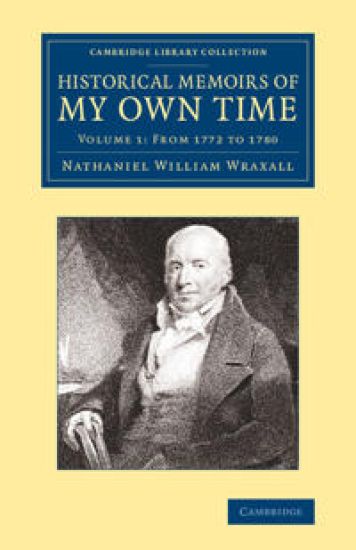
Sir Nathanial William Wraxall (1751–1831), traveller and writer, served as an MP from 1780 to 1794 and was made a baronet in 1813. Upon publication in 1815, his memoirs were an immediate, though controversial, success: 1,000 copies sold out within five weeks. Accused of libelling a Russian diplomat, and found guilty, Wraxall brought out this second edition later that same year, with the offending passages removed. Volume 1 covers 1772–81, a period of extensive travel, which took him across several European countries, including Portugal, France, Germany and Italy, returning to London in 1780. The volume also contains the start of the work's controversial second part, which deals with the beginning of Wraxall's parliamentary career under Lord North's administration. The memoirs make for an entertaining read, and few from the distinguished circles in which the author moved are spared from his merciless facility for description.
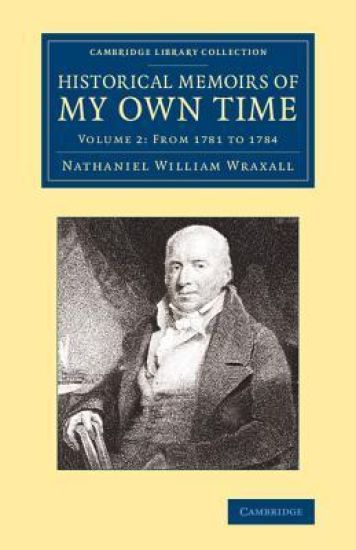
Sir Nathanial William Wraxall (1751–1831), traveller and writer, served as an MP from 1780 to 1794 and was made a baronet in 1813. Upon publication in 1815, his memoirs were an immediate, though controversial, success: 1,000 copies sold out within five weeks. Accused of libelling a Russian diplomat, and found guilty, Wraxall brought out this second edition later that same year, with the offending passages removed. Volume 2 comprises the majority of the second, and more controversial, part of the work, which covers 1781–4. Wraxall's early parliamentary years were a difficult period in England, the American War of Independence dominating Lord North's administration until his unexpected resignation on 20 March 1782. The 'great despondency' continued; nevertheless, Wraxall's colourful delineations of Fox and Burke, the Earl of Shelburne, Sheridan and Pitt, as well as 'the less efficient members of the cabinet', make for an entertaining read.
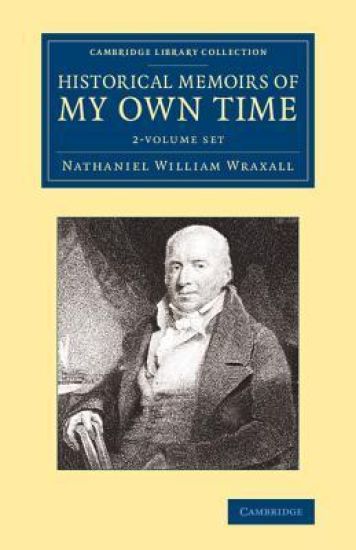
Sir Nathanial William Wraxall (1751–1831), traveller and writer, served as an MP from 1780 to 1794 and was made a baronet in 1813. Upon publication in 1815, his memoirs were an immediate, though controversial, success: 1,000 copies sold out within five weeks. Accused of libelling a Russian diplomat, and found guilty, Wraxall brought out this second edition later that same year, with the offending passages removed. Volume 1 covers 1772–81, a period of extensive travel, which took him across several European countries, including Portugal, France, Germany and Italy, returning to London in 1780. Volume 2 comprises the majority of the second, and more controversial, part of the work, which covers 1781–4 and Wraxall's early parliamentary years under Lord North's administration. The memoirs make for an entertaining read, and few from the distinguished circles in which the author moved are spared from his merciless facility for description.
Title: The History of France under the Kings of the race of Valois, from the accession of Charles the Fifth, in 1364, to the death of Charles the Ninth, in 1574 ... Third edition, with ... additions.Publisher: British Library, Historical Print EditionsThe British Library is the national library of the United Kingdom. It is one of the world's largest research libraries holding over 150 million items in all known languages and formats: books, journals, newspapers, sound recordings, patents, maps, stamps, prints and much more. Its collections include around 14 million books, along with substantial additional collections of manuscripts and historical items dating back as far as 300 BC.The HISTORY OF EUROPE collection includes books from the British Library digitised by Microsoft. This collection includes works chronicling the development of Western civilisation to the modern age. Highlights include the development of language, political and educational systems, philosophy, science, and the arts. The selection documents periods of civil war, migration, shifts in power, Muslim expansion into Central Europe, complex feudal loyalties, the aristocracy of new nations, and European expansion into the New World. ++++The below data was compiled from various identification fields in the bibliographic record of this title. This data is provided as an additional tool in helping to insure edition identification: ++++ British Library Wraxall, Nathaniel William; 1807. 2 vol.; 8 . 1321.b.11-12.
Title: The History of France under the Kings of the race of Valois, from the accession of Charles the Fifth, in 1364, to the death of Charles the Ninth, in 1574 ... Third edition, with ... additions.Publisher: British Library, Historical Print EditionsThe British Library is the national library of the United Kingdom. It is one of the world's largest research libraries holding over 150 million items in all known languages and formats: books, journals, newspapers, sound recordings, patents, maps, stamps, prints and much more. Its collections include around 14 million books, along with substantial additional collections of manuscripts and historical items dating back as far as 300 BC.The HISTORY OF EUROPE collection includes books from the British Library digitised by Microsoft. This collection includes works chronicling the development of Western civilisation to the modern age. Highlights include the development of language, political and educational systems, philosophy, science, and the arts. The selection documents periods of civil war, migration, shifts in power, Muslim expansion into Central Europe, complex feudal loyalties, the aristocracy of new nations, and European expansion into the New World. ++++The below data was compiled from various identification fields in the bibliographic record of this title. This data is provided as an additional tool in helping to insure edition identification: ++++ British Library Wraxall, Nathaniel William; 1807. 2 vol.; 8 . 1321.b.11-12.