Kirjojen hintavertailu. Mukana 11 342 296 kirjaa ja 12 kauppaa.

Kirjahaku

Etsi kirjoja tekijän nimen, kirjan nimen tai ISBN:n perusteella.

4 kirjaa tekijältä Navin Khaneja

Electron Waves in Solids

Electron Waves in Solids

Navin Khaneja

Springer International Publishing AG
2024
sidottu
This book explores the intricate world of electron behavior within solids, revealing them to be waves—a fundamental insight crucial to grasping modern electronics, computing, and solid-state devices. This comprehensive examination elucidates the factors determining material conductivity, distinguishing between conductors, insulators, and semiconductors. Through detailed analysis, the text illuminates the thermal agitation of solids, manifesting as vibrations known as phonons, which impede electron flow and contribute to electrical resistance. Readers gain insight into the production of electronic devices through semiconductor doping, exploring various device types and their functionalities. The book further investigates the temperature-dependent behavior of metal resistance, including the phenomenon of superconductivity, wherein resistance vanishes entirely at low temperatures—a phenomenon comprehensively elucidated within these pages. Moreover, the text unravels the mysteries of magnetism in solids, exploring how certain metals, such as iron, exhibit permanent magnetism. By probing into the underlying causes of magnetism, readers gain a deeper understanding of solid-state physics. Additionally, the book explores imaging techniques such as X-rays, offering insights into how scientists peer inside solids to decipher their internal structures and properties. Geared toward scientists and engineers, the book serves as an indispensable resource for mastering the foundational concepts of solid-state physics—a discipline indispensable to modern technology.

High Energy Physics

High Energy Physics

Navin Khaneja

Springer International Publishing AG
2024
sidottu
This book offers a comprehensive exploration of the phenomenology surrounding high-energy particle interactions. When particles possess kinetic energy surpassing their rest energy, remarkable phenomena occur. Colliding particles at such high energies can lead to the creation of entirely new particles, illuminating the intricate workings of the universe. Through vivid explanations, this book elucidates the intricate processes that unfold during particle collisions. From proton collisions yielding pions and kaons to electron-positron collisions producing muons, each collision unveils a tapestry of particle interactions. Central to these interactions is the exchange of photons, which come in various forms. Among them are electromagnetic (EM) photons, akin to the light photons that bind electrons to protons within atoms. Then, there are the heavy bosons responsible for beta decay, crucial mediators of weak interactions that govern the decay of particles such as muons and pions. Additionally, there exist photons that bind quarks within protons and neutrons, facilitating the strong force that holds atomic nuclei together. In 'High Energy Physics: A Level and Transition Approach,' we embark on a journey through the diverse array of particles and photons that orchestrate these interactions, shedding light on the fundamental forces shaping the fabric of our universe.
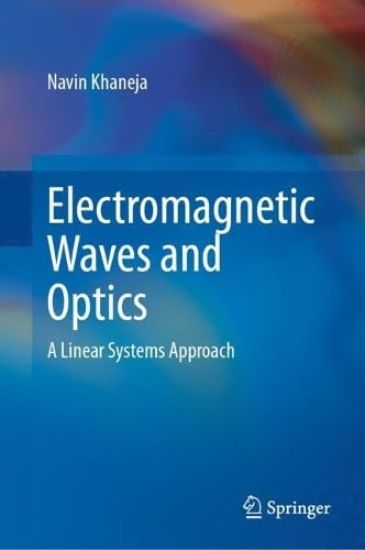
Electromagnetic Waves and Optics

Electromagnetic Waves and Optics

Navin Khaneja

Springer International Publishing AG
2025
sidottu
The book explores electromagnetic (EM) waves, which are present everywhere—from radio, television, and cell phones to satellite dishes, antennas, and WiFi. The propagation of EM waves is governed by Maxwell's equations. When these waves pass through a medium, they slow down and refract, while in a metallic medium, they are reflected. Metallic boxes and pipes can store and direct EM waves, known as cavities and waveguides. Oscillating currents generate and transmit EM waves through antennas, allowing for long-distance communication after the waves propagate. Since oscillating currents emit EM waves, the author uses coaxial cables and transmission lines to reduce radiation and carry high-frequency currents efficiently. EM waves at very high frequencies in the optical range are responsible for transmitting visual information. The author also discusses lenses and optical instruments like telescopes and microscopes, which are used to magnify optical signals. Additionally, the quantum mechanical origins of a material’s permittivity, which affects the speed of light through the medium, are examined.
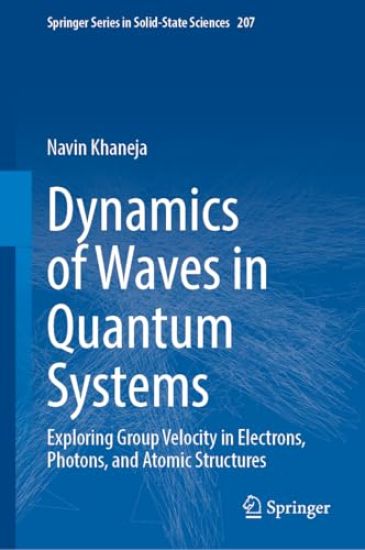
Dynamics of Waves in Quantum Systems

Dynamics of Waves in Quantum Systems

Navin Khaneja

Springer International Publishing AG
2026
sidottu
This book plays a crucial role in understanding the dynamics of quantum systems, exploring how group velocity shapes the behavior of electrons, photons, and other quantum entities while challenging classical perspectives on atomic orbitals and solid-state physics. In conventional treatments, atomic orbitals are constructed from plane waves with fixed energies, disregarding the role of group velocity. But what happens when group velocity is considered? Incorporating group velocity leads to unexpected results: electron waves disperse, atomic structures grow unrealistically large, and familiar models of the hydrogen atom require rethinking. This analysis reveals how group velocity introduces forces that demand new physics to reconcile. Beyond atomic orbitals, the influence of group velocity extends to solid-state physics, shaping electron transport, superconductivity, and lattice dynamics. In optics, it governs photon propagation and optical emissions, while in high-energy physics, it plays a crucial role in determining scattering cross-sections. Applications also span Fermi liquid theory and the behavior of electrons in magnetic fields, offering a unified framework that bridges diverse areas of modern physics. Serving as a compelling resource for researchers, students, and enthusiasts of quantum mechanics, solid-state physics, and optical sciences, this work provides a fresh perspective on the interplay between wave dynamics and the physical world.