Kirjojen hintavertailu. Mukana 11 244 527 kirjaa ja 12 kauppaa.

Kirjahaku

Etsi kirjoja tekijän nimen, kirjan nimen tai ISBN:n perusteella.

9 kirjaa tekijältä Neal Koblitz

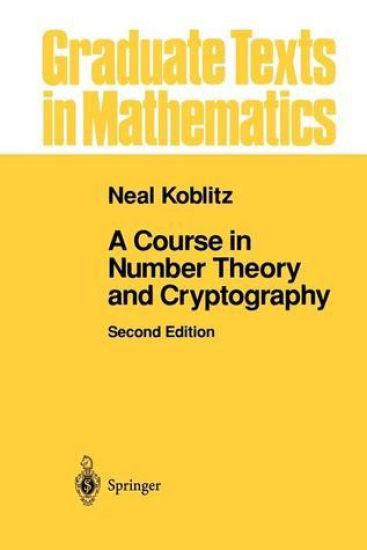
A Course in Number Theory and Cryptography

A Course in Number Theory and Cryptography

Neal Koblitz

Springer-Verlag New York Inc.
1994
sidottu
. . . both Gauss and lesser mathematicians may be justified in rejoic­ ing that there is one science [number theory] at any rate, and that their own, whose very remoteness from ordinary human activities should keep it gentle and clean. - G. H. Hardy, A Mathematician's Apology, 1940 G. H. Hardy would have been surprised and probably displeased with the increasing interest in number theory for application to "ordinary human activities" such as information transmission (error-correcting codes) and cryptography (secret codes). Less than a half-century after Hardy wrote the words quoted above, it is no longer inconceivable (though it hasn't happened yet) that the N. S. A. (the agency for U. S. government work on cryptography) will demand prior review and clearance before publication of theoretical research papers on certain types of number theory. In part it is the dramatic increase in computer power and sophistica­ tion that has influenced some of the questions being studied by number theorists, giving rise to a new branch of the subject, called "computational number theory. " This book presumes almost no background in algebra or number the­ ory. Its purpose is to introduce the reader to arithmetic topics, both ancient and very modern, which have been at the center of interest in applications, especially in cryptography. For this reason we take an algorithmic approach, emphasizing estimates of the efficiency of the techniques that arise from the theory.
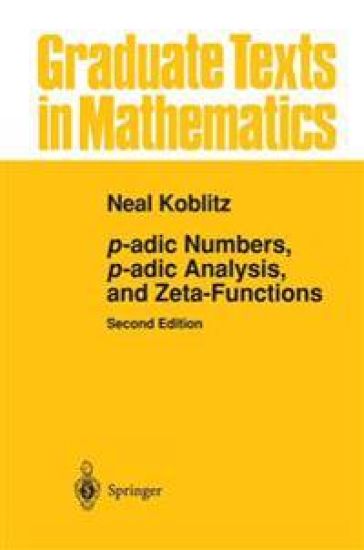
p-adic Numbers, p-adic Analysis, and Zeta-Functions

p-adic Numbers, p-adic Analysis, and Zeta-Functions

Neal Koblitz

Springer-Verlag New York Inc.
1984
sidottu
Neal Koblitz was a student of Nicholas M. Katz, under whom he received his Ph.D. in mathematics at Princeton in 1974. He spent the year 1974 -75 and the spring semester 1978 in Moscow, where he did research in p -adic analysis and also translated Yu. I. Manin's "Course in Mathematical Logic" (GTM 53). He taught at Harvard from 1975 to 1979, and since 1979 has been at the University of Washington in Seattle. He has published papers in number theory, algebraic geometry, and p-adic analysis, and he is the author of "p-adic Analysis: A Short Course on Recent Work" (Cambridge University Press and GTM 97: "Introduction to Elliptic Curves and Modular Forms (Springer-Verlag).
P-adic Analysis

P-adic Analysis

Neal Koblitz

Cambridge University Press
1980
pokkari
This introduction to recent work in p-adic analysis and number theory will make accessible to a relatively general audience the efforts of a number of mathematicians over the last five years. After reviewing the basics (the construction of p-adic numbers and the p-adic analog of the complex number field, power series and Newton polygons), the author develops the properties of p-adic Dirichlet L-series using p-adic measures and integration. p-adic gamma functions are introduced, and their relationship to L-series is explored. Analogies with the corresponding complex analytic case are stressed. Then a formula for Gauss sums in terms of the p-adic gamma function is proved using the cohomology of Fermat and Artin-Schreier curves. Graduate students and research workers in number theory, algebraic geometry and parts of algebra and analysis will welcome this account of current research.
A Course in Number Theory and Cryptography

A Course in Number Theory and Cryptography

Neal Koblitz

Springer-Verlag New York Inc.
2012
nidottu
. . . both Gauss and lesser mathematicians may be justified in rejoic­ ing that there is one science [number theory] at any rate, and that their own, whose very remoteness from ordinary human activities should keep it gentle and clean. - G. H. Hardy, A Mathematician's Apology, 1940 G. H. Hardy would have been surprised and probably displeased with the increasing interest in number theory for application to "ordinary human activities" such as information transmission (error-correcting codes) and cryptography (secret codes). Less than a half-century after Hardy wrote the words quoted above, it is no longer inconceivable (though it hasn't happened yet) that the N. S. A. (the agency for U. S. government work on cryptography) will demand prior review and clearance before publication of theoretical research papers on certain types of number theory. In part it is the dramatic increase in computer power and sophistica­ tion that has influenced some of the questions being studied by number theorists, giving rise to a new branch of the subject, called "computational number theory. " This book presumes almost no background in algebra or number the­ ory. Its purpose is to introduce the reader to arithmetic topics, both ancient and very modern, which have been at the center of interest in applications, especially in cryptography. For this reason we take an algorithmic approach, emphasizing estimates of the efficiency of the techniques that arise from the theory.
p-adic Numbers, p-adic Analysis, and Zeta-Functions

p-adic Numbers, p-adic Analysis, and Zeta-Functions

Neal Koblitz

Springer-Verlag New York Inc.
2012
nidottu
Neal Koblitz was a student of Nicholas M. Katz, under whom he received his Ph.D. in mathematics at Princeton in 1974. He spent the year 1974 -75 and the spring semester 1978 in Moscow, where he did research in p -adic analysis and also translated Yu. I. Manin's "Course in Mathematical Logic" (GTM 53). He taught at Harvard from 1975 to 1979, and since 1979 has been at the University of Washington in Seattle. He has published papers in number theory, algebraic geometry, and p-adic analysis, and he is the author of "p-adic Analysis: A Short Course on Recent Work" (Cambridge University Press and GTM 97: "Introduction to Elliptic Curves and Modular Forms (Springer-Verlag).
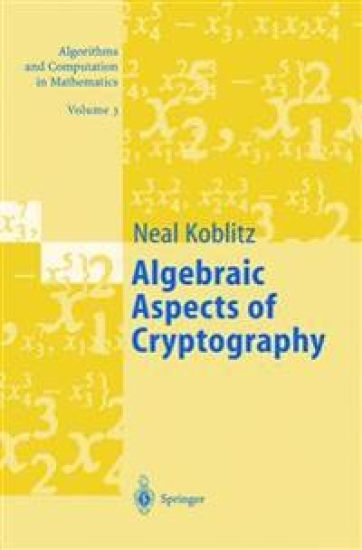
Algebraic Aspects of Cryptography

Algebraic Aspects of Cryptography

Neal Koblitz

Springer-Verlag Berlin and Heidelberg GmbH Co. K
1998
sidottu
This book is intended as a text for a course on cryptography with emphasis on algebraic methods. It is written so as to be accessible to graduate or advanced undergraduate students, as well as to scientists in other fields. The first three chapters form a self-contained introduction to basic concepts and techniques. Here my approach is intuitive and informal. For example, the treatment of computational complexity in Chapter 2, while lacking formalistic rigor, emphasizes the aspects of the subject that are most important in cryptography. Chapters 4-6 and the Appendix contain material that for the most part has not previously appeared in textbook form. A novel feature is the inclusion of three types of cryptography - "hidden monomial" systems, combinatorial-algebraic sys­ tems, and hyperelliptic systems - that are at an early stage of development. It is too soon to know which, if any, of these cryptosystems will ultimately be of practical use. But in the rapidly growing field of cryptography it is worthwhile to continually explore new one-way constructions coming from different areas of mathematics. Perhaps some of the readers will contribute to the research that still needs to be done. This book is designed not as a comprehensive reference work, but rather as a selective textbook. The many exercises (with answers at the back of the book) make it suitable for use in a math or computer science course or in a program of independent study.
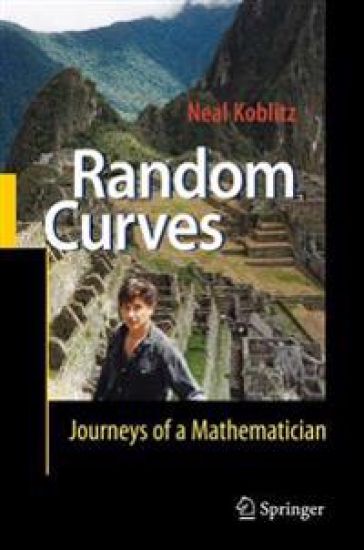
Random Curves

Random Curves

Neal Koblitz

Springer-Verlag Berlin and Heidelberg GmbH Co. K
2007
sidottu
These autobiographical memoirs of Neal Koblitz, coinventor of one of the two most popular forms of encryption and digital signature, cover many topics besides his own personal career in mathematics and cryptography - travels to the Soviet Union, Latin America, Vietnam and elsewhere, political activism, and academic controversies relating to math education, the C. P. Snow two-culture problem, and mistreatment of women in academia. The stories speak for themselves and reflect the experiences of a student and later a scientist caught up in the tumultuous events of his generation.
Algebraic Aspects of Cryptography

Algebraic Aspects of Cryptography

Neal Koblitz

Springer-Verlag Berlin and Heidelberg GmbH Co. K
2010
nidottu
This book is intended as a text for a course on cryptography with emphasis on algebraic methods. It is written so as to be accessible to graduate or advanced undergraduate students, as well as to scientists in other fields. The first three chapters form a self-contained introduction to basic concepts and techniques. Here my approach is intuitive and informal. For example, the treatment of computational complexity in Chapter 2, while lacking formalistic rigor, emphasizes the aspects of the subject that are most important in cryptography. Chapters 4-6 and the Appendix contain material that for the most part has not previously appeared in textbook form. A novel feature is the inclusion of three types of cryptography - "hidden monomial" systems, combinatorial-algebraic sys­ tems, and hyperelliptic systems - that are at an early stage of development. It is too soon to know which, if any, of these cryptosystems will ultimately be of practical use. But in the rapidly growing field of cryptography it is worthwhile to continually explore new one-way constructions coming from different areas of mathematics. Perhaps some of the readers will contribute to the research that still needs to be done. This book is designed not as a comprehensive reference work, but rather as a selective textbook. The many exercises (with answers at the back of the book) make it suitable for use in a math or computer science course or in a program of independent study.
Random Curves

Random Curves

Neal Koblitz

Springer-Verlag Berlin and Heidelberg GmbH Co. K
2014
nidottu
These autobiographical memoirs of Neal Koblitz, coinventor of one of the two most popular forms of encryption and digital signature, cover many topics besides his own personal career in mathematics and cryptography - travels to the Soviet Union, Latin America, Vietnam and elsewhere, political activism, and academic controversies relating to math education, the C. P. Snow two-culture problem, and mistreatment of women in academia. The stories speak for themselves and reflect the experiences of a student and later a scientist caught up in the tumultuous events of his generation.