Kirjojen hintavertailu. Mukana 11 342 296 kirjaa ja 12 kauppaa.

Kirjahaku

Etsi kirjoja tekijän nimen, kirjan nimen tai ISBN:n perusteella.

3 kirjaa tekijältä Neil Levine

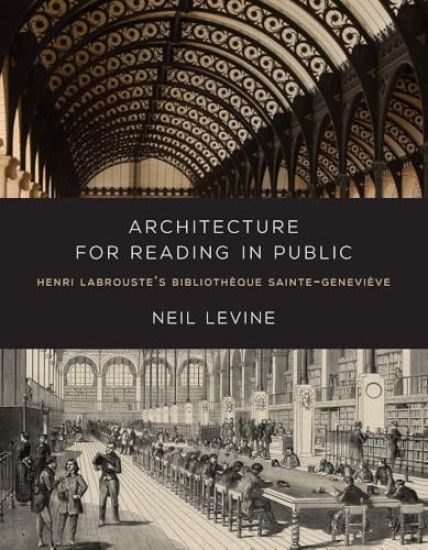
Architecture for Reading in Public

Architecture for Reading in Public

Neil Levine

YALE UNIVERSITY PRESS
2025
sidottu
An in-depth look at the iconic mid-nineteenth-century building and its construction during a period of revolution and its transformative impact on the history of architecture Since its completion in 1850, the Bibliothèque Sainte-Geneviève has been heralded as a major forerunner of modern architecture. The architect Henri Labrouste, a product of the École des Beaux-Arts, broke with the reigning neoclassical tradition by expressing on the exterior the building’s internal functions and exposing on the interior the unprecedented iron construction of its reading room. Underlying these radical departures from tradition was a new democratic form of spatial organization appropriate to the new reading public. Acclaimed architectural historian Neil Levine presents both a building history—discussing the significance of the program, site, prehistory, and building process—and a window into a period of momentous historical change by contextualizing Labrouste’s work within the revolutionary times of the latter part of the July Monarchy and Second Republic in France. He examines how the building communicates a public purpose through its anticlassical, nonhierarchic, egalitarian form and reveals how the Bibliothèque Sainte-Geneviève is the product of a poetic architectural intelligence mixed with radical, democratic ideals.
The Architecture of Frank Lloyd Wright

The Architecture of Frank Lloyd Wright

Neil Levine

Princeton University Press
1998
pokkari
Neil Levine's study of the architecture of Frank Lloyd Wright, beginning with his work in Oak Park in the late 1880s and culminating in the construction of the Guggenheim museum in New York and the Marin County Civic Center in the 1950s, if the first comprehensive and in-depth analysis of the architect's entire career since the opening of the Wright Archives over a decade ago. The most celebrated and prolific of modern architects, Wright built more than four hundred buildings and designed at least twice as many more. The characteristic features of his work--the open plan, dynamic space, fragmented volumes, natural materials, and integral structure--established the basic way that we think about modern architecture. For a general audience, this engaging book provides an introduction to Wright's remarkable accomplishments, as seen against the background of his eventful and often tragic life. For the architect or the architectural historian, it will be an important source of new insights into the development of Wright's whole body of work. It integrates biographical and historical material in a chronologically ordered framework that makes sense of his enormously varied career, and it provides over four hundred illustrations running parallel to the text. Levine conveys the meanings of the continuities and changes that he sees I Wright's architecture and thought by focusing successive chapters on his most significant buildings, such as the Winslow House, Taliesin, Hollyhock House, Fallingwater, Tailsen west, and the Guggenheim Museum. A new understanding of the representational imagery and narrative structure of Wright's work, along with a much-needed reconsideration of its historical and contextual underpinnings, gives this study a unique place in the writings on Wright. In contrast to the emphasis a previous generation of critics and historians placed on Wright's earlier buildings, this book offers a broader perspective that sees Wright's later work as the culmination of his earlier efforts and the basis for a new understanding of the centrality of his career to the evolution of modern architecture as a whole.
The Urbanism of Frank Lloyd Wright

The Urbanism of Frank Lloyd Wright

Neil Levine

Princeton University Press
2015
sidottu
This is the first book devoted to Frank Lloyd Wright's designs for remaking the modern city. Stunningly comprehensive, The Urbanism of Frank Lloyd Wright presents a radically new interpretation of the architect's work and offers new and important perspectives on the history of modernism. Neil Levine places Wright's projects, produced over more than fifty years, within their historical, cultural, and physical contexts, while relating them to the theory and practice of urbanism as it evolved over the twentieth century. Levine overturns the conventional view of Wright as an architect who deplored the city and whose urban vision was limited to a utopian plan for a network of agrarian communities he called Broadacre City. Rather, Levine reveals Wright's larger, more varied, interesting, and complex urbanism, demonstrated across the span of his lengthy career. Beginning with Wright's plans from the late 1890s through the early 1910s for reforming residential urban neighborhoods, mainly in Chicago, and continuing through projects from the 1920s through the 1950s for commercial, mixed-use, civic, and cultural centers for Chicago, Madison, Washington, Pittsburgh, and Baghdad, Levine demonstrates Wright's place among the leading contributors to the creation of the modern city. Wright's often spectacular designs are shown to be those of an innovative precursor and creative participant in the world of ideas that shaped the modern metropolis. Lavishly illustrated with drawings, plans, maps, and photographs, this book features the first extensive new photography of materials from the Frank Lloyd Wright Foundation Archives. The Urbanism of Frank Lloyd Wright will serve as one of the most important books on the architect for years to come.