Kirjojen hintavertailu. Mukana 11 244 527 kirjaa ja 12 kauppaa.

Kirjahaku

Etsi kirjoja tekijän nimen, kirjan nimen tai ISBN:n perusteella.

13 kirjaa tekijältä Neil MacCormick

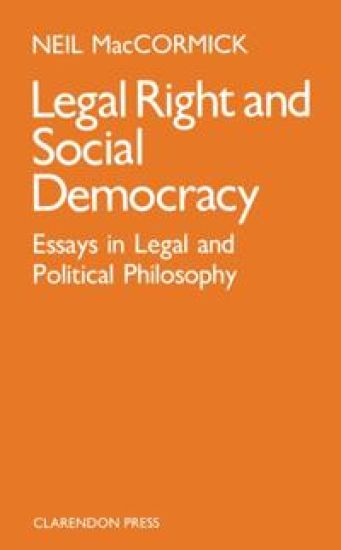
Legal Right and Social Democracy

Legal Right and Social Democracy

Neil MacCormick

Oxford University Press
1984
nidottu
A controversial collection of interrelated papers which investigate and argue about issues of concern for contemporary lawyers and politicians. The papers combine a scholarly regard for leading thinkers of the past and present, and a stringently argued view about questions of political obligation.
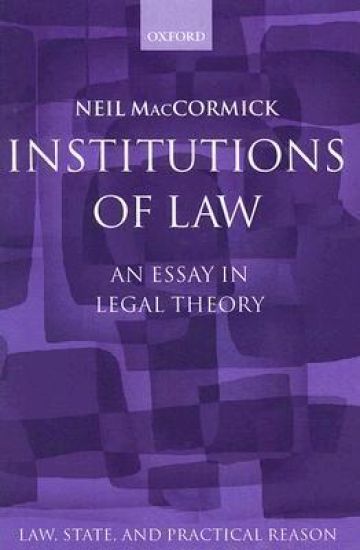
Institutions of Law

Institutions of Law

Neil MacCormick

Oxford University Press
2007
sidottu
Institutions of Law offers an original account of the nature of law and legal systems in the contemporary world. It provides the definitive statement of Sir Neil MacCormick's well-known 'institutional theory of law', defining law as 'institutional normative order' and explaining each of these three terms in depth. It attempts to fulfil the need for a twenty-first century introduction to legal theory marking a fresh start such as was achieved in the last century by H. L. A. Hart's The Concept of Law. It is written with a view to elucidating law, legal concepts and legal institutions in a manner that takes account of current scholarly controversies but does not get bogged down in them. It shows how law relates to the state and civil society, establishing the conditions of social peace and a functioning economy. In so doing, it takes account of recent developments in the sociology of law, particularly 'system theory'. It also seeks to clarify the nature of claims to 'knowledge of law' and thus indicate the possibility of legal studies having a genuinely 'scientific' character. It shows that there is an essential value-orientation of all work of this kind, so that valid analytical jurisprudence not merely need not, but cannot, be 'positivist' as that term has come to be understood. Nevertheless it is explained why law and morality are genuinely distinct by virtue of the positive character of law contrasted with the autonomy that is foundational for morality.
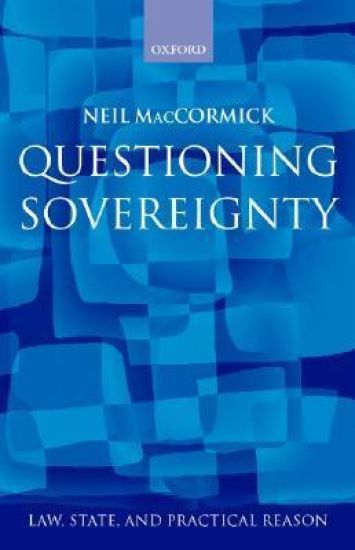
Questioning Sovereignty

Questioning Sovereignty

Neil MacCormick

Oxford University Press
1999
sidottu
This is a book about the transformation of sovereignty in the United Kingdom and the European Union, about the transition from 'sovereign states' to 'post-sovereign states', about devolution and nationalism and the future of the British union. It applies the institutional theory of law to a general inquiry into the relations of law and state, and to the question of the character of a Rechtsstaat or state under the rule of law. This clears the ground for a historical/analytical review of the United Kingdom as union state, and of the Benthamite or Diceyan view of its constitution, grounded in the idea of sovereignty. Can that sovereignty survive diffusion of power within the British state? Or can it survive the development of the European Union and the supremacy in it of European Community law? Was there a revolution in 1972, when Parliament enacted the European Communities Act, or later, when the House of Lords held that subsequent Acts of Parliament should be 'disapplied' when they conflict with Community law? The potential for conflict between member state constitutions and European legal order is no less in other member states - Germany, France, Ireland and the others. Indeed the issue is perhaps whether in the long run constitutional conflicts are inevitable. This leads on into a consideration of pluralistic as against monistic accounts of legal order viewed as a whole, and finally to a review of the concept of sovereignty, and of the possibility that there really could be a new order of post-sovereign states within a non-sovereign confederal union in Europe. If so, what becomes of democracy, and how can the democratic deficit in Europe be redeemed? The existing constitution of the 'European Commonwealth' is reviewed critically as an example of a mixed constitution and an argument is proposed about the value or values attaching to democracy and to subsidiarity in this vast commonwealth. Connected to subsidiarity is the issue of contemporary politics of identity all over Europe and beyond. MacCormick puts forward a carefully argued case for a moderate and liberal form of nationalism that sets universal but non-absolute principles of self-determination. The case is finally pressed home in relation to the relations of Scotland to the other countries of the British Isles, and an argument put for the idea of mutual independence within a Council of the Isles and the European Union.
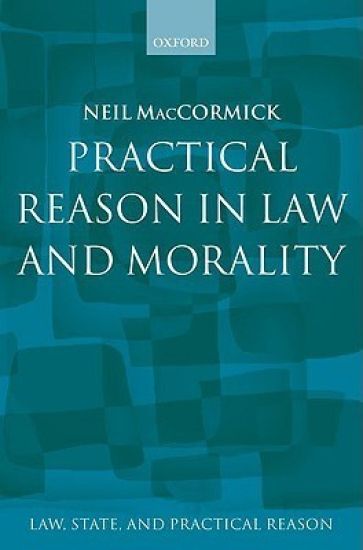
Practical Reason in Law and Morality

Practical Reason in Law and Morality

Neil MacCormick

Oxford University Press
2008
sidottu
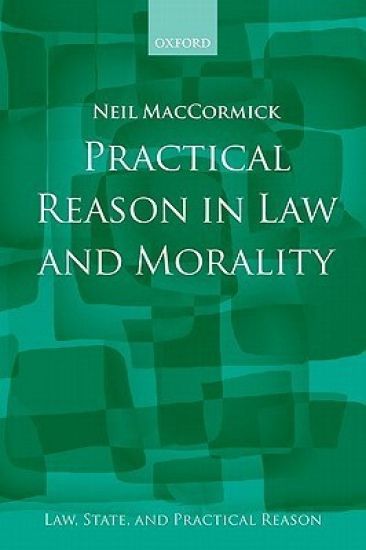
The concept of practical reason is central to contemporary thought on ethics and the philosophy of law - acting well means acting for good reasons. Explaining this requires several stages. How do reasons relate to actions at all, as incentives and in explanations? What are values, how do they relate to human nature, and how do they enter practical reasoning? How do the concepts of 'right and wrong' fit in, and in what way do they involve questions of mutual trust among human beings? How does our moral freedom - our freedom to form our own moral commitments - relate to our responsibilities to each other? How is this final question transposed into law and legal commitments? This book explores these questions, vital to understanding the nature of law and morality. It presents a clear account of practical reason, valuable to students of moral philosophy and jurisprudence at undergraduate or postgraduate levels. For more advanced scholars it also offers a reinterpretation of Kant's views on moral autonomy and Smith's on self-command, marrying Smith's 'moral sentiments' to Kant's 'categorical imperative' in a novel way. The book concludes and underpins the author's Law, State and Practical Reason series. Taken together the books offer an overarching theory of the nature of law and legal reason, the role of the State, and the nature of moral reason and judgement.
Rhetoric and The Rule of Law

Rhetoric and The Rule of Law

Neil MacCormick

Oxford University Press
2005
sidottu
Is legal reasoning rationally persuasive, working within a discernible structure and using recognisable kinds of arguments? Does it belong to rhetoric in this sense, or to the domain of the merely 'rhetorical' in an adversative sense? Is there any reasonable certainty about legal outcomes in dispute-situations? If not, what becomes of the Rule of Law? Neil MacCormick's book tackles these questions in establishing an overall theory of legal reasoning which shows the essential part 'legal syllogism' plays in reasoning aimed at the application of law, while acknowledging that simple deductive reasoning, though always necessary, is very rarely sufficient to justify a decision. There are always problems of relevancy, classification or interpretation in relation to both facts and law. In justifying conclusions about such problems, reasoning has to be universalistic and yet fully sensitive to the particulars of specific cases. How is this possible? Is legal justification at this level consequentialist in character or principled and right-based? Both normative coherence and narrative coherence have a part to play in justification, and in accounting for the validity of arguments by analogy. Looking at such long-discussed subjects as precedent and analogy and the interpretative character of the reasoning involved, Neil MacCormick expands upon his celebrated Legal Reasoning and Legal Theory (OUP 1978 and 1994) and restates his 'institutional theory of law'.
Legal Reasoning and Legal Theory

Legal Reasoning and Legal Theory

Neil MacCormick

Clarendon Press
1994
nidottu
What makes an argument in a law case good or bad? Can legal decisions be justified by purely rational argument or are they ultimately determined by more subjective influences? These questions are central to the study of jurisprudence, and are thoroughly and critically examined in Legal Reasoning and Legal Theory, now with a new and up-to-date foreword. Its clarity of explanation and argument make this classic legal text readily accessible to lawyers, philosophers, and any general reader interested in legal processes, human reasoning, or practical logic.
Questioning Sovereignty

Questioning Sovereignty

Neil MacCormick

Oxford University Press
2002
nidottu
This is a controversial work of applied legal theory, addressing urgent contemporary questions about law and the State, about the character of the UK as a state, and about the juridical character of the European Union in its relationship with the Member States of the Union.
Institutions of Law

Institutions of Law

Neil MacCormick

Oxford University Press
2008
nidottu
Institutions of Law offers an original account of the nature of law and legal systems in the contemporary world. It provides the definitive statement of Sir Neil MacCormick's well-known 'institutional theory of law', defining law as 'institutional normative order' and explaining each of these three terms in depth. It attempts to fulfil the need for a twenty-first century introduction to legal theory marking a fresh start such as was achieved in the last century by H. L. A. Hart's The Concept of Law. It is written with a view to elucidating law, legal concepts, and legal institutions in a manner that takes account of current scholarly controversies but does not get bogged down in them. It shows how law relates to the State and civil society, establishing the conditions of social peace and a functioning economy. In so doing, it takes account of recent developments in the sociology of law, particularly 'system theory'. It also seeks to clarify the nature of claims to 'knowledge of law' and thus indicate the possibility of legal studies having a genuinely 'scientific' character. It shows that there is an essential value-orientation of all work of this kind, so that valid analytical jurisprudence not merely need not, but cannot, be 'positivist' as that term has come to be understood. Nevertheless, it is explained why law and morality are genuinely distinct by virtue of the positive character of law contrasted with the autonomy that is foundational for morality.
Rhetoric and The Rule of Law

Rhetoric and The Rule of Law

Neil MacCormick

Oxford University Press
2009
nidottu
When cases come before courts can we predict the outcome? Is legal reasoning rationally persuasive, working within a formal structure and using recognisable forms of arguments to produce predictable results? Or is legal reasoning mere rhetoric´ in the pejorative sense, open to use, and abuse, to achieve whatever ends unscrupulous politicians, lawyers and judges desire? If the latter what becomes of the supposed security of living under the rule of law? This book tackles these questions by presenting a theory of legal reasoning, developing the author's classic account given in Legal Reasoning and Legal Theory (OUP, 1978). It explains the essential role syllogism plays in reasoning used to apply the law, and the elements needed in addition to deductive reasoning to give a full explanation of how law is applied and decisions justified through the use of precedent, analogy and principle. The book highlights that problems of interpretation, classification and relevance will always arise when applying general legal standards to individual cases. In justifying their conclusions about such problems, judges need to be faithful to categorical legal reasons and yet fully sensitive to the particulars of the cases before them. How can this be achieved, and how should we evaluate the possible approaches judges could take to solving these problems? By addressing these issues the book asks questions at the heart of understanding the nature of law and the moral complexity of the rule of law.
Practical Reason in Law and Morality

Practical Reason in Law and Morality

Neil MacCormick

Oxford University Press
2011
nidottu
The concept of practical reason is central to contemporary thought on ethics and the philosophy of law - acting well means acting for good reasons. Explaining this requires several stages. How do reasons relate to actions at all, as incentives and in explanations? What are values, how do they relate to human nature, and how do they enter practical reasoning? How do the concepts of 'right and wrong' fit in, and in what way do they involve questions of mutual trust among human beings? How does our moral freedom - our freedom to form our own moral commitments - relate to our responsibilities to each other? How is this final question transposed into law and legal commitments? This book explores these questions, vital to understanding the nature of law and morality. It presents a clear account of practical reason, valuable to students of moral philosophy and jurisprudence at undergraduate or postgraduate levels. For more advanced scholars it also offers a reinterpretation of Kant's views on moral autonomy and Smith's on self-command, marrying Smith's 'moral sentiments' to Kant's 'categorical imperative' in a novel way. The book concludes and underpins the author's Law, State, and Practical Reason series. Taken together the books offer an overarching theory of the nature of law and legal reason, the role of the State, and the nature of moral reason and judgement.
H.L.a. Hart

H.L.a. Hart

Neil MacCormick

Stanford Law and Politics
2008
sidottu
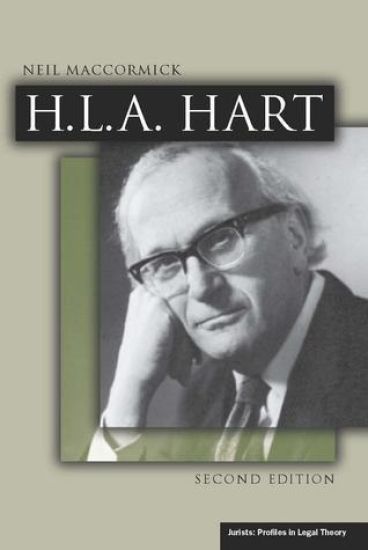
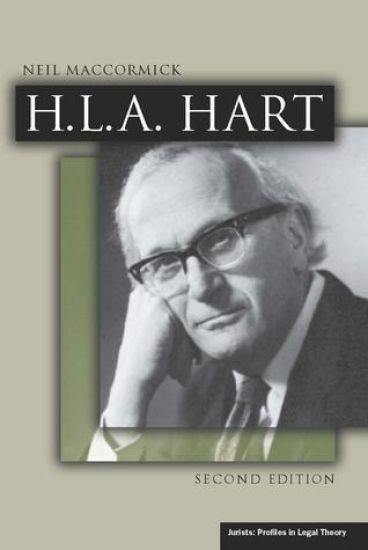
In this substantially revised second edition, Neil MacCormick delivers a clear and current introduction to the life and works of H.L.A. Hart, noted Professor of Jurisprudence at Oxford University from 1952 to 1968. Hart established a worldwide reputation through his powerful philosophical arguments and writings in favor of liberalizing criminal law and applying humane principles to punishment. This book demonstrates that Hart also made important contributions to analytical jurisprudence, notably by clarifying many terms and concepts used in legal discourse, including the concept of law itself. Taking into account developments since the first edition was published, this book provides a constructively critical account of Hart's legal thought. The work includes Hart's ideas on legal reasoning, judicial discretion, the social sources of law, the theory of legal rules, the sovereignty of individual conscience, the notion of obligation, the concept of a right, and the relationship between morality and the law. MacCormick actively engages with current scholarly interpretations, bringing this accessible account of England's greatest legal philosopher of the twentieth century up-to-date.
H.L.a. Hart

H.L.a. Hart

Neil MacCormick

Stanford University Press
2008
pokkari
In this substantially revised second edition, Neil MacCormick delivers a clear and current introduction to the life and works of H.L.A. Hart, noted Professor of Jurisprudence at Oxford University from 1952 to 1968. Hart established a worldwide reputation through his powerful philosophical arguments and writings in favor of liberalizing criminal law and applying humane principles to punishment. This book demonstrates that Hart also made important contributions to analytical jurisprudence, notably by clarifying many terms and concepts used in legal discourse, including the concept of law itself. Taking into account developments since the first edition was published, this book provides a constructively critical account of Hart's legal thought. The work includes Hart's ideas on legal reasoning, judicial discretion, the social sources of law, the theory of legal rules, the sovereignty of individual conscience, the notion of obligation, the concept of a right, and the relationship between morality and the law. MacCormick actively engages with current scholarly interpretations, bringing this accessible account of England's greatest legal philosopher of the twentieth century up-to-date.
Who's Afraid of a European Constitution?
In this short but authoritative book, the nature and purpose of the European Constitution are explained by someone involved in its preparation. The author discusses how it was drafted, and tackles some much debated questions: whether it promises any enhancement of democracy in the EU, whether it implies that the EU is becoming a superstate, and whether it will strengthen the principle of subsidiarity and the protection of human rights.