Kirjojen hintavertailu. Mukana 12 152 606 kirjaa ja 12 kauppaa.

Kirjahaku

Etsi kirjoja tekijän nimen, kirjan nimen tai ISBN:n perusteella.

10 kirjaa tekijältä Neil Nevitte

The North American Trajectory

The North American Trajectory

Neil Nevitte

AldineTransaction
1996
sidottu
North America is steering a new course, with the United States, Canada, and Mexico moving toward continental economic, integration. This book examines basic value changes that are' transforming economic, social, and political life in these three countries, demonstrating that they are gradually adopting an increasingly compatible cultural perspective. A narrow nationalism, dominant since the 19th century, has slowly been giving way to a more cosmopolitan sense of identity. As old economic boundaries become outmoded, a North American perspective makes greater sense. To what extent, then, do the three North American publics - I each with its own heterogeneities and tensions - share a common culture? That question can only be answered if we have some yardstick by which to measure their cultural similarity. These societies are far from identical. But data from the 1990- 1991 World Values survey, drawn from 43 societies around the world, show that on crucial topics, the core values of the American public are significantly closer to those of the Canadians and (to a somewhat lesser extent) to those of the Mexicans, than they are to those of most other peoples in the world. Furthermore, time series evidence indicates that the values of the three North American publics have been converging. This book draws on a unique body of directly comparable cross-national and cross-temporal survey evidence to show that what Americans, Canadians, and Mexicans want out of life is changing in analogous ways. These changes, coupled with sociostructural transformations, are reshaping peoples' feelings about national identity, about trusting each other, and about the balance between economic and non-economic goals. North American economic integration is being reinforced by the gradual emergence of increasingly similar cultural values.

The North American Trajectory

The North American Trajectory

Neil Nevitte

AldineTransaction
1996
nidottu
North America is steering a new course, with the United States, Canada, and Mexico moving toward continental economic, integration. This book examines basic value changes that are' transforming economic, social, and political life in these three countries, demonstrating that they are gradually adopting an increasingly compatible cultural perspective. A narrow nationalism, dominant since the 19th century, has slowly been giving way to a more cosmopolitan sense of identity. As old economic boundaries become outmoded, a North American perspective makes greater sense. To what extent, then, do the three North American publics - I each with its own heterogeneities and tensions - share a common culture? That question can only be answered if we have some yardstick by which to measure their cultural similarity. These societies are far from identical. But data from the 1990- 1991 World Values survey, drawn from 43 societies around the world, show that on crucial topics, the core values of the American public are significantly closer to those of the Canadians and (to a somewhat lesser extent) to those of the Mexicans, than they are to those of most other peoples in the world. Furthermore, time series evidence indicates that the values of the three North American publics have been converging. This book draws on a unique body of directly comparable cross-national and cross-temporal survey evidence to show that what Americans, Canadians, and Mexicans want out of life is changing in analogous ways. These changes, coupled with sociostructural transformations, are reshaping peoples' feelings about national identity, about trusting each other, and about the balance between economic and non-economic goals. North American economic integration is being reinforced by the gradual emergence of increasingly similar cultural values.
The Decline of Deference

The Decline of Deference

Neil Nevitte

Broadview Press Ltd
1996
pokkari
Since the 1980s Canadians have experienced turmoil on an unprecedented scale and on a variety of fronts. Constitutional battles pitted citizen against citizen and publics against leaders. Vigorous new interest groups challenged governments to respond to new issues like the environment, gay rights, and equality for women. In the face of expanding trade relations Canadians mobilized to respond to economic uncertainty, and family relations were exposed to new stresses. What explains the turmoil? In this extraordinarily wide-ranging book, Neil Nevitte demonstrates that the changing patterns of Canadian values are connected. Changing attitudes to authority in the family are connected to changing attitudes to the work-place and to politics and they all point to one theme—the decline of deference. Canada's turmoil is not unique, nor is it a result of the "Americanization" of Canadian values. Canada, he argues, is but one stage on which the rhythms of post-industrial value change are played out.
New Elites in Old States

New Elites in Old States

Neil Nevitte; Roger Gibbins

Oxford University Press, USA
1991
pokkari
This book examines attitudes about equality among youth elites in Canada, the United States, Britain, Australia, and New Zealand. Using data gathered from over 8,000 undergraduates from 1982 to 1987 in these five countries, the author argues that the attitudinal structures of these youth elites has far reaching consequences for the political and economic agendas of advanced industrial democracies.
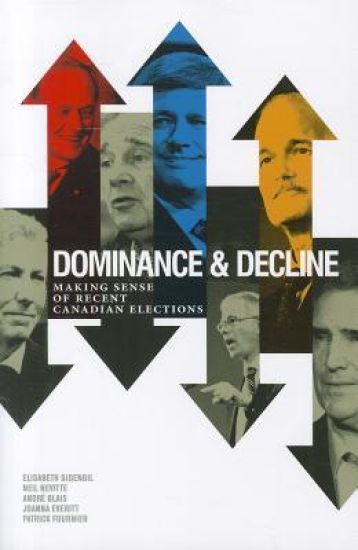
Dominance and Decline

Dominance and Decline

Elisabeth Gidengil; Neil Nevitte; Andre Blais; Joanna Everitt; Patrick Fournier

University of Toronto Press
2012
pokkari
Coming out of the 2000 Canadian federal election, the dominance of the Liberal Party seemed assured. By 2011 the situation had completely reversed: the Liberals suffered a crushing defeat, failing even to become the official opposition and recording their lowest ever share of the vote. Dominance and Decline provides a comprehensive, comparative account of Canadian election outcomes from 2000 through to 2008. The book explores the meaning of those outcomes within the context of the larger changes that have marked Canada's party system since 1988. It also shows how these trends were consistent with the outcome of the 2011 federal election. Throughout the book a variety of voting theories are revisited and reassessed in light of this analysis.
Citizens

Citizens

Elisabeth Gidengil; André Blais; Neil Nevitte; Richard Nadeau

University of British Columbia Press
2004
sidottu
Citizens are central to any meaningful definition of democracy. What does it say about the health of Canadian democracy when fewer citizens than ever are exercising their right to vote and party membership rolls are shrinking? Are increasingly well-educated citizens turning away from traditional electoral politics in favour of other forms of democratic engagement or are they simply withdrawing from political participation altogether?The first comprehensive assessment of citizen engagement in Canada, this volume raises challenging questions about the interests and capabilities of Canadians as democratic citizens, as well as the performance of our democratic institutions. It is essential reading for politicians and policy-makers, students and scholars of Canadian politics, and all those who care about the quality of Canadian democracy.
Citizens

Citizens

Elisabeth Gidengil; André Blais; Neil Nevitte; Richard Nadeau

University of British Columbia Press
2005
pokkari
Citizens are central to any meaningful definition of democracy. What does it say about the health of Canadian democracy when fewer citizens than ever are exercising their right to vote and party membership rolls are shrinking? Are increasingly well-educated citizens turning away from traditional electoral politics in favour of other forms of democratic engagement or are they simply withdrawing from political participation altogether?The first comprehensive assessment of citizen engagement in Canada, this volume raises challenging questions about the interests and capabilities of Canadians as democratic citizens, as well as the performance of our democratic institutions. It is essential reading for politicians and policy-makers, students and scholars of Canadian politics, and all those who care about the quality of Canadian democracy.
The Future of North America

The Future of North America

Elliot J. Feldman; Neil Nevitte

University Press of America
1984
sidottu
Canada's fate as a nation-state, and strains in Canadian-United States relations generated by American domination and Canadian response, have opened North America to a searching debate. This book reveals the drama of North American politics through the eyes of politicians, diplomats, civil servants, political scientists, economists, lawyers, and novelists; it exposes the present conflicts, explains them, and provides imaginative and comprehensive proposals for their resolution. First published in 1979 by the Harvard University Center for International Affairs.
The Future of North America

The Future of North America

Elliot J. Feldman; Neil Nevitte

University Press of America
1985
nidottu
Canada's fate as a nation-state, and strains in Canadian-United States relations generated by American domination and Canadian response, have opened North America to a searching debate. This book reveals the drama of North American politics through the eyes of politicians, diplomats, civil servants, political scientists, economists, lawyers, and novelists; it exposes the present conflicts, explains them, and provides imaginative and comprehensive proposals for their resolution. First published in 1979 by the Harvard University Center for International Affairs.
Anatomy of a Liberal Victory

Anatomy of a Liberal Victory

André Blais; Elisabeth Gidengil; Richard Nadeau; Neil Nevitte

Broadview Press Ltd
2002
pokkari
Anatomy of a Liberal Victory: Making Sense of the Vote in the 2000 Canadian Election provides a compressive account of the factors that led Canadians to vote the way they did in the Fall 2000 Canadian election, which resulted in a third consecutive Liberal majority government. The book explains the overall impact that these factors had on how well or poorly each of the parties did in the election. The authors address in particular the following questions: Why was turnout so low? What were Canadians’ perceptions of the economy and how much impact did these perceptions have on vote choice? What were voters' opinions on the major issues of the day and did these opinions affect their decision on election day? What did voters think of the leaders and how much weight did these evaluations have on their choice? The study is based on mass surveys, involving more than 3,000 respondents, conducted both during the campaign and after the election. It also draws on a detailed content analysis of the parties’ messages and nightly news broadcasts throughout the campaign and its aftermath. Academics please note that this is a title classified as having a restricted allocation of complimentary copies; complimentary copies remain readily available to adopters and to academics very likely to adopt this title in the coming academic year. When adoption possibilities are less strong and/or further in the future, academics are requested to purchase the title at an academic discount, with the provison that University of Toronto Press will happily refund the purchase price (with or without a receipt) if the book is indeed adopted.