Kirjojen hintavertailu. Mukana 11 244 527 kirjaa ja 12 kauppaa.

Kirjahaku

Etsi kirjoja tekijän nimen, kirjan nimen tai ISBN:n perusteella.

10 kirjaa tekijältä Neil Tennant

The Logic of Number

The Logic of Number

Neil Tennant

Oxford University Press
2022
sidottu
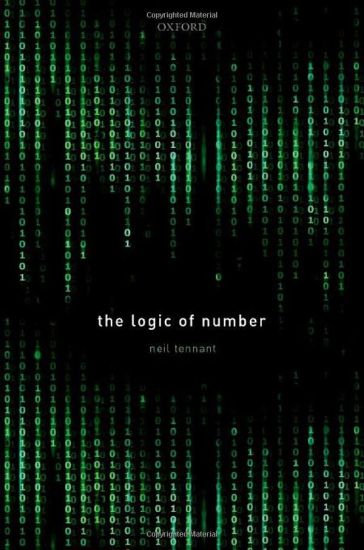
In The Logic of Number, Neil Tennant defines and develops his Natural Logicist account of the foundations of the natural, rational, and real numbers. Based on the logical system free Core Logic, the central method is to formulate rules of natural deduction governing variable-binding number-abstraction operators and other logico-mathematical expressions such as zero and successor. These enable 'single-barreled' abstraction, in contrast with the 'double-barreled' abstraction effected by principles such as Frege's Basic Law V, or Hume's Principle. Natural Logicism imposes upon its account of the numbers four conditions of adequacy: First, one must show how it is that the various kinds of number are applicable in our wider thought and talk about the world. This is achieved by deriving all instances of three respective schemas: Schema N for the naturals, Schema Q for the rationals, and Schema R for the reals. These provide truth-conditions for statements deploying terms referring to numbers of the kind in question. Second, one must show how it is that the naturals sit among the rationals as themselves again, and the rationals likewise among the reals. Third, one should reveal enough of the metaphysical nature of the numbers to be able to derive the mathematician's basic laws governing them. Fourth, one should be able to demonstrate that there are uncountably many reals. Natural Logicism is realistic about the limits of logicism when it comes to treating the real numbers, for which, Tennant argues, one needs recourse to geometric intuition for deeper starting-points, beyond which logic alone will then deliver the sought results, with absolute formal rigor. The resulting program enables one to delimit, in a principled way, those parts of number theory that are produced by the Kantian understanding alone, and those parts that depend on recourse to (very simple) a priori geometric intuitions.
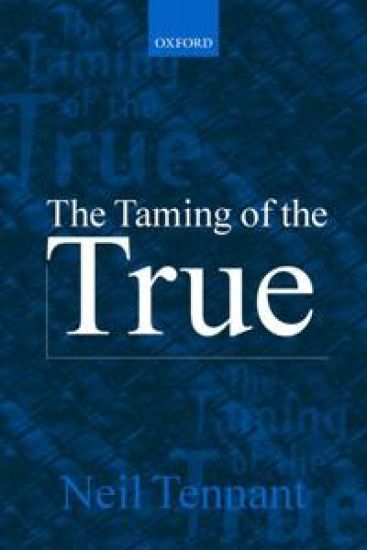
The Taming of the True

The Taming of the True

Neil Tennant

Clarendon Press
1997
sidottu
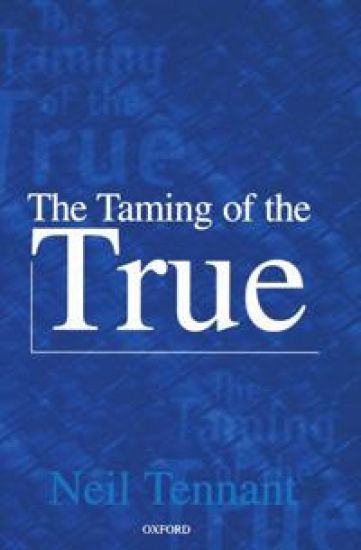
The Taming of the True poses a broad challenge to the realist views of meaning and truth that have been prominent in recent philosophy. Neil Tennant starts with a careful critical survey of the realism debate, guiding the reader through its complexities; he then presents a sustained defence of the anti-realist view that every truth is knowable in principle, and that grasp of meaning must be able to be made manifest. Sceptical arguments for the indeterminacy or non-factuality of meaning are countered; and the much-maligned notion of analyticity is reinvestigated and rehabilitated. Tennant goes on to show that an effective logical system can be based on his anti-realist view; the logical system that he advocates is justified as a body of analytic truths and inferential principles. Having laid the foundations for global semantic anti-realism, Tennant moves to the world of empirical understanding, and gives an account of the cognitive credentials of natural scientific discourse. He shows that the same canon of constructive and relevant inference suffices both for intuitionistic mathematics and for empirical science. This is an ambitious and contentious book which aims to reform not only theory of meaning, but our deductive practices across a broad range of discourses.
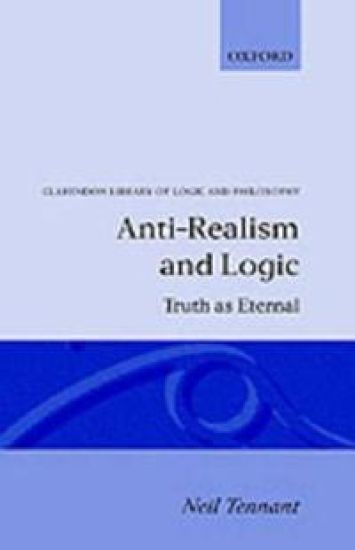
Anti-Realism and Logic

Anti-Realism and Logic

Neil Tennant

Clarendon Press
1987
sidottu
Anti-realism is a doctrine about logic, language, and meaning with roots in the work of Wittgenstein and Frege. In this book, the author clarifies Dummett's case for anti-realism and develops his arguments further. He concludes by advocating a radical reform of our logical practices.
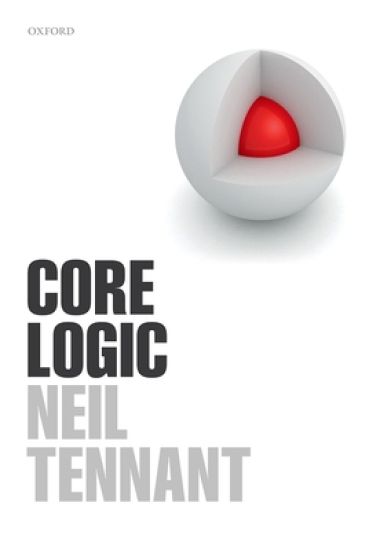
Core Logic

Core Logic

Neil Tennant

Oxford University Press
2017
sidottu
Neil Tennant presents an original logical system with unusual philosophical, proof-theoretic, metalogical, computational, and revision-theoretic virtues. Core Logic, which lies deep inside Classical Logic, best formalizes rigorous mathematical reasoning. It captures constructive relevant reasoning. And the classical extension of Core Logic handles non-constructive reasoning. These core systems fix all the mistakes that make standard systems harbor counterintuitive irrelevancies. Conclusions reached by means of core proof are relevant to the premises used. These are the first systems that ensure both relevance and adequacy for the formalization of all mathematical and scientific reasoning. They are also the first systems to ensure that one can make deductive progress with potential logical strengthening by chaining proofs together: one will prove, if not the conclusion sought, then (even better!) the inconsistency of one's accumulated premises. So Core Logic provides transitivity of deduction with potential epistemic gain. Because of its clarity about the true internal structure of proofs, Core Logic affords advantages also for the automation of deduction and our appreciation of the paradoxes.
The Taming of the True

The Taming of the True

Neil Tennant

Clarendon Press
2002
nidottu
The Taming of the True poses a broad challenge to the realist views of meaning and truth that have been prominent in recent philosophy. Neil Tennant starts with a careful critical survey of the realism debate, guiding the reader through its complexities; he then presents a sustained defence of the anti-realist view that every truth is knowable in principle, and that grasp of meaning must be able to be made manifest. Sceptical arguments for the indeterminacy or non-factuality of meaning are countered; and the much-maligned notion of analyticity is reinvestigated and rehabilitated. Tennant goes on to show that an effective logical system can be based on his anti-realist view; the logical system that he advocates is justified as a body of analytic truths and inferential principles. Having laid the foundations for global semantic anti-realism, Tennant moves to the world of empirical understanding, and gives an account of the cognitive credentials of natural scientific discourse. He shows that the same canon of constructive and relevant inference suffices both for intuitionistic mathematics and for empirical science. This is an ambitious and contentious book which aims to reform not only theory of meaning, but our deductive practices across a broad range of discourses.
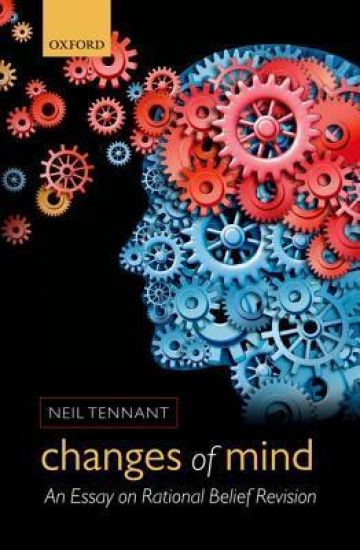
Changes of Mind

Changes of Mind

Neil Tennant

Oxford University Press
2012
sidottu
This is the first logically precise, computationally implementable, book-length account of rational belief revision. It explains how a rational agent ought to proceed when adopting a new belief - a difficult matter if the new belief contradicts the agent's old beliefs. Belief systems are modeled as finite dependency networks. So one can attend not only to what the agent believes, but also to the variety of reasons the agent has for so believing. The computational complexity of the revision problem is characterized. Algorithms for belief revision are formulated, and implemented in Prolog. The implementation tests well on a range of simple belief-revision problems that pose a variety of challenges for any account of belief revision. The notion of 'minimal mutilation' of a belief system is explicated precisely for situations when the agent is faced with conflicting beliefs. The proposed revision methods are invariant across different global justificatory structures (foundationalist, coherentist, etc.). They respect the intuition that, when revising one's beliefs, one should not hold on to any belief that has lost all its former justifications. The limitation to finite dependency networks is shown not to compromise theoretical generality. This account affords a novel way to argue that there is an inviolable core of logical principles. These principles, which form the system of Core Logic, cannot be given up, on pain of not being able to carry out the reasoning involved in rationally revising beliefs. The book ends by comparing and contrasting the new account with some major representatives of earlier alternative approaches, from the fields of formal epistemology, artificial intelligence and mathematical logic.
Introducing Philosophy

Introducing Philosophy

Neil Tennant

Routledge
2015
sidottu
Written for any readers interested in better harnessing philosophy’s real value, this book covers a broad range of fundamental philosophical problems and certain intellectual techniques for addressing those problems. In Introducing Philosophy: God, Mind, World, and Logic, Neil Tennant helps any student in pursuit of a ‘big picture’ to think independently, question received dogma, and analyse problems incisively. It also connects philosophy to other areas of study at the university, enabling all students to employ the concepts and techniques of this millennia-old discipline throughout their college careers – and beyond. KEY FEATURES AND BENEFITS:-- Investigates the philosophy of various subjects (psychology, language, biology, math), helping students contextualize philosophy and view it as an interdisciplinary pursuit; also helps students with majors outside of philosophy to see the relationship between philosophy and their own focused academic pursuits-- Author comes from a distinguished background in Logic and Philosophy of Language, which gives the book a level of rigor, balance, and analytic focus sometimes missing from primers to philosophy-- Introduces students to various important philosophical distinctions (e.g. fact vs. value, descriptive vs. prescriptive, norms vs. laws of nature, analytic vs. synthetic, inductive vs. deductive, a priori vs. a posteriori) providing skills that are important for undergraduates to develop in order to inform their study at higher levels. They are essential for further work in philosophy but they are also very beneficial for students pursuing most other disciplines-- Is much more methodologically comprehensive than competing introductions, giving the student the ability to address a wide range of philosophical problems – and not just the ones reviewed in the book-- Offers a companion website with links to apt primary sources, organized chapter-by-chapter, making unnecessary a separate Reader/Anthology of primary sources – thus providing students with all reading material necessary for the course-- Provides five to ten discussion questions for each chapter, helping instructors and students better interact with the ideas and concepts in the text
Introducing Philosophy

Introducing Philosophy

Neil Tennant

Routledge
2015
nidottu
Written for any readers interested in better harnessing philosophy’s real value, this book covers a broad range of fundamental philosophical problems and certain intellectual techniques for addressing those problems. In Introducing Philosophy: God, Mind, World, and Logic, Neil Tennant helps any student in pursuit of a ‘big picture’ to think independently, question received dogma, and analyse problems incisively. It also connects philosophy to other areas of study at the university, enabling all students to employ the concepts and techniques of this millennia-old discipline throughout their college careers – and beyond. KEY FEATURES AND BENEFITS:-- Investigates the philosophy of various subjects (psychology, language, biology, math), helping students contextualize philosophy and view it as an interdisciplinary pursuit; also helps students with majors outside of philosophy to see the relationship between philosophy and their own focused academic pursuits-- Author comes from a distinguished background in Logic and Philosophy of Language, which gives the book a level of rigor, balance, and analytic focus sometimes missing from primers to philosophy-- Introduces students to various important philosophical distinctions (e.g. fact vs. value, descriptive vs. prescriptive, norms vs. laws of nature, analytic vs. synthetic, inductive vs. deductive, a priori vs. a posteriori) providing skills that are important for undergraduates to develop in order to inform their study at higher levels. They are essential for further work in philosophy but they are also very beneficial for students pursuing most other disciplines-- Is much more methodologically comprehensive than competing introductions, giving the student the ability to address a wide range of philosophical problems – and not just the ones reviewed in the book-- Offers a companion website with links to apt primary sources, organized chapter-by-chapter, making unnecessary a separate Reader/Anthology of primary sources – thus providing students with all reading material necessary for the course-- Provides five to ten discussion questions for each chapter, helping instructors and students better interact with the ideas and concepts in the text
One Hundred Lyrics and a Poem

One Hundred Lyrics and a Poem

Neil Tennant

Faber Faber
2018
sidottu
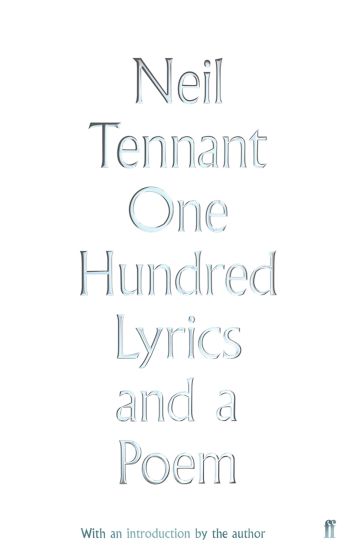
Everything I've ever doneEverything I ever doEvery place I've ever beenEverywhere I'm going toOver a career that spans four decades and thirteen studio albums with Pet Shop Boys, Neil Tennant has consistently proved himself to be one of the most elegant and stylish of contemporary lyricists. Arranged alphabetically, One Hundred Lyrics and a Poem presents an overview of his considerable achievement as a chronicler of modern life: the romance, the break-ups, the aspirations, the changing attitudes, the history, the politics, the pain. The landscape of Tennant's lyrics is recognisably British in character - restrained and preoccupied with the mundane, occasionally satirical, yet also yearning for escape and theatrical release. Often surprisingly revealing, this volume is contextualised by a personal commentary on each lyric and an introduction by the author which gives a fascinating insight into the process and genesis of writing. Flamboyant, understated, celebratory and elegiac, Neil Tennant's lyrics are a document of our times.
One Hundred Lyrics and a Poem

One Hundred Lyrics and a Poem

Neil Tennant

FABER FABER
2026
nidottu
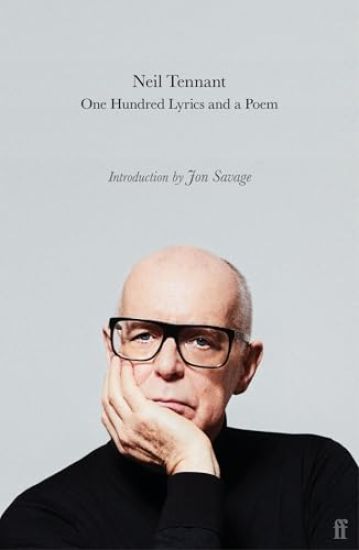
**Featuring a new introduction by Jon Savage** Everything I've ever done Everything I ever do Every place I've ever been Everywhere I'm going to Over a career that spans four decades and fourteen studio albums with Pet Shop Boys, Neil Tennant has consistently proved himself to be one of the most elegant and stylish of contemporary lyricists. Arranged alphabetically, One Hundred Lyrics and a Poem presents an overview of his considerable achievement as a chronicler of modern life: the romance, the break-ups, the aspirations, the changing attitudes, the history, the politics, the pain. The landscape of Tennant's lyrics is recognisably British in character - restrained and preoccupied with the mundane, occasionally satirical, yet also yearning for escape and theatrical release. Often surprisingly revealing, this volume is contextualised by a personal commentary on each lyric and an introduction by the author which gives a fascinating insight into the process and genesis of writing. Flamboyant, understated, celebratory and elegiac, Neil Tennant's lyrics are a document of our times.