Kirjojen hintavertailu. Mukana 11 244 527 kirjaa ja 12 kauppaa.

Kirjahaku

Etsi kirjoja tekijän nimen, kirjan nimen tai ISBN:n perusteella.

5 kirjaa tekijältä Neil Weinstock Netanel

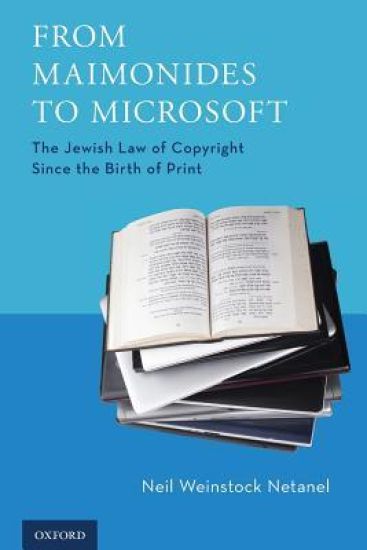
From Maimonides to Microsoft

From Maimonides to Microsoft

Neil Weinstock Netanel

Oxford University Press Inc
2018
nidottu
Jewish copyright law is a rich body of jurisprudence that developed in parallel with modern copyright laws and the book privileges that preceded them. Jewish copyright law owes its origins to a reprinting ban that the Rome rabbinic court issued for three books of Hebrew grammar in 1518. It continues to be applied today, notably in a rabbinic ruling outlawing pirated software, issued at Microsoft's request. In From Maimonides to Microsoft, Professor Netanel traces the historical development of Jewish copyright law by comparing rabbinic reprinting bans with secular and papal book privileges and by relaying the stories of dramatic disputes among publishers of books of Jewish learning and liturgy. He describes each dispute in its historical context and examines the rabbinic rulings that sought to resolve it. Remarkably, the rabbinic reprinting bans and copyright rulings address some of the same issues that animate copyright jurisprudence today: Is copyright a property right or just a right to receive fair compensation? How long should copyrights last? What purposes does copyright serve? While Jewish copyright law has borrowed from its secular law counterpart at key junctures, it fashions strikingly different answers to those key questions. The story of Jewish copyright law also intertwines with the history of the Jewish book trade and with steadfast efforts of rabbinic leaders to maintain their authority to regulate that trade in the face of the dramatic erosion of Jewish communal autonomy in the eighteenth and nineteenth centuries. This book will thus be of considerable interest to students of Jewish law and history, as well as copyright scholars and practitioners.
Copyright's Paradox

Copyright's Paradox

Neil Weinstock Netanel

Oxford University Press Inc
2008
sidottu
The United States Supreme Court famously labeled copyright "the engine of free expression" because it provides a vital economic incentive for much of the literature, commentary, music, art, and film that makes up our public discourse. Yet today's greatly expanded copyright law often does the opposite--it can be used to quash news reporting, political commentary, church dissent, historical scholarship, cultural critique, and artistic expression. In Copyright's Paradox, Neil Weinstock Netanel explores the tensions between copyright law and free speech concerns, revealing how copyright law can impose unacceptable burdens on speech. Netanel provides concrete illustrations of how copyright often prevents speakers from effectively conveying their message, tracing this conflict across both traditional and digital media and considering current controversies such as the YouTube and MySpace copyright infringements, Hip-hop music and digital sampling, and the Google Book Search litigation. The author juxtaposes the dramatic expansion of copyright holders' proprietary control against the individual's newly found ability to digitally cut, paste, edit, remix, and distribute sound recordings, movies, TV programs, graphics, and texts the world over. He tests whether, in light of these developments and others, copyright still serves as a vital engine of free expression and he assesses how copyright does--and does not--burden speech. Taking First Amendment values as his lodestar, Netanel argues that copyright should be limited to how it can best promote robust debate and expressive diversity, and he presents a blueprint for how that can be accomplished. Copyright and free speech will always stand in some tension. But there are ways in which copyright can continue to serve as an engine of free expression while leaving ample room for speakers to build on copyrighted works to convey their message, express their personal commitments, and fashion new art. This book shows us how.
Copyright's Paradox

Copyright's Paradox

Neil Weinstock Netanel

Oxford University Press Inc
2010
nidottu
Providing a vital economic incentive for much of society's music, art, and literature, copyright is widely considered "the engine of free expression^"--but it is also used to stifle news reporting, political commentary, historical scholarship, and even artistic expression. In Copyright's Paradox, Neil Weinstock Netanel explores the tensions between copyright law and free speech, revealing the unacceptable burdens on expression that copyright can impose. Tracing the conflict across both traditional and digital media, Netanel examines the remix and copying culture at the heart of current controversies related to the Google Book Search litigation, YouTube and MySpace, hip-hop music, and digital sampling. The author juxtaposes the dramatic expansion of copyright holders' proprietary control against the individual's newly found ability to digitally cut, paste, edit, remix, and distribute sound recordings, movies, TV programs, graphics, and texts the world over. He tests whether, in light of these and other developments, copyright still serves as a vital engine of free expression and assesses how copyright does--and does not--burden free speech. Taking First Amendment values as his lodestar, Netanel offers a crucial, timely call to redefine the limits of copyright so it can most effectively promote robust debate and expressive diversity--and he presents a definitive blueprint for how this can be accomplished.
Copyright

Copyright

Neil Weinstock Netanel

Oxford University Press Inc
2018
sidottu
Copyright law was once an esoteric backwater, the special province of professional authors, publishers, and entertainment companies, but it now impacts everyone who uses the Internet or consumes cultural expression on a computer, mobile phone, or personal tablet. Copyright has come to be immensely controversial as well. For instance, the proposed Stop Online Piracy Act (SOPA), copyright-industry backed legislation met its defeat at the hands of a popular outcry spearheaded by Google, Wikipedia, and other online aggregators of content and information. SOPA and other such initiatives would target the massive online piracy that threatens the economic viability of newspapers, movie studios, record labels, and book publishers. But the copyright industries' arguably heavy-handed response threatens to chill the free-wheeling wellspring of online creativity, expression, and ready access to information upon which we have all come to rely. To navigate the shoals of these opposing, equally dim prospects is a complex undertaking. No less daunting, even for the educated layperson, is to understand the legal framework, policy arguments, industry economics, legislative proposals, and judicial decisions that fuel the copyright debate. In Copyright: What Everyone Needs to Know®, law professor Neil Netanel guides readers through the murky dynamics of modern copyright law, answering questions about topics such as the new challenges posed by the digital environment, copyright and piracy in the global marketplace, and proposals for future reform. From the basis and purpose of copyright law to a glimpse at what the law could - or should - become in the digital age, Netanel offers the necessary tools for following the debates that have raged everywhere from internet forums to the halls of Congress.
Copyright

Copyright

Neil Weinstock Netanel

Oxford University Press Inc
2018
nidottu
Copyright law was once an esoteric backwater, the special province of professional authors, publishers, and media companies. This is no longer the case. In the age of social media and cloud storage, we have become a copying and sharing culture. Much of our everyday communication, work, and entertainment now directly involves copyright law. Copyright law and policy are ferociously contested. Record labels, movie studios, book publishers, newspapers, and many authors rage that those who share music, video, text, and images over the Internet are âstealingâ their property. By contrast, copyright industry critics celebrate digital technologyâs potential to make the universe of movies, music, books, and art accessible anytime and anywhere â and to empower individuals the world over to express themselves by sharing and remixing those works. These critics argue that excessive copyright enforcement threatens that promise and stifles creativity. In Copyright: What Everyone Needs to Know®, Neil Weinstock Netanel explains the concepts needed to understand the heated debates about copyright law and policy. He identifies the combatants, unpacks their arguments, and illuminates what is at stake in the debates over copyrightâs present and future.