Kirjojen hintavertailu. Mukana 11 342 296 kirjaa ja 12 kauppaa.

Kirjahaku

Etsi kirjoja tekijän nimen, kirjan nimen tai ISBN:n perusteella.

44 kirjaa tekijältä Nic Fields

Lepanto 1571

Lepanto 1571

Nic Fields

PEN SWORD BOOKS LTD
2023
nidottu
The battle of Lepanto has long been considered one of the decisive naval battles of history. Yet, the savage fighting on Sunday, 7 October 1571 left the strategic map unchanged and the defeated Ottoman Turks were able to replace their losses and launch a new fleet the following year. Nic Fields re-examines the battle and concludes that, while it merely confirmed a strategic reality that had already emerged during the 16th century (i.e. that naval supremacy lay with the Sublime Porte in the eastern Mediterranean, and with Habsburg Spain and its Catholic allies in the western Mediterranean), it's vital importance was psychological. It sank the perception of Ottoman dominance and the inevitability of Islam's westward encroachment beyond the Balkans. With over 200 ships per side, it was the largest naval battle in sixteen centuries and the last major fight between fleets composed entirely of the muscle-driven galley. These slender ships were the direct descendants of the Classical trireme but carried cannon and marines bearing firearms, although massed archery and cold steel still played a major r le on the fateful day. Nic Fields gives an excellent account of this fascinating and spectacular battle.
AD69

AD69

Nic Fields

PEN SWORD BOOKS LTD
2023
nidottu
With the death of Nero by his own shaky hand, the ill-sorted, ill-starred Iulio-Claudian dynasty came to an ignominious end, and Rome was up for the taking. This was 9 June, AD 68. The following year, commonly known as the Year of the Four Emperors, was probably one of Romes worst. Nero's death threw up a critical question for the Empire. How could a new man occupy the vacant throne in Rome and establish a new dynasty? This situation had never arisen before, since in all previous successions the new emperor had some relation to his predecessor, but the psychotic and paranoid Nero had done away with any eligible relatives. And how might a new emperor secure his legal position and authority with regards to the Senate and to the army, as well as to those who had a vested interest in the system, the Praetorian Guard? The result was that ambitious and unscrupulous generals of the empire fell into a bloody power struggle to decide who had the right to wear the imperial purple. Tacitus, in his acid way, remarks that 'one of the secrets of ruling had been revealed: an emperor could be created outside Rome'. This was because imperial authority was ultimately based on control of the military. Thus, to retain power a player in the game of thrones had to gain an unshakable control over the legions, which were dotted along the fringes of the empire. Of course, this in turn meant that the soldiers themselves could impose their own choice. Indeed, it turned out that even if an emperor gained recognition in Rome, this counted for nothing in the face of opposition from the armies out in the frontier provinces. It was to take a tumultuous year of civil war and the death of three imperial candidates before a fourth candidate could come out on top, remain there, and establish for himself a new dynasty. Nic Fields narrates the twists and turns and the military events of this short but bloody period of Roman history.Nic Fields, is a former Royal Marine turned classical scholar and now full-time military historian. Among his many previous works are Roman Conquests: North Africa (2010) and The Spartan Way (2012), both published by Pen & Sword.
Attila the Hun

Attila the Hun

Nic Fields

Osprey Publishing
2015
nidottu
A gripping account of how and why the legendary 'scourge of God' was able to inscribe his legacy into the annals of military history.One of the most powerful men in late antiquity, Attila’s peerless Hunnic empire stretched from the Ural mountains to the Rhine river. In a series of epic campaigns dating from the AD 430s until his death in AD 453, he ravaged first the Eastern and later the Western Roman Empire, invading Italy in AD 452 and threatening Rome itself.Lavishly illustrated, this up-to-date analysis of his military achievements examines how Attila was able to sweep across Europe, the tactics and innovations he employed and the major battles he faced, including one of his few major setbacks, the defeat at the battle of the Catalaunian Fields in AD 451.
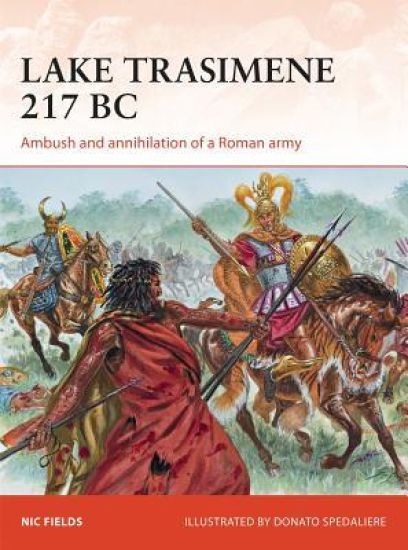
Lake Trasimene 217 BC

Lake Trasimene 217 BC

Nic Fields

Osprey Publishing
2017
nidottu
One of the greatest ambushes in military history, Lake Trasimene was the site of the slaughter of an entire Roman army at the hands of Hannibal during the Second Punic War. An ideal book for all enthusiasts of ancient warfare.Following Hannibal’s crushing victory at the battle of the Trebbia, the reeling Roman Republic sent a new army under the over-confident consul Caius Flaminius to destroy the Carthaginian invaders – unbeknownst to him they were ready and waiting. The destruction of the Roman force at Lake Trasimene firmly established Hannibal as one of the Ancient World’s greatest commanders thanks to his use of innovative tactics, including the first recorded use of a turning movement. The Romans would not send another major army to confront him until the battle of Cannae in 216 BC. This up-to-date study, based on recent archaeological work on the battlefield itself, tells the full story of one of Hannibal’s greatest victories with the help of maps, full-colour illustrations, and detailed sections on the make-up of the armies and their commanders.
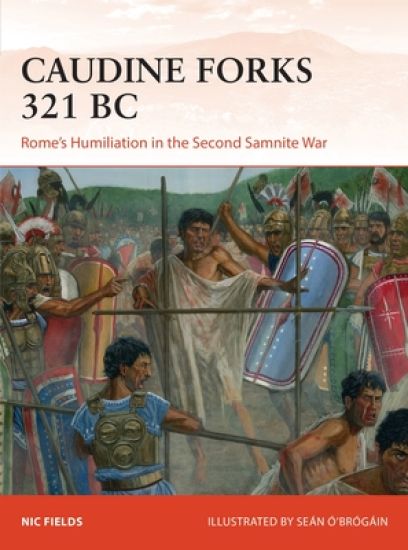
Caudine Forks 321 BC

Caudine Forks 321 BC

Nic Fields

Osprey Publishing
2021
nidottu
A highly illustrated account of one of Ancient Rome's most humiliating defeats, the battle of the Caudine Forks in 321 BC, and how the embarrassment spurred the Roman Army on to eventual triumph.In its long history, the Roman Republic suffered many defeats, but none as humiliating as the Caudine Forks in the summer of 321 BC. Rome had been at war with the Samnites – one of early Rome’s most formidable foes – since 326 BC in what would turn out to be a long and bitter conflict now known as the Second Samnite War. The rising, rival Italic powers vied for supremacy in central and southern Italy, and their leaders were contemplating the conquest of the entire Italian peninsula.Driven by the ambitions of Titus Veturius Calvinus and Spurius Postumius Albinus, Roman forces were determined to inflict a crippling blow on the Samnites, but their combined armies were instead surprised, surrounded, and forced to surrender by the Samnites led by Gavius Pontius. The Roman soldiers, citizens of Rome to a man, were required to quit the field by passing under the yoke of spears in a humiliating ritual worse than death itself.This study, using specially commissioned artwork and maps, analyses why the Romans were so comprehensively defeated at the Caudine Forks, and explains why the protracted aftermath of their dismal defeat was so humiliating and how it spurred them on to their eventual triumph over the Samnites.With this in mind, this study will widen its focus to take account of other major events in the Second Samnite War.
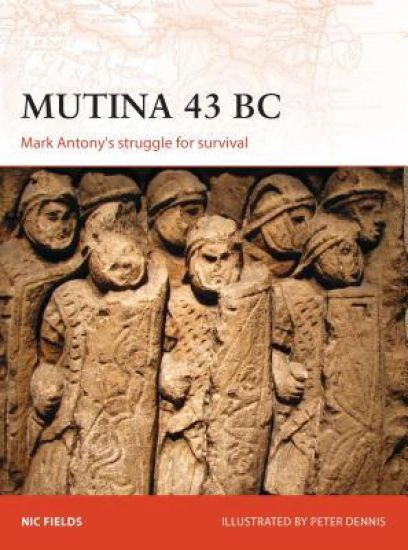
Mutina 43 BC

Mutina 43 BC

Nic Fields

Osprey Publishing
2018
nidottu
In the aftermath of Julius Caesar's assassination, Octavian and the forces of the late Republic battled Mark Antony in the battles of Forum Gallorum and Mutina in 43 BC.Gaius Julius Caesar's self-declared successor Mark Antony struggled to hold together his legacy. Following an abortive coup attempt by Caesar’s adopted son Octavian, two of Antony’s legions declared for him, leading to a renewed outbreak of civil war. Antony moved into northern Italy and invaded the city of Mutina, which was held by Decimus Brutus. There they were quickly sandwiched between the city walls on one side and the newly arrived Senate-backed forces of Octavian on the other.These two heirs of Caesar then fought to claim their former mentor’s legacy. Fully illustrated with specially commissioned artwork and maps, this is the full story of the battles which would see Octavian move from being a young, inexperienced aristocrat to the dominating figure of Augustus.
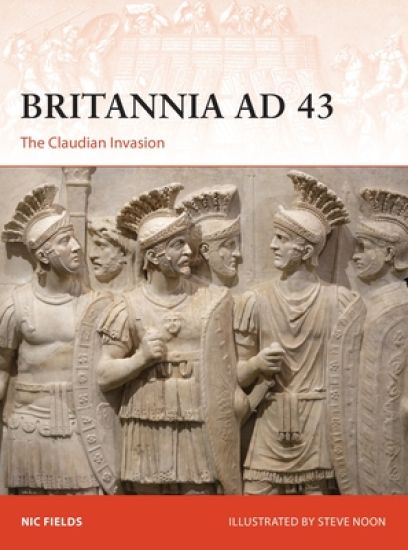
Britannia AD 43

Britannia AD 43

Nic Fields

Osprey Publishing
2020
nidottu
In this highly illustrated and detailed title, Nic Fields tells the full story of the invasion which established the Romans in Britain, explaining how and why the initial Claudian invasion succeeded and what this meant for the future of Britain.For the Romans, Britannia lay beyond the comfortable confines of the Mediterranean world around which classical civilisation had flourished. Britannia was felt to be at the outermost edge of the world itself, lending the island an air of dangerous mystique.To the soldiers crossing the Oceanus Britannicus in the late summer of AD 43, the prospect of invading an island believed to be on its periphery must have meant a mixture of panic and promise. These men were part of a formidable army of four veteran legions (II Augusta, VIIII Hispana, XIIII Gemina, XX Valeria), which had been assembled under the overall command of Aulus Plautius Silvanus.Under him were, significantly, first-rate legionary commanders, including the future emperor Titus Flavius Vespasianus. With the auxiliary units, the total invasion force probably mounted to around 40,000 men, but having assembled at Gessoriacum (Boulogne) they refused to embark. Eventually, the mutinous atmosphere was dispelled, and the invasion fleet sailed in three contingents. Ninety-seven years after Caius Julius Caesar, the Roman army landed in south-eastern Britannia. After a brisk summer campaign, a province was established behind a frontier zone running from what is now Lyme Bay on the Dorset coast to the Humber estuary. Though the territory overrun during the first campaign season was undoubtedly small, it laid the foundations for the Roman conquest which would soon begin to sweep across Britannia.
Athenian Trireme vs Persian Trireme

Athenian Trireme vs Persian Trireme

Nic Fields

BLOOMSBURY PUBLISHING PLC
2022
nidottu
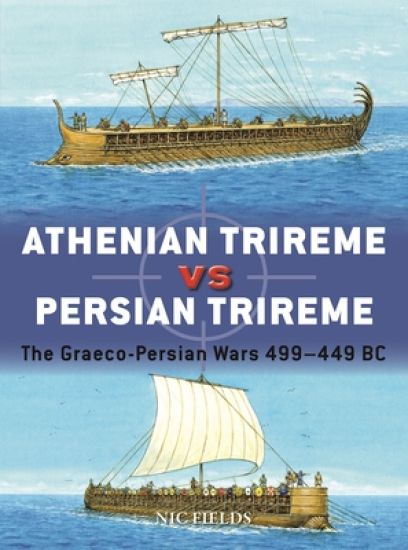
A fascinating and detailed exploration of one of the most famous warships of the Ancient world - the trireme - and its tactical employment by the opposing sides in the 5th-century BC Graeco-Persian Wars.You may be familiar with the Athenian trireme – but how much do you know about the ram-armed, triple-oared warships that it dueled against at the battles of Artemision, Salamis and the Eurymedon River? How similar or different were these warships to each other? And why did the Persians rely on Phoenician vessels to form much of their navy? Much attention has been devoted to the Greek trireme, made famous by modern reconstruction – with only passing notice given to the opposing Persian navy’s vessels in illustrated treatments. Join us on the Aegean as, for the first time, we reveal a rarely attempted colour reconstruction of a trireme in Persian service. Compare the form, construction, design, manoeuvrability, and tactical deployment of the opposing triremes, aided by stunning illustrations. Man the decks of these warships with the fighting complement of Greek citizen hoplites, Scythian archers and Persian marines, and learn why the Greeks placed a bounty of 10,000 drachmae on the head of Artemisia – the Karian queen and Persian admiral, and the only woman among Xerxes’ commanders.
Carrhae 53 BC

Carrhae 53 BC

Nic Fields

BLOOMSBURY PUBLISHING PLC
2022
nidottu
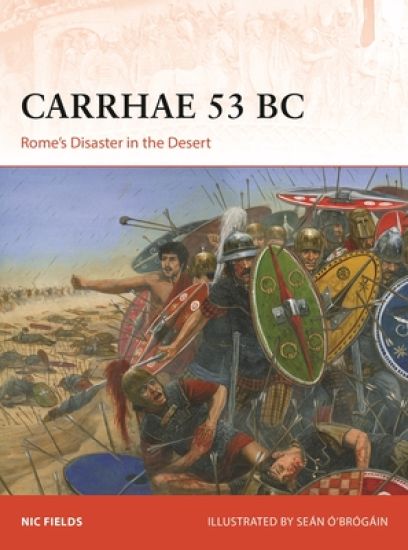
Explores the critical battle of Carrhae, a fascinating tale of treachery, tactics, and topography in which Rome experienced one of its most humiliating defeats.The Battle of Carrhae is from a heady moment in Roman history – that of the clever carve-up of power between the ‘First Triumvirate’ of Caius Iulius Caesar, Cnaeus Pompeius Magnus and Marcus Licinius Crassus (the Roman general who had famously put down the Spartacan revolt). It is a fascinating tale of treachery, tactics, and topography in which Rome experienced one of its most humiliating defeats at the hands of the Parthians, not far from a trade-route town hunkered down on the fringes of the arid wastes of northern Mesopotamia, sending shock waves through the Roman power structure. In this work, classical historian Dr Nic Fields draws out the crucial psychological and political factors (including Crassus’ lust for military glory and popular acclaim) that played a key role in this brutal battle. Despite being heavily outnumbered, the Parthian general Surena's horsemen completely outmanoeuvered Crassus' legionaries, killing or capturing most of the Roman soldiers. The detailed battlescene artworks reveal the tactics and techniques of the Parthian horse archers, and Roman and Parthian equipment and weaponry, and the approach to battle is clearly explained in 2d maps and 3D bird's-eye views.
The Hydaspes 326 BC

The Hydaspes 326 BC

Nic Fields

BLOOMSBURY PUBLISHING PLC
2023
nidottu
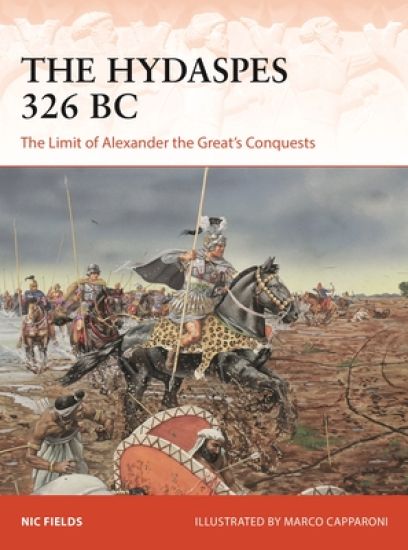
The first dedicated examination of Alexander the Great’s final battle and acknowledged tactical masterpiece. In the years that followed Alexander the Great’s victory at Gaugamela on 1 October 331 BC, his Macedonian and Greek army fought a truly ‘Herculean’ series of campaigns in what is today Iran, Turkmenistan, Afghanistan, and Pakistan. But it was in the Indus Valley, on the banks of the Hydaspes River (known today as the Jhelum) in 326 BC that Alexander would fight his last major battle against King Poros. Using detailed maps and 3D diagrams, this beautifully illustrated work shows how Alexander used feints and deception to transport a select force from his army across the swollen River Hydaspes without attracting the enemy’s attention, allowing his troops the crucial element of surprise. Battlescene artworks and photographs reveal the fascinating array of forces that clashed in the battle, including Indian war elephants and chariots, and horse archers and phalanx formations. Also examined are the differences in weaponry and armour between the opposing sides, which would prove crucial to the outcome. Although a tactical masterpiece, the Hydaspes was the closest that Alexander the Great came to defeat, and was one of the costliest battles fought by his near-exhausted army.
The Cimbrian War 113–101 BC

The Cimbrian War 113–101 BC

Nic Fields

BLOOMSBURY PUBLISHING PLC
2023
nidottu
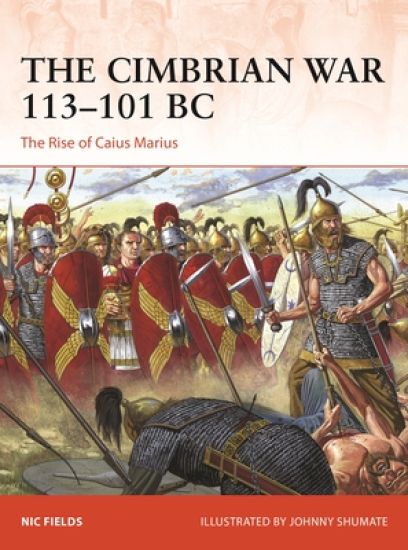
A gripping illustrated narrative of the Cimbrian (or Cimbric) War, in which the armies of the Roman Republic finally defeated the Germanic tribes of the Cimbri, Teutons, Ambrons and Tigurini.Rome's victory in the Cimbrian War was born of a number of huge and devastating defeats at the hands of the Germanic tribes (chiefly the Cimbri and Teutones), who had migrated en masse southwards in the late 2nd century BC. These included the defeat in 113 BC of the consul Cnaeus Papirius Carbo at Noreia; the smashing of Marcus Iunius Silanus’ army near Burdigala (Bourdeaux) in 109 BC, and the humiliating destruction of two consular armies at Arausio (Orange) four years later. This work explores how, in the autumn of 105 BC, Caius Marius managed to contain the Germanic threat in the north, before crushing it in two successful battles, at Aquae Sextiae (Aix-en-Provence) in Gallia Transalpina in 102 BC and at Vercellae (Vercelli) in Gallia Cisalpina in 101 BC.Packed with stunning illustrations covering the major clashes of this epic and drawn-out war of the late Republic, this work brings to life for the first time Rome's vital quashing of the Germanic threat to its very existence. It also documents the rise of Marius, one of Rome’s most important martial figures, who was highly significant in the transformation of its armed forces.
The Jugurthine War 112–106 BC

The Jugurthine War 112–106 BC

Nic Fields

BLOOMSBURY PUBLISHING PLC
2025
nidottu
The fascinating story of Republican Rome's gruelling six-year campaign against the insurgent Numidian warlord, Jugurtha.Jugurtha, the adoptive son of Micipsa, king of the Numidians, was initially a much-respected ally of Rome, fighting gallantly alongside the Romans during the Numantine War in Iberia. Over the course of the campaign, however, the ambitious and hot-headed Jugurtha fell in with more unsavoury company, who urged him to stage a coup d’etat and wrest control of Numidia from the legitimate heirs to the throne. Although he was warned not to consort with some of Rome’s more crooked governing elites, this advice fell on deaf ears, beginning a civil war. Rome’s response was to decide on war to punish Jugurtha for his acts of aggression. Among the commanders proving their worth against this formidable opponent would be Quintus Metellus and Caius Marius.Here, classical historian Dr Nic Fields narrates the events of a bruising six-year campaign against the wily, elusive Jugurtha. He explores how Roman military performance was hampered by petty rivalries, knee-jerk partisanship, and grubby jostling between commanders. With photographs and artwork bringing the clashes in North Africa to life, the maps and diagrams provide context for this lengthy campaign. The war constituted an important stage in the Roman subjugation of North Africa, and the rise of the empire.
God's Viking: Harald Hardrada

God's Viking: Harald Hardrada

Nic Fields

Pen Sword Military
2019
sidottu
Harald Hardrada is perhaps best known as the inheritor of seven feet of English soil in that year of fateful change, 1066\. But Stamford Bridge was the terminal point of a warring career that spanned decades and continents. Thus, prior to forcibly occupying the Norwegian throne, Harald had an interesting (and lucrative) career in the Varangian Guard, and he remains unquestionably the most notable of all the Varangians who served the Byzantine emperors: in the latter employment he saw active service in the Aegean, Sicily, Italy, Anatolia, Syria, Palestine and Bulgaria, while in Constantinople he was the hired muscle behind a palace revolution. A man of war, his reign in Norway was to be taken up with a wasteful, vicious and ultimately futile conflict against Denmark, a kingdom (like England) he believed was his to rule. We follow Harald s life from Stiklestad, where aged fifteen he fought alongside his half-brother king Olaf, through his years as a mercenary in Russia and Byzantium, then back to Norway, ending with his death in battle in England.
Lepanto 1571

Lepanto 1571

Nic Fields

Pen Sword Maritime
2020
sidottu
The battle of Lepanto has long been considered one of the decisive naval battles of history. Yet, the savage fighting on Sunday, 7 October 1571 left the strategic map unchanged and the defeated Ottoman Turks were able to replace their losses and launch a new fleet the following year. Nic Fields re-examines the battle and concludes that, while it merely confirmed a strategic reality that had already emerged during the 16th century (i.e. that naval supremacy lay with the Sublime Porte in the eastern Mediterranean, and with Habsburg Spain and its Catholic allies in the western Mediterranean), it's vital importance was psychological. It sank the perception of Ottoman dominance and the inevitability of Islam's westward encroachment beyond the Balkans. With over 200 ships per side, it was the largest naval battle in sixteen centuries and the last major fight between fleets composed entirely of the muscle-driven galley. These slender ships were the direct descendants of the Classical trireme but carried cannon and marines bearing firearms, although massed archery and cold steel still played a major r le on the fateful day. Nic Fields gives an excellent account of this fascinating and spectacular battle.
Alesia 52 BC

Alesia 52 BC

Nic Fields

Osprey Publishing
2014
nidottu
52 BC is the key year of the Gallic Revolt, with the near-disastrous Roman defeat at Gergovia followed by the climactic victory over the Gallic chieftain Vercingetorix at Alesia.In 52, BC Caesar's continued strategy of annihilation had engendered a spirit of desperation, which detonated into a revolt of Gallic tribes under the leadership of the charismatic young Arvernian noble Vercingetorix. Major engagements were fought at Noviodunum, Avaricum, and Gergovia, with the last action being the most serious reverse that Caesar faced in the whole of the Gallic War.However, Vercingetorix soon realized that he was unable to match the Romans in pitched battle. Taking advantage of the tribesmen's superior knowledge of their home territory, Vercingetorix began a canny policy of small war and defensive manoeuvres, which gravely hampered Caesar's movements by cutting off his supplies. For Caesar it was to be a grim summertime – his whole Gallic enterprise faced disaster.In the event, by brilliant leadership, force of arms, and occasionally sheer luck, Caesar succeeded in stamping out the revolt in a long and brutal action culminating in the siege of Alesia. Vercingetorix finally surrendered and Alesia was to be the last significant resistance to the Roman will. Never again would a Gallic warlord independent of Rome hold sway over the Celts of Gaul.
Thermopylae 480 BC

Thermopylae 480 BC

Nic Fields

Osprey Publishing
2007
nidottu
An authoritative re-telling of one of the greatest tales of heroism of all time and a decisive moment for the history of the world, Leonidas and the 300 Spartans' fight to the death against overwhelming Persian forces preserved the future of Greece and the golden age of classical civilization. Nic Fields vividly describes the battle for the pass of Thermopylae as the combined Greek forces held off the army of Xerxes, buying time for a retreat which would save Greece. Lavishly illustrated and with full-colour artwork, detailed maps and dramatic battle scenes, this is an in-depth analysis of one of the most famous acts of resolute defence in the face of overwhelming odds.
Hadrian’s Wall AD 122–410

Hadrian’s Wall AD 122–410

Nic Fields

Osprey Publishing
2003
nidottu
Hadrian's Wall is the most important monument built by the Romans in Britain. It is the best known frontier in the entire Roman Empire and stands as a reminder of past glories of one of the world's greatest civilizations. Its origins lie in a visit by the Emperor Hadrian to Britain in AD 122 when he ordered the wall to be built to mark the northern boundary of his Empire and to "separate the Romans from the Barbarians". This work details the design development and construction of the wall and covers the everyday lives of those who manned it as well as the assaults it withstood.
Troy c. 1700–1250 BC

Troy c. 1700–1250 BC

Nic Fields

Osprey Publishing
2004
nidottu
In all the stories told by mankind and recorded through its history, the tale of the siege of Troy is perhaps the greatest secular story ever told. It has certainly captured the western imagination for some 3000 years. Archaeological work has revealed that the site around Hisarlik, where Troy is believed to have been, is considerably larger and more interesting than was previously thought, making it more likely that the Trojan Wars were on the scale implied by Homer. This book reveals the literary, historical and archaeological records which make up the background to the tale of Troy and describes in detail the fortifications of Troy VI (i.e. Homer's Troy) and their correlation to other Bronze Age defence works in the Near East. This book also introduces the reader to the literary, historical and archaeological records which make up the background to the tale of Troy.
Mycenaean Citadels c. 1350–1200 BC

Mycenaean Citadels c. 1350–1200 BC

Nic Fields

Osprey Publishing
2004
nidottu
From 1600 BC urban civilisation in Greece began to thrive and the power of a number of warlord states began to be felt around the Aegean. This period of Greek development and prosperity is called the Late Helladic or Mycenaean period, a time when Greek society was constantly geared for battle and invasion, and cities were fortress-like with extremely thick perimeter walls. Mycenae, Tiryns, Argos, Krisa, the Athenian Acropolis and Gla are all representative of the fortified citadels that dominated the Greek countryside for over 2000 years. This title charts the histories of the fortresses inhabited by Homer's heroes, detailing their development, use in war and eventual decline.