Kirjojen hintavertailu. Mukana 11 244 527 kirjaa ja 12 kauppaa.

Kirjahaku

Etsi kirjoja tekijän nimen, kirjan nimen tai ISBN:n perusteella.

47 kirjaa tekijältä Nicholas Hagger

The Secret Founding of America [16 Pt Large Print Edition]
The widely accepted story of the founding of America is that The Mayflower delivered the first settlers from Plymouth to the New World in 1620. Yet thirteen years earlier, in 1607, the Jamestown settlers became the first English - speaking outpost to survive. And it is from this date that the USA is celebrating its 400th anniversary. The Secret ...
The Secret American Destiny

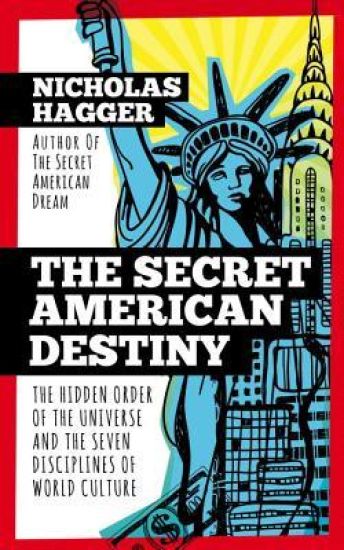
The Secret American Destiny

Nicholas Hagger

Watkins Publishing
2016
pokkari
At present religious adherents outnumber non-religious by nearly 6 to 1 and world culture is divided between traditional and modern outlooks. In each of world culture's seven disciplines there are conflicting metaphysical and secular approaches. A unified world culture is essential if there is to be a World State, and The Secret American Destiny shows how America can heal this division by reviving science's view of the order in the universe, the experience of the common essence of all religions (the ordering Light), and the traditional view of order in each of the seven disciplines.In this accessible, thought-provoking and highly informed work, which carries forward his thinking in his widely discussed and acclaimed The Secret Founding of America and The Secret American Dream and in his studies of civilizations and cultures, Nicholas Hagger shows how Universalism, the study of the whole of humankind's activities, is in line to be the next American philosophy and how American Universalism can * challenge the secular, social approach that denies the traditional metaphysical perspective and regards the universe as an accident; * reconcile the traditional and modern approaches on their common regard for order; and * champion the prospect of world unity under a coming democratic World State based on the UN General Assembly. Hagger shows how restoring the metaphysical vision of order in Nature, the sciences and the seven disciplines will enable America to unify world culture and humankind, and fulfill America's destiny to bring to birth a World State that will transcend all nation-states and export the American Dream of freedom and prosperity to all humankind.
The Secret Founding of America

The Secret Founding of America

Nicholas Hagger

Watkins Publishing
2016
pokkari
The widely accepted story of the founding of America is that The Mayflower delivered the first settlers from Plymouth to the New World in 1620. Yet in reality, the Jamestown settlers had already become the first English-speaking outpost thirteen years earlier in 1607."The Secret Founding of America"introduces these two groups of founders - the Planting Fathers, who established the earliest settlements along essentially Christian lines, and the Founding Fathers, who unified the colonies with the Declaration of Independence and the Constitution - and it argues that the new nation, conceived in liberty, was the Freemasons' first step towards a new world order. Drawing on original findings and an in-depth understanding of the political and philosophical realities of the time, historianNicholas Haggercharts the connections between Gosnold and Smith, Templars and Jacobites, and secret societies and libertarian ideals. He also explains how the influence of German Illuminati worked on the constructors of the new republic, and shows the hand of Freemasonry at work at every turning point in America's history, from Civil War to today's global struggles for democracy."
My Double Life 2 – A Rainbow Over the Hills

My Double Life 2 – A Rainbow Over the Hills

Nicholas Hagger

John Hunt Publishing
2015
nidottu
In My Double Life 1 Nicholas Hagger told of his four years' service and double life as an undercover British intelligence agent during the Cold War (there revealed for the first time). Lost in a dark wood like Dante following his encounters with Gaddafi's Libya and the African liberation movements, he found Reality on a 'Mystic Way' of loss, purgation and illumination, perceived the universe as a unity and had 16 experiences of the metaphysical Light. In My Double Life 2 he continues the story. He received new powers, coped with fresh ordeals, acquired three schools, renovated a historic house, and had 76 further experiences of the metaphysical Light. He founded a new philosophy of Universalism and new approaches to contemporary history, international statecraft and world literature. He produced nearly 1,500 poems, over 300 classical odes, five verse plays, two poetic epics, over a thousand short stories - and 40 books that include innovative literary, historical and philosophical works. His vision of Universalism in seven disciplines is like a rainbow with seven bands overarching seven hills. He produced nearly 1,500 poems, over 300 classical odes, five verse plays, two poetic epics, over a thousand short stories - and 40 books that include innovative literary, historical and philosophical works. His vision of Universalism in seven disciplines is like a rainbow with seven bands overarching seven hills.
Selected Poems: Quest for the One

Selected Poems: Quest for the One

Nicholas Hagger

John Hunt Publishing
2015
nidottu
These poems serve as an introduction to Nicholas Hagger's poetic works, which include nearly 1,500 poems, more than 300 classical odes, two poetic epics and five verse plays. They are grouped in two parts which reflect the two aspects of the fundamental theme of world literature outlined in his A New Philosophy of Literature: 'Quest for the One' and 'Follies and Vices'. They present a quest for Reality along with moments of heightened consciousness in which the universe is seen as a unity, and condemn social follies and over 220 vices in terms of an implied virtue. This selection of poems combines image and statement in the reconciling Universalist manner, and in different poems blends Romantic search and organic form with classical social attitudes, verbal precision and architectural structure. The poems cover five decades and include extracts from 'The Silence', which describes Freeman's quest for Reality in Modernist style, 'Archangel' (a reflection on Communism following visits to China and the Soviet Union), poems written during a Dark Night of the Soul, glimpses of illumination and poems of social satire. There are also extracts from Hagger's verse plays. As can be seen from his 'A Metaphysical in Marvell's Garden' Hagger derives his inspiration from the 17th-century Metaphysical poets and seeks to unite the later Augustan and Romantic traditions. This selection offers a chance to reappraise a poet whose material, accomplished technique and reconciling sensibility places him in the forefront of poets writing today.
Selected Stories: Follies and Vices of the Modern Elizabethan Age
These stories serve as an introduction to Nicholas Hagger's five volumes totalling 1,001 stories (an echo of The Thousand and One Nights, or Arabian Nights). They are grouped in two parts which reflect the two aspects of the fundamental theme of world literature outlined in his A New Philosophy of Literature: 'Follies and Vices' and 'Quest for the One'. These stories condemn follies and vices in relation to an implied virtue - more than 150 vices are listed in a Preface - and present moments of heightened consciousness in which the universe is perceived as a unity.
World State – How a democratically–elected World Government can replace the UN and bring peace
Since 1945 the UN has failed to prevent 162 wars and the proliferation of nuclear weapons, and there is talk of a Third World War involving the Middle East, the Baltic states and North Korea. Competing nation-states seem powerless to achieve world peace under the UN. Continuing a tradition that began with the 1945 atomic bombs, Nicholas Hagger follows Truman, Einstein, Churchill, Eisenhower, Gandhi, Russell, J.F. Kennedy and Gorbachev in calling for a democratic, partly-federal World State with sufficient authority to abolish war, enforce disarmament, combat famine, disease and poverty, and solve the world’s financial and environmental problems. In World State Hagger sets out the historical background and the failure of the current political order of nation-states. He presents the ideal World State - its seven federal goals, its structure and the benefits it would bring - and sets out a manifesto that would turn the UN General Assembly into an elected lower house of a democratic World State.
Dream of Europa, The – The Triumph of Peace

Dream of Europa, The – The Triumph of Peace

Nicholas Hagger

John Hunt Publishing
2015
nidottu
In The Dream of Europa, following the tradition of celebratory court masques in verse by Ben Jonson and more recently William Empson, Nicholas Hagger celebrates the court of the leaders of the European Union. Through a chorus of 50 representatives of European states he presents the growth and expansion of what became the EU in an epic sweep that takes us from 1945 to 2015 and incorporates the five elements (prologue, antimasque, masque, revels, epilogue) and blend of mythology and history found in all masques. Zeus asks Europa, the goddess of Europe, to sort out the chaos and disorder that devastated Europe in 1945. Europa presides over the growing unification of a European Union of 28 states with 22 more expected to join. Celebratory revels acclaim the Treaty of Lisbon but there is a discordant note, and Churchill has strong words for the UK representative. Finally Europa hands the EU back to Zeus. The dream of Europa is that one day the EU will turn into a United States of Europe consisting of 50 states (see front cover) like the USA, and will bring in a Universalist World State. As a court entertainment for European leaders celebrating Europe's progress from disorder to order, The Dream of Europa cries out to be performed in Brussels. It heralds the triumph of peace during the 70 years following 1945 and calls for a strengthening of European unity in the face of an expanding Russia that still regards Eastern Europe as being within its sphere of influence. This masque and its informative appendix on European states and rights will appeal to all generations in the 50 European states and to all beyond who value a peaceful Europe in our troubled time.
Algorithm of Creation, The

Algorithm of Creation, The

Nicholas Hagger

Collective Ink
2023
nidottu
The Algorithm of Creation is the last of Nicholas Hagger’s quartet on the unity of the universe and humankind, and follows The Universe and the Light (1993), The One and the Many (1999) and The New Philosophy of Universalism (2009). It offers an algebraic formula written out for him by Junzaburo Nishiwaki, Japan’s T.S. Eliot, in Tokyo in October 1965, that sums up the wisdom of the East: “+A + –A = 0.” Based on ancient Chinese thinking, yin (dark) + yang (light) = the Tao, it shows all opposites reconciled in the underlying unity of the One Void whose emptiness is also a fullness. During a dinner at a conference of leading scientists at Jesus College, Cambridge in September 1992, watched by Nobel physics prizewinner Roger Penrose, Hagger reversed the formula to 0 = +A + –A when he wrote down the maths for his view of the origin and creation of the universe and showed the first two particles emerging from the Void’s singularity, influenced by the 1992 discovery of ripples in the cosmic microwave background radiation and the Presocratic Anaximander of Miletus. In this work Hagger shows how this algebraic formula has worked as a universal algorithm, 0 = +A + –A = 0. Its many variations have acted as rules that have controlled the creation and development of the expanding universe, its evolution and the rise of human history, religion and science, and its ultimate fate. The formula is behind many of Hagger’s works, and his application of this algorithm to all human knowledge of the universe and all disciplines takes him to a first-ever Theory of Everything, which is set out at the end: the algorithm of Creation containing 100 mathematical symbols (reflecting all the variations) that can be summed up in the above algorithm. This startling achievement has been made possible by his Universalist cross-disciplinary approach which focuses on the fundamental oneness of the universe and humankind, and the unitive vision.
Building of the Great Pyramid, The

Building of the Great Pyramid, The

Nicholas Hagger

Collective Ink
2024
nidottu
When he was ten Nicholas Hagger’s dentist, Howard Carter’s brother, told him about the opening of Tutankhamun’s tomb, and he was later given a shawabti (funerary figurine) of Tutankhamun that came from the tomb. As a teenager he was fascinated by the Great Pyramid, and in 1963 he wrote ‘The Riddle of the Great Pyramid’ as a parable for our time. Written as a report by an official living at Giza during the construction in progress in c.2600BC, it explains the massive organisation and endeavour that has gone into the building so far when those involved in the work do not know its purpose or why it is being built. The notion of the Great Pyramid as a symbol of bafflement and a microcosm of Western society has haunted Hagger throughout his working life. After visiting it in 2005 he wrote a sequel by the same official, ‘The Meaning and Purpose of the Great Pyramid’, which carries the story forward, and after another visit in 2020 he wrote ‘The Great Pyramid as a House of Eternity’, which completed a Pyramid trilogy. These three reports, which have followed research into the building of the Great Pyramid for 57 years, are now brought out together with illustrations that throw light on the events described and reveal the Pharaoh’s face on the Sphinx. Collectively they offer a factual account of the construction soon after 2600BC and the aspirations of humans seeking a life beyond death before the birth of the established religions, and as parables in the tradition of Swift, they profoundly question the modern world of work and organisation of Western society. They present a quest for eternity that is also a self-aggrandising folly at the beginning of recorded history, and illustrate the dialectic between a quest for Reality and condemnation of follies and vices that Hagger identified as the fundamental theme of world literature in A New Philosophy of Literature.
Peace for our Time

Peace for our Time

Nicholas Hagger

John Hunt Publishing
2018
nidottu
In this remarkable memoir Nicholas Hagger reflects on war and peace and on 'peace for our time', Chamberlain’s haunting words in 1938 that ushered in the Second World War. Peace then turned out to be an illusion shattered by the outbreak of hostilities. Will world peace again turn out to be an illusion? With a lightness of touch Nicholas Hagger addresses the burning issue of our time - whether a new world structure can avert a new world war - and unveils a vision of a better, safer world for our grandchildren. This stimulating work will fascinate and inspire a new generation looking beyond nation-state self-interest to world unity.
King Charles the Wise

King Charles the Wise

Nicholas Hagger

John Hunt Publishing
2018
nidottu
In King Charles the Wise, Nicholas Hagger celebrates the UK’s post-Brexit global destiny and foresees the birth of a united world. Following the tradition of Ben Jonson’s 17th-century celebratory court masques in verse and his own The Dream of Europa (which celebrated 70 years of peace in Europe), and incorporating the blend of mythology and history and five sections (prologue, antimasque, masque, revels and epilogue) found in all masques, he describes how Zeus sends Minerva, goddess of Wisdom, as an ambassador to Prince Charles in Buckingham Palace. Zeus wants a democratic World State to end all wars, as called for by Truman, Einstein, Churchill, Eisenhower, Gandhi, Russell, J.F. Kennedy and Gorbachev. He sees the innovative and influential UK as best placed to give this humanitarian vision global prominence, and seeks the support of its future King, Charles, deeming him more enduring and open-minded than its transient, partisan politicians. Minerva confronts Prince Charles with the conflicting perspectives of the goddesses Britannia, Europa and Columbia (who speak for the UK, EU and US), and foresees a World State that will abolish war. He accepts the humanitarian concerns behind this Universalist vision, and Minerva crowns him `King Charles the Wise’. Besides being King of the UK and all its faiths he will sympathise with the plight of all humankind and inspire a new world structure that can bring universal peace during the coming Carolingian Age.
Oak Tree and the Branch, The

Oak Tree and the Branch, The

Nicholas Hagger

Collective Ink
2025
nidottu
Nicholas Hagger?s Collected Poems?contained 30 volumes of his poems, and Life Cycle and Other New Poems?contained volumes 31?34. Together they reflect his quest along the Mystic Way, and the vision of unity and harmony to which it led. The Oak Tree and the Branch?contains volumes 35?41 and continues his presentation of apparent conflicts (Brexit, coronavirus, war and extreme suffering) and the underlying unity of the universe within his Arcadia. The Oak Tree and the Branch?sees the UK?s departure from Europe as a lopped branch from the Tree of Tradition of European civilisation. The Tapestry?dwells on his rootedness in the past, especially in the Tudor time. A Plague in Arcadia: Oneness with Nature and the Universe?presents a host of Nature poems in his local Fairmead?s Arcadian paradise during the spread of coronavirus, the Covid plague. An Oval Cloud?presents a sequence of encounters with an oval cloud seen behind his closed eyes, which he tries to understand. Court Poems: More Royal Classical Odes?includes Royal events: a wedding, two funerals and a coronation, and another lopped branch. In Arcady: A Gong and Padded Stick?surveys his Providential life. And the harrowing Agony in Arcady: Stroke?wrings from him the whole range of emotions as he comes to terms with his daughter?s severe stroke (another lopped branch) and heroic endurance. Hagger?s mystical vision of the unity of Nature, the universe and humankind shines through all these new poems. Hagger derives his inspiration from the 16th- and 17th-century Metaphysical poets and seeks to unite the later Augustan and Romantic traditions. These poems reconcile the soul?s harmony with the universe and the conflicts in public life, and add significantly to the themes of Collected Poems, Classical Odes, Life Cycle?and Hagger?s two poetic epics, Overlord?and Armageddon, all published by O-Books. They carry forward his Universalist approach to poetry which unveils an ordered universe behind the apparent chaos of world events
Still Brimming Twilit River, The

Still Brimming Twilit River, The

Nicholas Hagger

Collective Ink
2025
nidottu
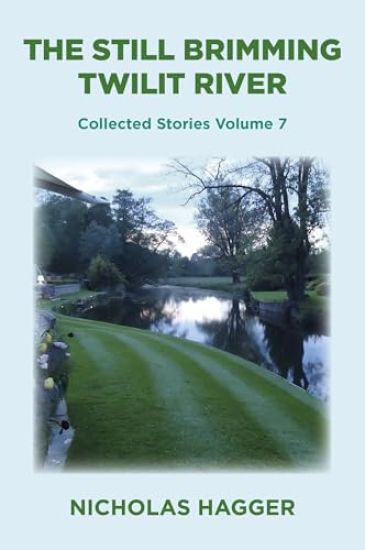
The Still Brimming Twilit River?is volume 7 of Nicholas Hagger?s Collected Stories?and follows The First Dazzling Chill of Winter/ (2016), which dealt with impending old age. The 1,202 short stories in the previous six volumes cover six decades (from the 1960s to the 2010s) in the life of Philip Rawley. This seventh volume covers a seventh decade and contains 220 more stories and deals with his defiance of growing old. Philip Rawley?s attitude is akin to Tennyson?s Ulysses who, despite the infirmities of old age, is ready to 'sail beyond the sunset and the baths/Of all the western stars'?in search of new experience and new adventures. These mini-stories present a range of characters from a stable society. A number of these characters reappear in other stories, and are presented with their strengths, follies and flaws in different situations. The stories offer a complete literary experience in a page or two, and their brevity is innovatory. The combination of opposites in their vivid titles derives inspiration from the 17th century: Dr Johnson?s definition of the wit of the Metaphysical poets as 'a combination of dissimilar images'?in which 'the most heterogeneous ideas are yoked by violence together'?(?Life of Cowley?). These stories are verbal paintings and present an image in action with a poet?s eye for significant detail. Hagger?s stories are imagistic, economical and vivid in clean prose and reflect the Age. They contain memorable images and studies of character. They are ideal for short concentration spans, reading on journeys or in bed. They drop into the consciousness like stones and leave the mind to reflect on the spreading ripples. ?
Visions of England

Visions of England

Nicholas Hagger

John Hunt Publishing
2019
nidottu
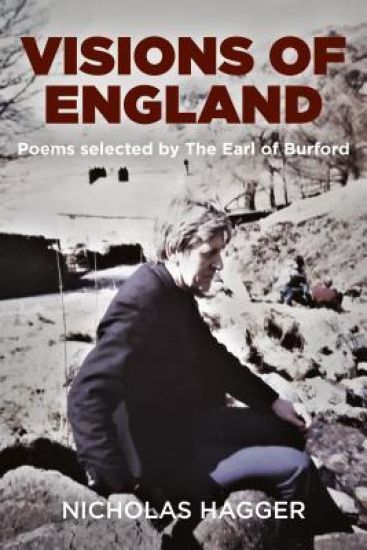
In 1999, while working as his Literary Secretary, the Earl of Burford, a descendant of the 3rd Earl of Southampton (Shakespeare’s patron) and of the 17th Earl of Oxford and heir to the Dukedom of St Albans, made a selection of Nicholas Hagger’s poems that celebrates places in England, conveys his mystical awareness of the unity of the universe and places him in the visionary tradition of William Blake, the poet of `Jerusalem’ and “England’s green and pleasant land”. Soon after Visions of England was completed the Earl of Burford came to international attention when he leapt onto the Woolsack of the House of Lords in a principled protest against the Blair Government’s plan to abolish hereditary peers’ voting rights, which led to 92 remaining in the Lords. A few months later he left Nicholas Hagger’s employ and the selection was buried under papers for nearly 20 years. In 2018 Nicholas Hagger came across Visions of England while preparing papers to send to his archive. It now seemed as if the selection had been made with Brexit in mind. The places are full of English history and culture, and the poems are prophetic in their anticipation of England’s new spirit of independence. These poems convey Englishness with a freshness and vividness that startle. The Earl of Burford is a prominent lecturer and biographer, and his selection is noteworthy for the metaphysical perspective he brings out in Nicholas Hagger’s profound poems whose traditional qualities constantly surprise and delight.
Collected Prefaces

Collected Prefaces

Nicholas Hagger

John Hunt Publishing
2022
nidottu
Nicholas Hagger's 55 books include innovatory works on literature, history, philosophy and international politics. In his first published literary work he revived the Preface, which had fallen into disuse after Wordsworth and Shelley. He went on to write Prefaces (sometimes called ‘Prologues’, ‘Introductions’ or ‘Introductory Notes’) for all his subsequent books. Collected Prefaces, a collection of 55 Prefaces (excluding the Preface to this book), sets out his thinking and the reader can follow the development of his philosophy of Universalism (of which he is the main exponent), his literary approach (particularly his combination of Romanticism and Classicism which he calls "neo-Baroque") and his metaphysical thinking. His Prefaces can be read as essays, and as in T.S. Eliot’s Selected Essays there is an interaction between adjacent Prefaces that brings an entirely new perspective to Hagger's works. These Prefaces cover an enormous range. Nicholas Hagger is a Renaissance man at home in many disciplines. His Universalism focuses on humankind’s relationship to the whole universe as reflected in seven key disciplines seen as wholes: the whole of literature, history, philosophy and the sciences, mysticism, religion, international politics and statecraft and world culture. Behind all the Prefaces is Hagger’s fundamental perception of the unity of the universe as the One and of humankind’s position in it. These Prefaces complement his Selected Letters, a companion volume also published by O-Books, and contain startling insights that illumine and send readers to the works the Prefaces introduce.
Fools' Paradise

Fools' Paradise

Nicholas Hagger

John Hunt Publishing
2020
nidottu
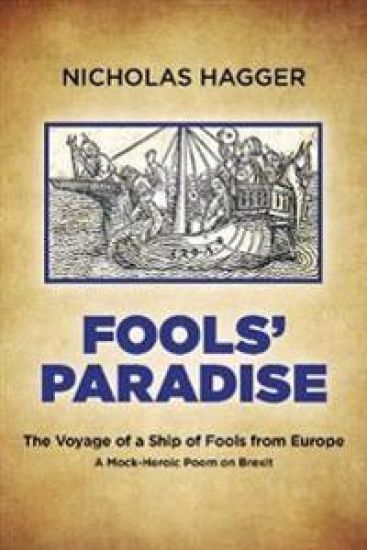
In Fools’ Paradise, a mock-heroic poem on Brexit which complements his masque King Charles the Wise, Nicholas Hagger presents the most important British event since the Second World War: the Brexiteers’ struggle to wrest control of the UK’s laws, borders, money and trade from the EU and turn the UK into a more prosperous paradise. In 16 cantos and an epilogue of heroic couplets with an epic tone he narrates the 2018 Chequers compromise and its aftermath: the EU’s opposition, lack of internal support, looming ‘no deal’ and requests for extensions that keep the UK in the EU. He shows the UK Ship of State as manned by a squabbling crew sailing for an illusory paradise and too riven by division to reach agreement. The dream all were promised seems undeliverable. In the tradition of the social satire of Dryden and Pope, the elevated style is undermined by a recurring image of the Ship of Fools in Sebastian Brant’s 1494 Swiss poem Ship of Fools (Das Narrenschiff), which makes a chaotic voyage from Europe to an illusory paradise across the waves. It becomes apparent that all on the UK Ship of State are to some extent living in a fools’ paradise. Focusing on the historic decision to leave Europe that if carried through would have immense repercussions for coming generations, Nicholas Hagger presents the warring factions on the UK Ship of State and in true Universalist manner foresees a resolution of the conflict in the reconciliation of a coming united world. This is an astonishing poem that approaches the most important national event of our time in the spirit of Tennyson and gets to the heart of the UK’s national predicament.
Coronation of King Charles, The

Coronation of King Charles, The

Nicholas Hagger

John Hunt Publishing
2021
nidottu
In King Charles the Wise, Nicholas Hagger celebrated Prince Charles’s humanitarian vision and foresaw the birth of a united world. In The Coronation of King Charles he celebrates the coming Carolingian Age. The hope is that all the divisions within the UK and problems of humankind will be resolved under a new democratic World State working to abolish war, enforce disarmament, combat famine, disease and poverty, and solve the world’s environmental and ecological problems of climate change and global warming; and that King Charles, Head of a Commonwealth of 53 nation-states, will work to bring his humanitarian vision to all the world’s nations. Following the tradition of Ben Jonson’s 17th-century court masques in verse and of his own masques The Dream of Europa and King Charles the Wise, which incorporate the blend of mythology and history and five sections (prologue, antimasque, masque, revels and epilogue) found in all masques. Hagger sets the third masque in his trilogy in London's Banqueting House, where masques were performed before James I. This coronation masque contains three pageant entertainments that are viewed by King Charles before his coronation and contrast the disorder and political chaos before his reign with the order and harmony of his new Carolingian Age. His philosopher-King’s concern to benefit the lot of all humankind is applauded by the Universalist God of the One who assumes protean forms - the gods of all faiths including Biblical Israel’s Yahweh and Olympian Zeus - and cares for all creation, and watches over him. King Charles, co-author of Harmony, is shown as presiding over what promises to be an Age of Universal Harmony.
Baroque Vision, A

Baroque Vision, A

Nicholas Hagger

Collective Ink
2024
nidottu
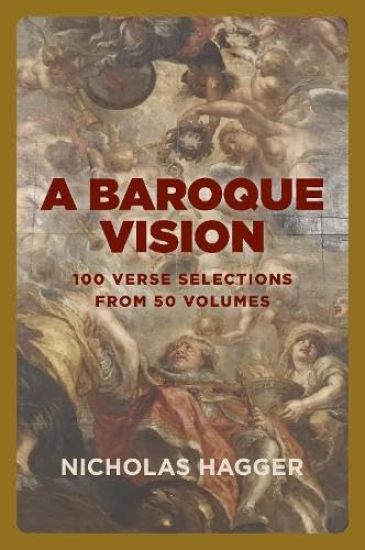
Between 1979 and 1982 Nicholas Hagger wrote three letters to the eminent literary critic Christopher Ricks about his poetic identity, and Ricks agreed with his final view that his verse blends the Romantic and Classical traditions within the Baroque tradition. In 1979 and again in 1982 Ricks asked him to select 30 poems. Forty years later A Baroque Vision presents a selection that shows his Baroque roots. Part One presents 30 poems written before 1979, and Part Two adds 70 verse selections written between 1979 and 2019. A Baroque Vision presents 100 verse selections drawn from 50 volumes of his poems, verse plays and masques. The Baroque style, which can be found in all European countries, combines the spiritual and the sensual, and features movement, transformation, the Mystic Way, the mysterious Light, the transcending of death, the divine soul and Heaven, as illustrated in Rubens’ The Apotheosis of James I (shown on the front cover); and blends the Romantic and Classical traditions. In his Preface Hagger shows very clearly that his Baroque vision was behind, and grew into, his Universalism, his philosophy and worldview of the unity of the universe whose development can be traced in his Selected Letters and Collected Prefaces, and in the companion volume to this work The Essentials of Universalism (all published by O-Books). These 100 verse selections confirm that his Baroque vision is inspired by the 17th century (by the Metaphysical poets, Milton and Dryden), but also by the 18th and 19th centuries (by Pope, Wordsworth and Tennyson).
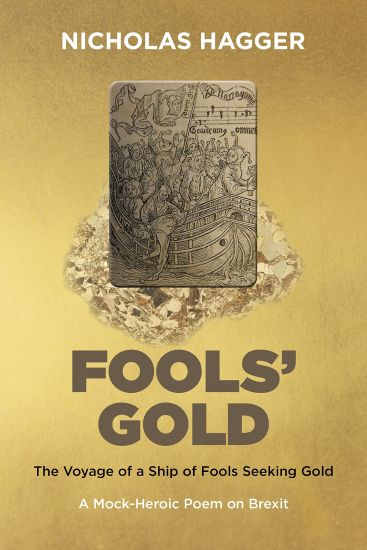
Fools' Gold

Fools' Gold

Nicholas Hagger

Collective Ink
2022
nidottu
In Fools’ Paradise Nicholas Hagger presented the UK’s attempt to leave the EU under Prime Minister Theresa May in terms of the voyage of Sebastian Brant’s 1494 Ship of Fools heading with a mutinous crew for the illusory, nonexistent paradise of Narragonia. His mock-heroic satirical poem on the political chaos surrounding the most important UK decision since the Second World War is in rhymed heroic couplets, in the tradition of Dryden and Pope. In this sequel, Fools’ Gold, Hagger focuses on the beginning of Boris Johnson’s premiership, the promises that won him the 2019 General Election with an 80-seat majority, and his removal of the UK from the EU, only to be engulfed by the deadly Covid pandemic which has devastated the UK economy. Hagger describes the catastrophic national events in heroic blank verse, which befits the darkening mood. The UK public has been promised a new Golden Age, an age of plenty, and it remains to be seen whether there will be prosperity for all - gold - now that the UK is facing colossal debt outside the EU, or whether the promises will turn out to be worthless iron pyrites: fools’ gold.