Kirjojen hintavertailu. Mukana 11 342 296 kirjaa ja 12 kauppaa.

Kirjahaku

Etsi kirjoja tekijän nimen, kirjan nimen tai ISBN:n perusteella.

6 kirjaa tekijältä Nicholas R. Jones

Staging Habla de Negros

Staging Habla de Negros

Nicholas R. Jones

Pennsylvania State University Press
2019
sidottu
In this volume, Nicholas R. Jones analyzes white appropriations of black African voices in Spanish theater from the 1500s through the 1700s, when the performance of Africanized Castilian, commonly referred to as habla de negros (black speech), was in vogue.Focusing on Spanish Golden Age theater and performative poetry from authors such as Calderón de la Barca, Lope de Rueda, and Rodrigo de Reinosa, Jones makes a strong case for revising the belief, long held by literary critics and linguists, that white appropriations and representations of habla de negros language are “racist buffoonery” or stereotype. Instead, Jones shows black characters who laugh, sing, and shout, ultimately combating the violent desire of white supremacy. By placing early modern Iberia in conversation with discourses on African diaspora studies, Jones showcases how black Africans and their descendants who built communities in early modern Spain were rendered legible in performative literary texts.Accessibly written and theoretically sophisticated, Jones’s groundbreaking study elucidates the ways that habla de negros animated black Africans’ agency, empowered their resistance, and highlighted their African cultural retentions. This must-read book on identity building, performance, and race will captivate audiences across disciplines.
Staging Habla de Negros

Staging Habla de Negros

Nicholas R. Jones

Pennsylvania State University Press
2020
pokkari
In this volume, Nicholas R. Jones analyzes white appropriations of black African voices in Spanish theater from the 1500s through the 1700s, when the performance of Africanized Castilian, commonly referred to as habla de negros (black speech), was in vogue.Focusing on Spanish Golden Age theater and performative poetry from authors such as Calderón de la Barca, Lope de Rueda, and Rodrigo de Reinosa, Jones makes a strong case for revising the belief, long held by literary critics and linguists, that white appropriations and representations of habla de negros language are “racist buffoonery” or stereotype. Instead, Jones shows black characters who laugh, sing, and shout, ultimately combating the violent desire of white supremacy. By placing early modern Iberia in conversation with discourses on African diaspora studies, Jones showcases how black Africans and their descendants who built communities in early modern Spain were rendered legible in performative literary texts.Accessibly written and theoretically sophisticated, Jones’s groundbreaking study elucidates the ways that habla de negros animated black Africans’ agency, empowered their resistance, and highlighted their African cultural retentions. This must-read book on identity building, performance, and race will captivate audiences across disciplines.
Cervantine Blackness

Cervantine Blackness

Nicholas R. Jones

Pennsylvania State University Press
2024
sidottu
There is no shortage of Black characters in Miguel de Cervantes’s works, yet there has been a profound silence about the Spanish author’s compelling literary construction and cultural codification of Black Africans and sub-Saharan Africa. In Cervantine Blackness, Nicholas R. Jones reconsiders in what sense Black subjects possess an inherent value within Cervantes’s cultural purview and literary corpus.In this unflinching critique, Jones charts important new methodological and theoretical terrain, problematizing the ways emphasis on agency has stifled and truncated the study of Black Africans and their descendants in early modern Spanish cultural and literary production. Through the lens of what he calls “Cervantine Blackness,” Jones challenges the reader to think about the blind faith that has been lent to the idea of agency—and its analogues “presence” and “resistance”—as a primary motivation for examining the lives of Black people during this period. Offering a well-crafted and sharp critique, through a systematic deconstruction of deeply rooted prejudices, Jones establishes a solid foundation for the development of a new genre of literary and cultural criticism. A searing work of literary criticism and political debate, Cervantine Blackness speaks to specialists and nonspecialists alike—anyone with a serious interest in Cervantes’s work who takes seriously a critical reckoning with the cultural, historical, and literary legacies of agency, antiblackness, and refusal within the Iberian Peninsula and the global reaches of its empire.
Cervantine Blackness

Cervantine Blackness

Nicholas R. Jones

Pennsylvania State University Press
2024
pokkari
There is no shortage of Black characters in Miguel de Cervantes’s works, yet there has been a profound silence about the Spanish author’s compelling literary construction and cultural codification of Black Africans and sub-Saharan Africa. In Cervantine Blackness, Nicholas R. Jones reconsiders in what sense Black subjects possess an inherent value within Cervantes’s cultural purview and literary corpus.In this unflinching critique, Jones charts important new methodological and theoretical terrain, problematizing the ways emphasis on agency has stifled and truncated the study of Black Africans and their descendants in early modern Spanish cultural and literary production. Through the lens of what he calls “Cervantine Blackness,” Jones challenges the reader to think about the blind faith that has been lent to the idea of agency—and its analogues “presence” and “resistance”—as a primary motivation for examining the lives of Black people during this period. Offering a well-crafted and sharp critique, through a systematic deconstruction of deeply rooted prejudices, Jones establishes a solid foundation for the development of a new genre of literary and cultural criticism. A searing work of literary criticism and political debate, Cervantine Blackness speaks to specialists and nonspecialists alike—anyone with a serious interest in Cervantes’s work who takes seriously a critical reckoning with the cultural, historical, and literary legacies of agency, antiblackness, and refusal within the Iberian Peninsula and the global reaches of its empire.
A Poetry Precise and Free

A Poetry Precise and Free

Nicholas R. Jones

The University of Michigan Press
2018
sidottu
A Poetry Precise and Free collects 150 lyric poems by the Renaissance Italian poet Giovanni Battista Guarini in new translations, accompanied by the Italian originals and commentary that will enlighten and engage both scholars and general readers. Guarini’s madrigals provide insight into northern Italian court culture of the late Renaissance, when poetry and music were enjoyed as companion arts. Hundreds of composers of Guarini’s day set his lyric poems to music. Primarily known today in their vocal settings, most famously those of Claudio Monteverdi, the poems merit appreciation in their own right. This volume is organized into ten sections, grouping the madrigals around themes such as the anguish of passion, the asymmetry of desire, the incursions of jealousy, and the possibility of mutual bliss. Nicholas R. Jones renders Guarini’s poetry into accessible contemporary English verse that nevertheless stays true to the substance and form of the original texts, reflecting their roots in the Petrarchan poetic tradition and displaying the emotion and musicality that made these lyrics so popular from the start. A substantive introduction provides cultural context for the madrigals and their musical settings; brief commentaries follow each translation to illuminate aspects of poetic and rhetorical craft. An extensive appendix lists the madrigal compositions that set these lyrics for vocal performance. The book fills a major gap in the scholarship on Guarini’s literary legacy. It will appeal to scholars of literature, Renaissance studies, and musicology, early-music performers, and general readers interested in poetry and classical music.
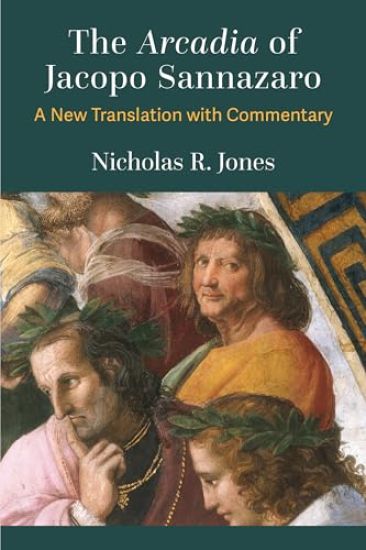
The Arcadia of Jacopo Sannazaro

The Arcadia of Jacopo Sannazaro

Nicholas R. Jones

THE UNIVERSITY OF MICHIGAN PRESS
2025
sidottu
Five hundred years ago, working from hints in classical Greek and Latin poets, the young author Jacopo Sannazaro crafted the book called Arcadia, a narrative in richly descriptive Italian prose interwoven with elegant and passionate poems. A young man—transparently a stand-in for the author—leaves his home in Naples to join a community of shepherds in the remote Greek region of Arcadia. Yet he finds that this seemingly idyllic land is as fraught as the homeland he fled. Like the author’s humanist community in Naples, ravaged in the fifteenth century by invasion and regime change, the eloquent shepherd-poets of Arcadia are driven to distraction and depression by the frustrations of desire and the social unrest that threatens their pastoral lives. Amidst all that, they tell each other their personal histories and share their sorrows in song. Sannazaro’s Arcadia is widely recognized as a foundational text of pastoral poetry, humanism, and Italian literature. But the book itself has been largely inaccessible to English-language students and readers. This new translation uses contemporary American English to convey Arcadia’s youthful vigor, narrative energy, and poetic inventiveness. The extensive introduction and commentaries place Arcadia in the context of late fifteenth-century humanist thought and writing, as well as the complicated crisis of Naples in the years just before 1500. This translation is designed to facilitate the re-entry of Arcadia into scholarly discourse and general readership while outlining its lasting cultural influence on poetry, drama, art and music.