Kirjojen hintavertailu. Mukana 11 699 587 kirjaa ja 12 kauppaa.

Kirjahaku

Etsi kirjoja tekijän nimen, kirjan nimen tai ISBN:n perusteella.

5 kirjaa tekijältä Nicholas Russell

Household Names: Russell Hobbs and the Automatic Kettle - A Story of Innovation and Design
Household Names is all about the iconic Russell Hobbs automatic kettles of the 1950s and 60s and the people who invented, designed and made them, set in the wider context of the British economy and culture in the second half of the twentieth century. Russell Hobbs (founded in 1952) was the brainchild of Bill Russell and Peter Hobbs. They had started out at Morphy Richards before parting company and setting up on their own, with Bill on design and engineering and Peter on marketing and sales. Their story demonstrates the significance of invention and design for successful manufacturing, often neglected by British firms, especially during the latter part of the 20th century, and provides object lessons in how successful product manufacturing might still be done. Russell Hobbs was an independent firm for only a decade but in that short time established an international reputation for design quality. Brexit and the Coronavirus will almost certainly force British industry to pay more attention to local manufacturing again and this is a timely look at the origins of this famous brand by Nicholas Russell the son of Bill Russell.
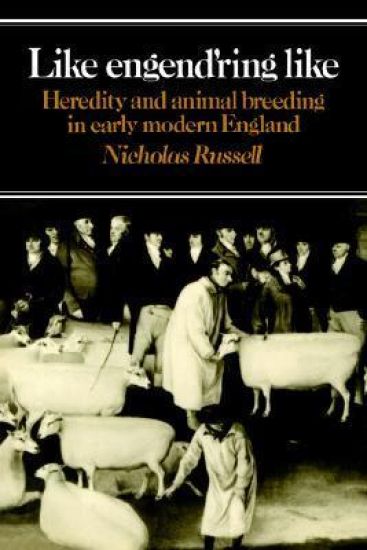
Like Engend'ring Like

Like Engend'ring Like

Nicholas Russell

Cambridge University Press
2007
pokkari
Robert Bakewell of Dishley Grange in Leicestershire is usually regarded as the founding father of modern farm livestock breeding, and is thought of as one of the legendary pioneers of the agricultural revolution in late eighteenth-century Britain. However, Bakewell was by no means the first English breeder to practise deliberate selection of desirable qualities in his livestock. This book sets out to examine the ideas and techniques of earlier generations of agricultural and sporting improvers in the seventeenth and eighteenth centuries, and to demonstrate the earlier sources of many of Bakewell's opinions and procedures. It reviews the relationships which may have existed between the ideas of practical animal breeders and those of philosophical naturalists with theoretical ideas about heredity. It also touches on the question of whether the stimulus for the development of new stock was provided by demand for different products or by a desire to obtain knowledge about the heredity of domestic animals.
Communicating Science

Communicating Science

Nicholas Russell

Cambridge University Press
2009
sidottu
Governments and scientific establishments have been encouraging the development of professional and popular science communication. This book critically examines the origin of this drive to improve communication, and discusses why simply improving scientists' communication skills and understanding of their audiences may not be enough. Written in an engaging style, and avoiding specialist jargon, this book provides an insight into science's place in society by looking at science communication in three contexts: the professional patterns of communication among scientists, popular communication to the public, and science in literature and drama. This three-part framework shows how historical and cultural factors operate in today's complex communication landscape, and should be actively considered when designing and evaluating science communication. Ideal for students and practitioners in science, engineering and medicine, this book provides a better understanding of the culture, sociology and mechanics of professional and popular communication.
Communicating Science

Communicating Science

Nicholas Russell

Cambridge University Press
2009
pokkari
Governments and scientific establishments have been encouraging the development of professional and popular science communication. This book critically examines the origin of this drive to improve communication, and discusses why simply improving scientists' communication skills and understanding of their audiences may not be enough. Written in an engaging style, and avoiding specialist jargon, this book provides an insight into science's place in society by looking at science communication in three contexts: the professional patterns of communication among scientists, popular communication to the public, and science in literature and drama. This three-part framework shows how historical and cultural factors operate in today's complex communication landscape, and should be actively considered when designing and evaluating science communication. Ideal for students and practitioners in science, engineering and medicine, this book provides a better understanding of the culture, sociology and mechanics of professional and popular communication.
Morals and the Media, 2nd Edition

Morals and the Media, 2nd Edition

Nicholas Russell

University of British Columbia Press
2005
pokkari
Confronted daily with decisions on how to present their stories, what to write and what not to write, journalists and the media are frequently accused of sensationalizing, of choosing to report the bad news, and of misquoting those they interview. In this substantially updated edition of Morals and the Media, Nick Russell addresses many of the concerns the public has about the media as he examines why the media behave the way they do. He also discusses how values have been developed and applied and suggests value systems that can be used to judge special situations.This revised edition covers the many changes in the Canadian media in the last decade, including further concentration of media ownership, media convergence, online journalism, the rise of the web log, and the tightening economic pressures on the industry as a whole. While much of the debate in this field has focused on conditions in the United States, Russell points out that the ethical issues that arise in Canada are often substantially different from those in the US. He has also added new "Tough Calls" at the end of each chapter, inviting readers to test their own ethics in scenarios drawn from real news stories.Morals and the Media will be essential reading in journalism courses as well as an important resource for journalists. It will also be of interest to the consumers of journalism – the readers, listeners, and watchers – who wonder why the media do what they do.