Kirjojen hintavertailu. Mukana 12 016 292 kirjaa ja 12 kauppaa.

Kirjahaku

Etsi kirjoja tekijän nimen, kirjan nimen tai ISBN:n perusteella.

4 kirjaa tekijältä Nigel Dennis

Cards of Identity

Cards of Identity

Nigel Dennis

Faber Faber
2010
nidottu
'Formerly, he thinks to himself, an artist took real people and transformed them into painted ones: how much finer and more satisfying is the modern method of assuming that people are not real at all, only self-painted, and of proceeding to make them real by giving them new selves based on the best-available theories of human nature...'In Nigel Dennis's 1955 novel - instantly acclaimed as a satirical masterpiece - a long-empty country house is reopened by Captain Mallet, his wife, and his dashing son Beaufort. Their task is to prepare for the annual summer conference of 'The Identity Club': a group of psychologists firmly of the view that people can be instructed as to who they really are and, consequently, persuaded to do well-nigh anything.'I have read no novel published during the last fifteen years with greater pleasure and admiration.' W.H. Auden, 1955 'One of the funniest, most intelligent and far-reaching pieces of satire.' Times

Boys and Girls Come Out to Play

Boys and Girls Come Out to Play

Nigel Dennis

Faber Faber
2010
nidottu
'Everyone who now remembers Nigel Dennis thinks that his first novel was Cards of Identity (1955). But in fact he had already written Boys and Girls Come Out to Play (1949)... what I recall liking so much about it was first the story of a young man's emergence from the dark tunnel of his childhood, with the discovery that there are drugs to control the epilepsy that has kept him imprisoned, and then the account of his first glorious summer of freedom... in an unnamed but famously picturesque north European city... What caught my imagination was Dennis's ability both to enjoy the brightness of this little arena of casual pleasure and to go with the waiters and skivvies into the backstage world of dark kitchens and hard labour that frames and sustains it.' Michael Frayn, Guardian
A House in Order

A House in Order

Nigel Dennis

Faber Faber
2010
pokkari
A House in Order was Nigel Dennis's third and final novel, first published in 1966. 'A quizzical pleasure... This civilized conundrum is about a nameless man captured in a timeless war in an anonymous country who manages to survive in a greenhouse, where he is most protected as well as most exposed... An antiseptic little man, a cartographer by profession, a horticulturist by avocation, he spends a first night in an abandoned, mucky greenhouse and is very happy to be permitted to stay on there, tending his 283 plants... However he lives in the fear that every day will be his last...' Kirkus Review 'A parable of human anguish raised to an existential level.' Time 'A haunting allegory that has influenced my writing.' Diane Johnson (Lulu in Marrakech, Le Divorce)
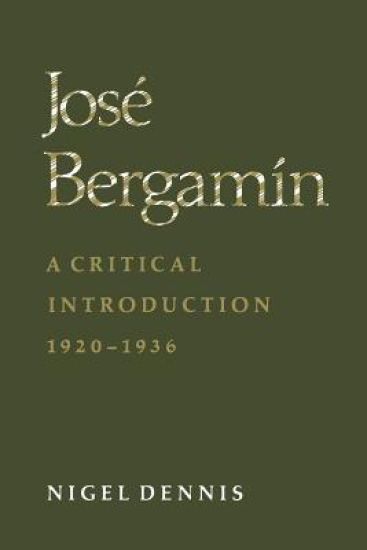
José Bergamín

José Bergamín

Nigel Dennis

University of Toronto Press
1986
pokkari
Writer, critic, and cultural activist José Bergamín (1895-1983) was unjustly relegated to the sidelines of contemporary Spanish intellectual life for reasons that have more to do with his political dissidence and long periods of exile than with the interest and importance of his written work. This book represents the first attempt to come to terms with that work. Professor Dennis's study focuses on the period 1920-1936, the so-called silver age of Spanish literature, during which Bergamín rose to prominence alongside a group of superlatively gifted writers and friends, among them Frederico Garcia Lorca, Rafael Alberti, Jorge Guillén, and Pedro Salinas. It sets out to explain the nature of the relationship Bergamín had as a critic and prose writer with the major poets of the 1920s and 1930s, and at the same time systematically examines the singularity of his own work as an aphorist, essayist, and dramatist. Professor Dennis also devotes attention to explaining the sense of Bergamín's initiative in founding the important journal Cruz y Raya (1933-1936) and the role this publication played, both culturally and politically, during the troubled years of the Second Republic. This book not only fills a notable gap in our understanding of pre--Civil War literary and intellectual life in Spain, but also lays the foundation for all future research into the work of this fascinating and enigmatic writer.