Kirjojen hintavertailu. Mukana 11 244 527 kirjaa ja 12 kauppaa.

Kirjahaku

Etsi kirjoja tekijän nimen, kirjan nimen tai ISBN:n perusteella.

4 kirjaa tekijältä Nigel Swain

Collective Farms which Work?

Collective Farms which Work?

Nigel Swain

Cambridge University Press
2008
pokkari
This book analyses Hungarian collectivization from a sociological perspective. Rather than consider Eastern European societies in the light of social stratification and social mobility surveys, it takes as its point of departure the commitment of Eastern European societies to industrialization within the constraints of a socialist economy and, by examining social change from the viewpoint of labour and those who control it, places the focus more strongly than has traditionally been the case on the production of social wealth, and the relations which circumscribe it, rather than on the ways in which wealth is distributed and consumed.
Collective Farms which Work?

Collective Farms which Work?

Nigel Swain

Cambridge University Press
1985
sidottu
The book’s novelty lies both in the fact that it is the first book in English to analyse Hungarian collectivisation from a sociological perspective, and also in the nature of that perspective. Rather than consider Eastern European societies in the light of social stratification and social mobility surveys, it takes as its point of departure the commitment of Eastern European societies to industrialisation within the constraints of a socialist economy and, by examining social change from the viewpoint of labour and those who control it, places the focus more strongly than has traditionally been the case on the production of social wealth, and the relations which circumscribe it, rather than on the ways in which wealth is distributed and consumed.

Hungary

Hungary

Nigel Swain

Verso Books
1992
nidottu
Why were Hungarians, including those who would be considered radical in the West, happy to see the introduction of a market economy? Why was there no real opposition to the dismantling of socialist achievements like universal free education and health care? Nigel Swain's topical book answers these questions through one of the most thorough analyses to date of a socialist economy in practice and dissolution.Carefully tracing Hungary's postwar economic history, Swain shows why both Stalinist central planning and 'feasible' market socialism failed. He argues that these failures were caused not by imperfections in the Hungarian model, but by crucial problems inherent in the socialist project itself. Far from a eulogy to free-market capitalism, yet offering a sobering account of the consequences of socialist economic errors - technological backwardness, corruption and declining morale - Hungary will be a major contribution to political and economic debate on the left.
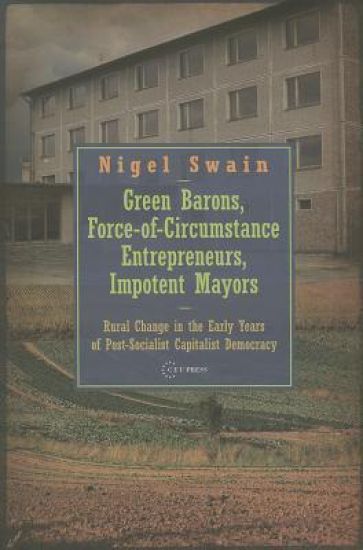
Green Barons, Force-of-Circumstance Entrepreneurs, Impotent Mayors

Green Barons, Force-of-Circumstance Entrepreneurs, Impotent Mayors

Nigel Swain

Central European University Press
2013
sidottu
An exemplary study in comparative contemporary history, this monograph looks at rural change in six countries: Bulgaria, Czech Republic, Hungary, Poland, Romania and Slovakia. In the 1990s most of these nations experienced a fourth radical restructuring of agricultural relations in the twentieth century, and all went through the dramatic transition from communism to capitalism. The author analyzes attempts to activate democracy on a local level and recreate farming structures and non-agricultural businesses based on private ownership and private enterprise. He describes the emergence of a new business class that seeks to dominate local government structures; the recuperation of former communist farming entities by former managers; and the transformation of peasants into rural citizens, who nevertheless remain the underdogs. Swain exposes common features as well as specific divergences between the six countries; he portrays the winners, losers and engineers of transformations. He situates his themes in a wider context that will appeal to a broad range of social scientists and historians.