Kirjojen hintavertailu. Mukana 12 390 323 kirjaa ja 12 kauppaa.

Kirjahaku

Etsi kirjoja tekijän nimen, kirjan nimen tai ISBN:n perusteella.

40 kirjaa tekijältä Nigel Thomas, Peter Abbott

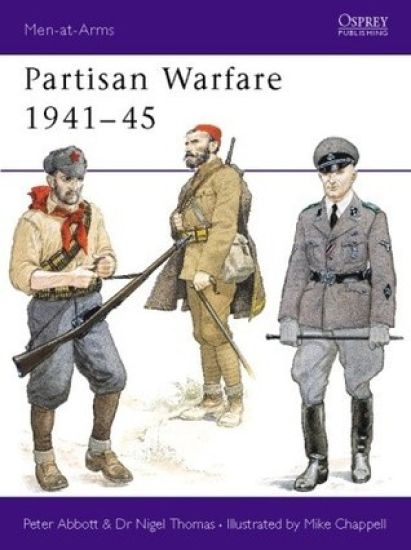
Partisan Warfare 1941–45

Partisan Warfare 1941–45

Nigel Thomas; Peter Abbott

Osprey Publishing
1983
nidottu
A compact volume on the history, organisation, uniforms and equipment of the Communist-led and non-Communist resistance groups resisting German occupation.During 1941 the Germans occupied first Greece and the former Yugoslavia, then enormous areas of European Russia. Once the front line troops had moved on the struggle continued as bands of resistance fighters waged war against the occupation forces until their final withdrawal. The term 'partisan' is associated with Communist-led bands and they were often the most fanatical defenders of the Soviet realm. However, there were also non-Communist resistance groups which were nationalist and broadly constitutionalist and as a result a complicated three-way war developed.This book details the guerrilla war which was waged in the various regions and the uniforms and equipment of the combatants.
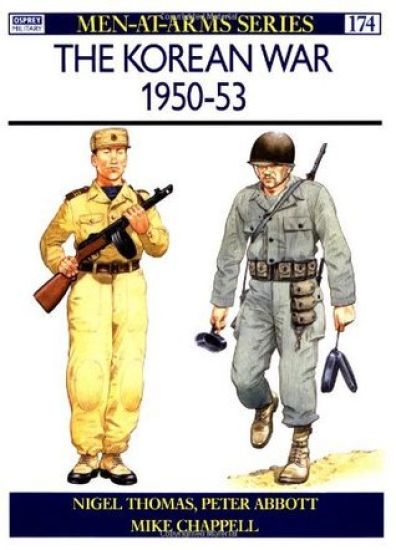
The Korean War 1950–53

The Korean War 1950–53

Nigel Thomas; Peter Abbott

Osprey Publishing
1986
nidottu
A concise illustrated study of the first military conflict of the Cold War. At 4am on Sunday 25 June 1950, powerful North Korean forces invaded South Korea, advancing down the Uijongbu Corridor towards the Southern Capital of Seoul. South Korean troops resisted bravely, but were crushed by overwhelming Northern superiority. Later that day, the United Nations Security Council condemned the aggression, and on 7 July appointed US General of the Army Douglas MacArthur to command UN forces which would be sent to save South Korea. Nigel Thomas and Peter Abbott explore the history of this conflict, which pitted UN forces against the People's Republic of China in a struggle that resulted in hundreds of thousands of casualties. The text is accompanied by black and white photographs, maps and diagrams, along with colour plates from artist Mike Chappell depicting uniforms and equipment of soldiers of North and South Korea, People's Republic of China, the United States and other UN forces.
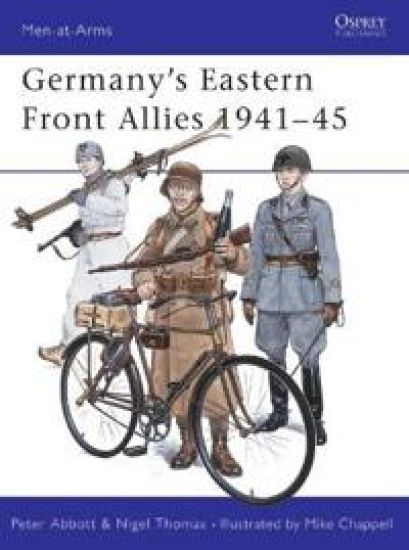
Germany's Eastern Front Allies 1941–45

Germany's Eastern Front Allies 1941–45

Peter Abbott; Nigel Thomas

Osprey Publishing
1982
nidottu
The 1930s were a time of growing tension for the smaller states of Eastern Europe. Since the end of the First World War they had enjoyed an independence which most of them had not known for centuries, but this was now threatened by the growing power of Nazi Germany and Soviet Russia. Instead of combining for self defence, they were bitterly divided. The Munich crisis showed how little reliance could be placed on the Western democracies, whose power to intervene militarily in Eastern Europe was negligible. In effect this left the smaller East European states with little alternative but to become clients of either Germany or Russia.
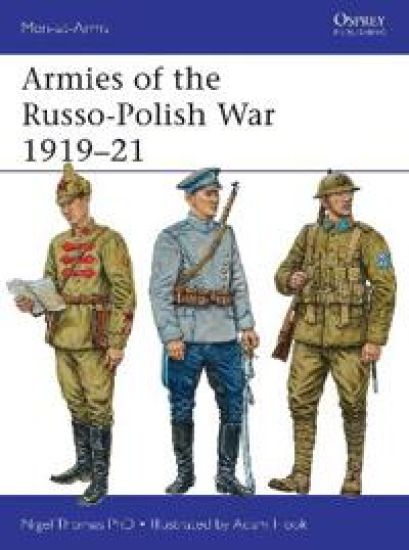
Armies of the Russo-Polish War 1919–21

Armies of the Russo-Polish War 1919–21

Nigel Thomas

Osprey Publishing
2014
nidottu
In 1918 war broke out for Poland’s independence, involving the the Poles, the Red and White Russian armies, at least two different Ukrainian forces, and Allied intervention troops. The armies that fought these campaigns were extraordinarily varied in their uniforms and insignia, equipment and weapons, and when peace was signed in 1921, Poland had achieved recognised nationhood for the first time since 1794.Featuring specially commissioned full-colour artwork, this engaging study explains and illustrates the armies that fought in the epic struggle for the rebirth of the independent Polish nation, in the bitter aftermath of World War I and the Russian Revolution.
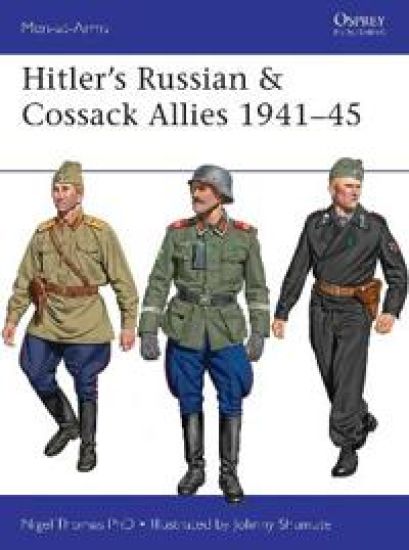
Hitler’s Russian & Cossack Allies 1941–45
Surely nobody who had suffered the ferocity of the Nazi invasion could consider switching sides and joining the Germans? Yet that is exactly what up to 400,000 Soviet citizens did in World War II.These included not only the ‘legions’ recruited from non-Russian ethnic groups eager for freedom from Stalin’s dictatorship, but also some 100,000 Russians and Cossacks. What began as small local security units of ‘Ostruppen’, enrolled for the ongoing campaigns against Soviet partisans, were later reorganized, given special systems of uniform and insignia, amalgamated into larger formations, and eventually committed to the front line.This book is an essential guide to the appearance, formation and equipment of the myriad Russian and Soviet units that fought for the Germans. Featuring rare photographs and revealing colour illustrations, this is a peerless visual reference to the troops who switched from one ruthless superpower to another and met with a horrific fate when the fighting was over.
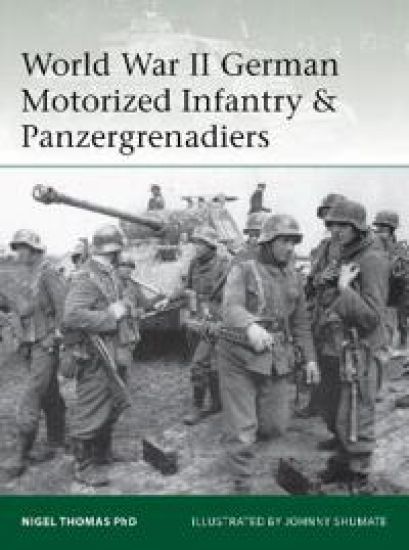
World War II German Motorized Infantry & Panzergrenadiers
In World War II Germany's doctrine of mobile warfare dominated the battlefield. By trial and error, the Germans were the first to correctly combine the strength in tanks and in mobile infantry and artillery. This integration of mobile units, equipment and tactics underpinned Germany's successes in the first half of the war. As the war dragged on, the Allies sought to copy German tactics but German armies remained supreme in this type of warfare until their losses had seriously degraded their capabilities. This study traces the development of the different types of unit that came together in the Panzergrenadier branch from the inter-war years through World War II. Using colour plates to display the changes in uniform, equipment and insignia in all theatres of operations throughout the conflict, this is a complete account of Hitler’s elite armoured infantry.
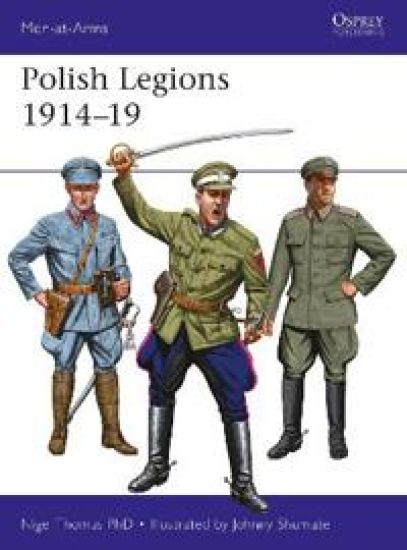
Polish Legions 1914–19

Polish Legions 1914–19

Nigel Thomas

Osprey Publishing
2018
nidottu
Due to its partitions and dissolution in the late eighteenth century, hundreds of thousands of Polish soldiers enlisted in distinct units in the armies of many countries.Polish legions were found primarily in the Russian and Austro-Hungarian empires, but also that of the German Reich and the French Republic. All these forces were uniformed and equipped by the parent armies, though often with explicitly Polish features. The collapse of Tsarist Russia in 1917 and of the Central Powers in 1918 allowed these diverse forces to unite in a re-created Polish Army under the new-born Second Polish Republic in November 1918.With full colour illustrations of their unique and colourful uniforms as well as contemporary photographs, this is the fascinating story of the Poles who fought on both sides of the trenches in World War I and then united to fight for their freedom in the Russian Civil War.
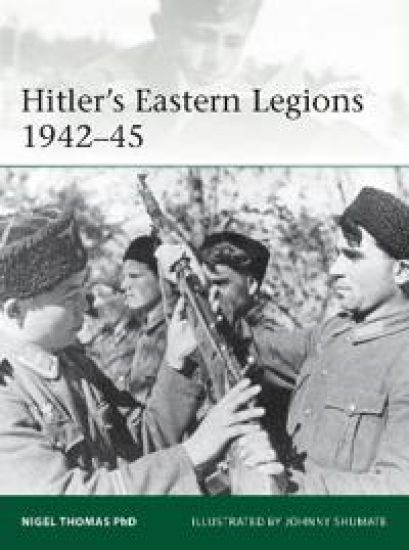
Hitler's Eastern Legions 1942–45

Hitler's Eastern Legions 1942–45

Nigel Thomas

Osprey Publishing
2020
nidottu
Between 1941–45, the Germans recruited around 175,000 men from a number of minorities in the USSR, distinguishing between 'Turkomans' (predominantly Muslims) and 'Caucasians' (predominantly Orthodox Christians). Of these, many formed rear-area auxiliary units, but at least 55,000 were combat troops. The first recruits formed two battalions in the 444th Security Division raised as early as November 1941; during 1942–­43 seven legions were formed, each of several battalions, eventually totalling some 53 battalions (equivalent to about 6 full divisions). However, with one exception (162nd Turkoman Division), they were not deployed as whole formations; after training in Poland, individual battalions were posted to fill out German regiments in the front lines, at first in Army Group South but later in all three Army Groups fighting on the Eastern Front. Units were also sent to Yugoslavia, Italy and the Western Front.This fully illustrated history of the Eastern legions details the organization, battle orders, combat history, uniforms and insignia of these unique units, combining contemporary photographs and full-colour illustrations with expert research from military historian Dr Nigel Thomas.
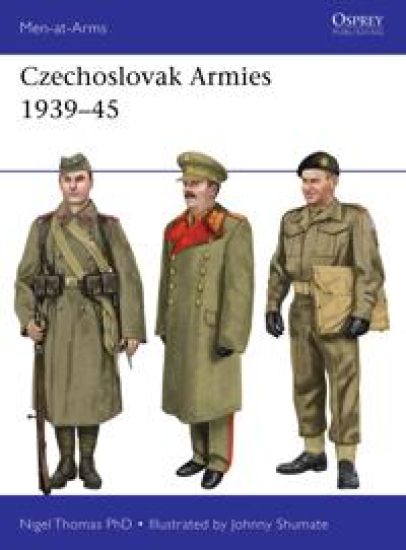
Czechoslovak Armies 1939–45

Czechoslovak Armies 1939–45

Nigel Thomas

BLOOMSBURY PUBLISHING PLC
2024
nidottu
Featuring rare photos, detailed colour illustrations and insignia tables, this study explores the contribution made by Czech and Slovak troops fighting alongside Allied forces during World War II. Following the Anglo-French failure at the Munich Conference in March 1938 to prevent a Nazi take-over of Bohemia-Moravia (modern Czech Republic/Czechia), many frustrated Czech and Slovak soldiers sided with Allied forces and fought alongside their armies – first in Poland, then in France, and finally from Britain. Using depictions of relevant uniforms and equipment plus photos of the troops in action, military uniformology expert Nigel Thomas explains how the Czech Army was organized and how it fought alongside Allied forces in the Middle East and at Normandy. He describes the involvement of free Czech agents operating from Britain in Operation Anthropoid, the assassination of Nazi governor Reinhard Heydrich in occupied Bohemia-Moravia, and the part Czech soldiers played in mutinies in both Italy and Prague against German occupation which ultimately helped to secure a final Allied victory.
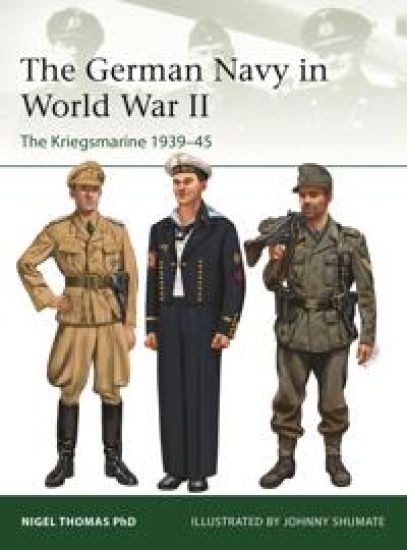
The German Navy  1935–45

The German Navy 1935–45

Nigel Thomas

BLOOMSBURY PUBLISHING PLC
2025
nidottu
An illustrated study of the uniforms and personal equipment worn by the personnel of the Kriegsmarine, the German Navy of the Third Reich, from 1935–45.Founded in defiance of the Treaty of Versailles, the Kriegsmarine was established in 1935 and reached a peak strength of more than 800,000 personnel in 1944. Its original aim of amassing a surface fleet on parity with Great Britain’s Royal Navy shifted with the outbreak of World War II, after which focus moved to submarine warfare, with the Kriegsmarine’s U-boats exacting a heavy toll on Allied shipping across the globe. Meanwhile, several of its formidable capital ships – notably the Graf Spee, Bismarck, Tirpitz, Scharnhorst and Gneisenau – saw widespread action as Nazi Germany strove to defeat the Allies at sea.In this new study, Nigel Thomas examines the evolving organization, uniforms and equipment used by the Kriegsmarine during its ten-year existence, spanning its pre-war beginnings, the invasion of Norway in 1940, and through to the deployment of Kriegsmarine personnel as grounds troops from 1943–45. The different gear worn by its various branches of service is described in detail and illustrated with newly commissioned colour artwork and an array of specially selected photographs.
Cure Sore Throats, Colds and Coughs with Cayenne Pepper

Cure Sore Throats, Colds and Coughs with Cayenne Pepper

Nigel Thomas

Createspace Independent Publishing Platform
2013
pokkari
Once the sore throat and aching limbs of a cold begin, what you need is something that will quickly relieve the symptoms and get you back onto the road to recovery. Cayenne pepper is the very thing.Although there are many over the counter products that claim to be able to do this, cayenne pepper is a natural product that has a huge healing benefit.These healing properties have remained unknown to the majority of people, whilst those in the know have used them to their advantage for hundreds of years.Learn how using this secret miracle cure will relieve the symptoms of a cold quickly and easily.Miracle is not a word used lightly to describe the healing benefits of Cayenne Pepper.This book describes in detail the usage and directions for each step to cure a sore throat, cold and cough.For anyone wanting a more natural approach to recover from a cold or flu like symptoms then Cayenne Pepper should be at the top of your list.In this book you will learn: The different recipes and dosages to be taken for each stage of the cold.The benefits and reasons why they help you . . . . . . and, how often to use them.The healing properties of this natural spice should not be taken lightly, its benefits go way beyond just relieving a cold or flu and these benefits are also listed in this book.This is a GREAT little guide book for using Cayenne Pepper to relieve a cold
How to Lower High Blood Pressure using Cayenne Pepper

How to Lower High Blood Pressure using Cayenne Pepper

Nigel Thomas

Createspace Independent Publishing Platform
2013
pokkari
High blood pressure has become known as, "the silent killer," for a very good reason. It is estimated that around one third of all adults suffer from high blood pressure. Even more concerning is the fact that a great deal of them will be unaware they even suffer from the condition.More people suffer from high blood pressure now than at any other time In this book you will learn: What the effects of high blood pressure are.How cayenne pepper is a natural cure for high blood pressure.How to use cayenne pepper to lower high blood pressureAnd, how to prevent high blood pressureThis is a GREAT little guide book for learning How to Lower High Blood Pressure Using Cayenne Pepper that I am sure you will benefit from.
Cayenne Pepper Health Benefits

Cayenne Pepper Health Benefits

Nigel Thomas

Createspace Independent Publishing Platform
2013
pokkari
Cayenne Pepper - the natural way to achieving good healthI have written this book as a follow on from my other two successful books on Cayenne Pepper - Cure Sore Throats, Colds and Coughs with Cayenne Pepper and How to Lower High Blood Pressure using Cayenne Pepper. I decided to write this book because I realised so many people were looking for a more natural way to treat their health problems. The health benefits of cayenne pepper have been known about for thousands of years and can cure a multitude of different ailments and symptoms, plus it is totally natural. That is why it is quite rightly called a miracle cure - but not enough people know about this little miracle.That is why I have tried to show you all the different benefits that can be found in cayenne pepper. Or as Dr. Richard Schulze, the famed medical herbalist put it, - "If you master only one herb in your life, master cayenne pepper. It is more powerful than any other."In this book you will learn how cayenne pepper can help heal such ailments as - Blood PressureArthritisAllergiesSinusitisTooth Ache . . .. . . and even CancerI have included recipes for the different doses and mixtures and have even included a chapter on making your own cayenne infused oil and cayenne tincture.This is a GREAT book for anyone wanting to know more about Cayenne Pepper Health Benefits.
Hitler’s Blitzkrieg Enemies 1940

Hitler’s Blitzkrieg Enemies 1940

Nigel Thomas

Osprey Publishing
2014
nidottu
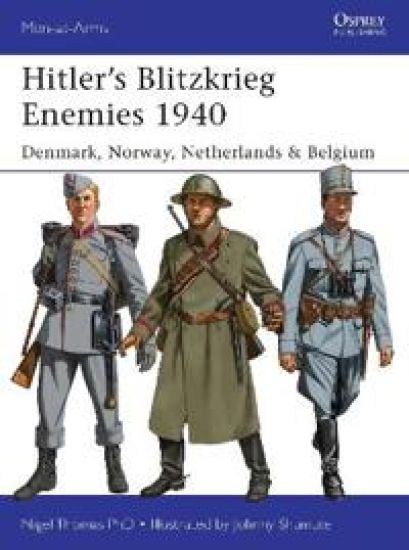
The armies of Denmark, Norway, the Netherlands and Belgium bore the first crushing impact of Hitler’s mighty Blitzkrieg war machine in Western Europe, in a campaign that astonished and terrified the world.The German Wehrmacht was millions strong, equipped with the latest guns, tanks and aircraft, and had the priceless advantage of having learned the realities of modern warfare in Poland the previous September. The defenders of Scandinavia and the Low Countries were raised from small populations, and were inadequately funded, trained, equipped and armed. Their modest numbers, inexperience, and largely indefensible borders condemned them to rapid defeat. For this reason they have tended to be neglected by history – in many cases, unjustly.Featuring period photographs and full-colour artwork, this book examines the dress, insignia, equipment, organization and combat performance of the Danish, Norwegian, Dutch and Belgium armies - thousands of soldiers who fought heroically in hopeless defence against the Nazi juggernaut.
The German Army in World War I (1)

The German Army in World War I (1)

Nigel Thomas

Osprey Publishing
2003
nidottu
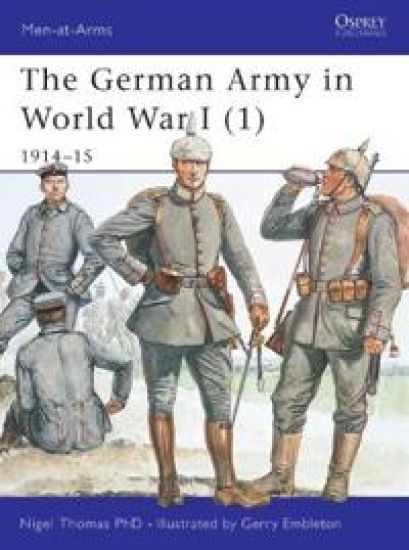
This is the first of three books that study the German Army of World War I in great detail. They give a comprehensive study of the organisation, uniforms, insignia and equipment of the Imperial German army - in practice the combined armies of Prussia, Bavaria, Saxony and Wurttemberg. This first volume covers the troops who fought at Mons, Arras, and 1st Ypres in 1914; in winter 1914; at Neuve Chappelle, 2nd Ypres, Artois and the Argonne, 1915; and in East Prussia and Poland, 1914-15. It reflects the impact of the first period of trench warfare on the uniforms worn at the outbreak of war.
The German Army in World War I (2)

The German Army in World War I (2)

Nigel Thomas

Osprey Publishing
2004
nidottu
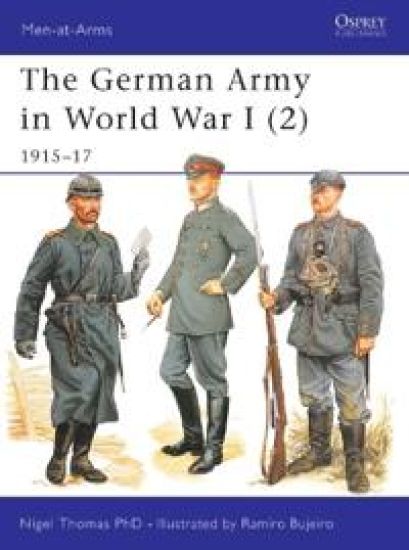
The years 1915-17 saw the Imperial German Army, like the other Great War combatants, forced to adapt to the new realities of static trench warfare. Prewar uniforms and equipment had to be modified, for reasons of both utility and economy; on battlefields ruled by machine guns and artillery the steel helmet reappeared, and masks to protect against the terrifying new weapon of poison gas. The fashionable cavalry regiments became irrelevant on the Western Front; many were dismounted to join the infantry, while new types of unit usurped their prestige - assault battalions, and the air corps. This second volume in a three-part sequence offers a mass of detail on organization, uniforms and insignia, illustrated with rare photographs and meticulous colour artwork.
The German Army in World War I (3)

The German Army in World War I (3)

Nigel Thomas

Osprey Publishing
2004
nidottu
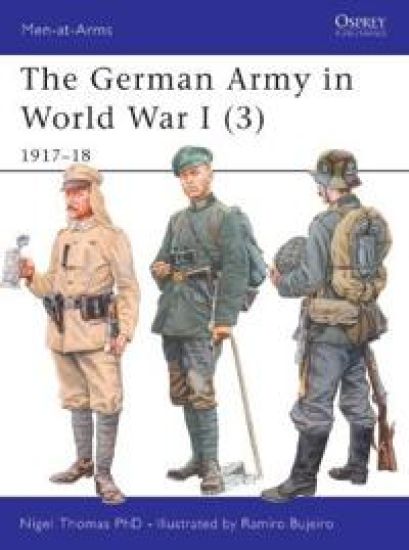
This third volume of a mini-series covering the German forces in World War I examines the troops that fought during the climax of the war on all fronts: the last great battles of attrition in the West (Arras, Messines, 3rd Ypres - Passchendaele/Langemarck - and Cambrai, 1917) and the collapse of Russia in the East. The 'Kaiserschlacht' campaign is covered, as are the German operations in Italy, the Balkans, and in support of Turkey in the Middle East. Uniform changes during this period reflected the introduction of new tactics and weapons and new types of troops, such as tanks and assault battalions.
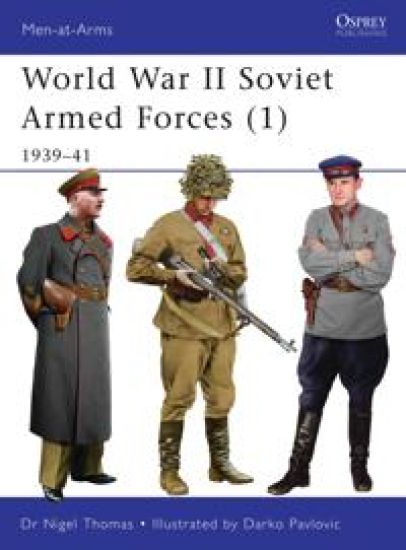
World War II Soviet Armed Forces (1)

World War II Soviet Armed Forces (1)

Nigel Thomas

Osprey Publishing
2010
nidottu
This would be a detailed analysis of the Soviet Army at the outbreak of World War II, including the Red Army's campaigns against Japan on the Manchurian plains as well as in Finland. It would also cover the Red Army's first operations during Operation Barbarossa when the Red Army was forced to defend Mother Russia against the German onslaught. This book would offer a breakdown of all the armed forces including the army, air force, paratroopers, navy and NKVD troops. In particular, it will cover the evolution of uniforms, equipment and insignia with the introduction of new regulations in 1935 and 1940.
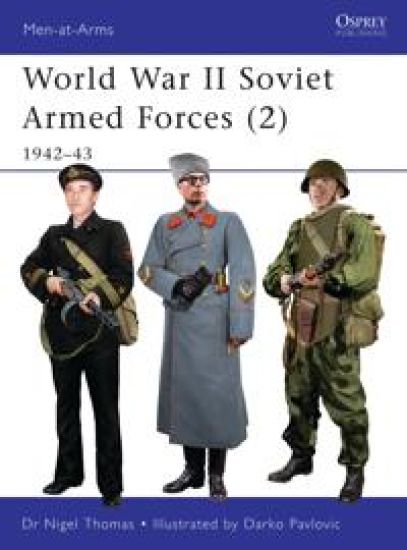
World War II Soviet Armed Forces (2)

World War II Soviet Armed Forces (2)

Nigel Thomas

Osprey Publishing
2011
nidottu
In this second volume of a three-part series on the Soviet Armed Forces in World War II, author Nigel Thomas turns his attention to the mid-war period. Focusing on the uniforms and organization of Soviet troops during the campaigns of the Caucasus, Stalingrad and Kursk, this book offers a detailed breakdown of all the armed forces which conducted the valiant defensive campaigns, including the army, air force, paratroopers, navy and NKVD troops. It also covers equipment and insignia and the changes brought about by the new regulations of 1943.
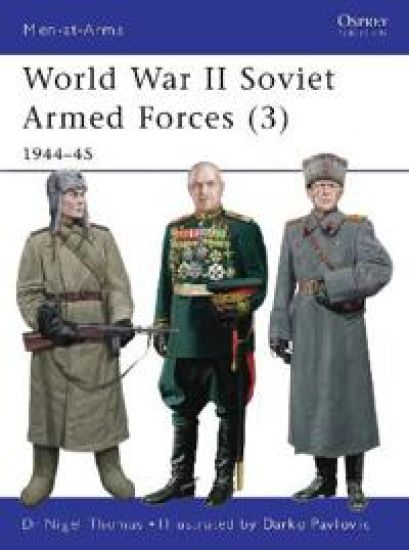
World War II Soviet Armed Forces (3)

World War II Soviet Armed Forces (3)

Nigel Thomas

Osprey Publishing
2012
nidottu
A detailed analysis of the Soviet armed forces during the final days of the war, covering the soldiers that successfully turned the tide against the Nazi onslaught and pushed it back into Germany itself.This final part of the series documents the Red Army's push through Germany to Berlin, which eventually culminated in the surrender of the German forces to the Allies in 1945. It also offers a detailed breakdown of all the armed forces that conducted the offensive campaigns on the Eastern Front, including the army, air force, paratroopers, navy and NKVD troops.Its colourful illustrations also include the uniforms and organizations of the Russian forces serving against Japan until the eventual surrender of all Japanese Imperial forces in August 1945.