Kirjojen hintavertailu. Mukana 12 390 323 kirjaa ja 12 kauppaa.

Kirjahaku

Etsi kirjoja tekijän nimen, kirjan nimen tai ISBN:n perusteella.

6 kirjaa tekijältä Nigel Walford

Practical Statistics for Geographers and Earth Scientists
Practical Statistics for Geographers and Earth Scientists provides an introductory guide to the principles and application of statistical analysis in context. This book helps students to gain the level of competence in statistical procedures necessary for independent investigations, field-work and other projects. The aim is to explain statistical techniques using data relating to relevant geographical, geospatial, earth and environmental science examples, employing graphics as well as mathematical notation for maximum clarity. Advice is given on asking the appropriate preliminary research questions to ensure that the correct data is collected for the chosen statistical analysis method. The book offers a practical guide to making the transition from understanding principles of spatial and non-spatial statistical techniques to planning a series analyses and generating results using statistical and spreadsheet computer software. Learning outcomes included in each chapterInternational focusExplains the underlying mathematical basis of spatial and non-spatial statisticsProvides an geographical, geospatial, earth and environmental science context for the use of statistical methodsWritten in an accessible, user-friendly style Datasets available on accompanying website at www.wiley.com/go/Walford
Geographical Data Analysis

Geographical Data Analysis

Nigel Walford

John Wiley Sons Inc
1995
nidottu
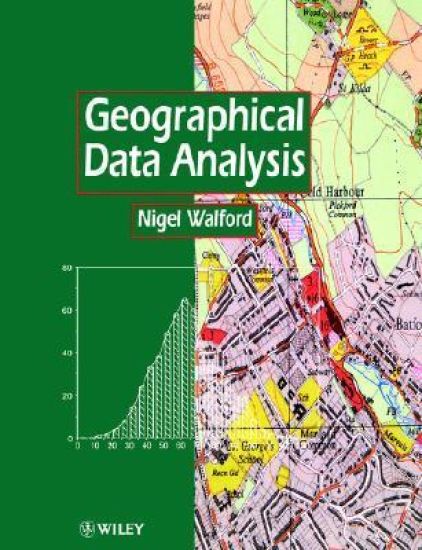
It is increasingly important for the earth science student to appreciate that the acquisition of skills in statistics and computerised data analysis is as much part of modern geography as work in the field, laboratory or library. In this respect, Geographical Data Analysis aims to link the use of statistical techniques by means of computer software, to the acquisition of geographical-knowledge and the scientific method of enquiry. The book has three objectives: to explain basic statistical techniques and demonstrate their application to quantitative geography; to equip students with the knowledge and skills necessary for carrying out research projects; and to make the link between statistical analysis and the substantive topics taught as part of a geography course. An important innovative feature of the book is its project-orientated approach, which utilises exemplar projects drawn from human and physical geography. Each exemplar project shows the progress from the conception of the initial research through to the formulation of tentative hypotheses and the subsequent statistical analysis. The projects exemplify both primary and secondary methods for collecting geographical data, with the computer-based application of a wide range of statistical techniques. Thus, these projects allow discussion of sample design, data collection and computerisation, and a selection of appropriate statistical techniques. As such, Geographical Data Analysis integrates quantitative and geographical methodologies and provides a thorough understanding of basic statistical techniques for the undergraduate geography student; it will be of use from first year through to final degree dissertations.
Geographical Data

Geographical Data

Nigel Walford

John Wiley Sons Inc
2002
sidottu
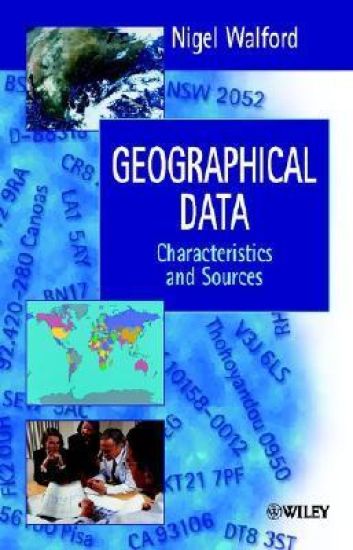
Geographical Data: Characteristics and Sources represents a response to the remarkable growth in the volume of geographical data in recent years, especially in the amount captured directly into a digital format. Information and communication technologies are now the basis for analysing, handling and visualising data about the Earth's surface, and Geographical Information Systems (GIS) provide the tools for performing these tasks within the public, private and educational sectors. This book focuses on the principle sources of geographical data and provides a comprehensive overview of their characteristics and analytical capabilities. Geographical Data: Characteristics and Sources is a unique text in several ways: *Details the characteristics of spatial and thematic geographical data relating to the environmental and human domains. These types of data are remotely sensed, cartographic, census/survey, and administrative/statutory *Highlights the benefits and drawbacks of using geographical data *Focuses on the availability of digital (rather than analogue) geo-referenced datasets *Presents a comparative development of spatial data frameworks from countries across the world in Australasia, Asia, Europe and North America *Looks to future developments in Internet-based GIS, online access and potential new sources of geographical data. Geographical Data: Characteristics and Sources is intended for professionals within the administrative, commercial, educational, governmental and voluntary sectors, and academic users of GIS technology who want to branch out into new applications involving unfamiliar data sources. It also provides novice users with a guide to the complexities of geographical data.
Practical Statistics for Geographers and Earth Scientists
A practice-oriented and accessible introduction to geographical statistics In the newly revised Second Edition of Practical Statistics for Geographers and Earth Scientists, distinguished researcher Nigel Walford delivers an authoritative and easy-to-follow introduction to the principles and applications of statistical analysis in a geographical context. The book assists students in the development of competence in the statistical procedures necessary to conduct independent investigations, field-work, and related geographical research projects. The book explains statistical techniques relevant to geographical, geospatial, earth, and environmental data. It employs graphics and mathematical notation for maximum clarity. Guidance is provided on how to formulate research questions to ensure that the correct data is collected for the chosen analysis method. This new edition incorporates a new section on exploratory spatial analysis and spatial statistics. It also offers: A thorough introduction to first principles in the statistical analysis of geographical data, including discussions of the quality, content, collection, and acquisition of geographical dataIn-depth treatments of geographical data exploration, including the taking of statistical measures or quantities, as well as frequency distributions, probability, and hypothesesComprehensive explorations of testing times, including parametric and nonparametric testsInsightful discussions of relationship investigation, including correlation and regression, as well as the spatial aspects of geographical data Perfect for undergraduates pursuing a degree in geography, Practical Statistics for Geographers and Earth Scientists will also be a valuable tool for students in other earth and environmental sciences.
Internal Migration

Internal Migration

Darren P. Smith; Nissa Finney; Nigel Walford

Routledge
2018
nidottu
Over the last two decades there have been numerous profound changes in UK society which have had an impact on the scale, geographies, meaning and experiences of internal migration. Providing a critical appraisal of migration scholarship from the perspective of Geography, reviewing theory, substantive foci and method, this book demonstrates how sub-national migration in the UK gives rise to and reflects new patterns of population, housing, economies and cultures. Each chapter is written by a Population Geographer together with a scholar representing another Human Geography sub-discipline thus providing a cross-disciplinary perspective on a specific aspect of migration. Critically reviewing and setting an agenda for internal migration scholarship from a spatial perspective, this book will be of interest to academics and students of Geography and other disciplines concerned with migration, both within the UK and further afield.
Internal Migration

Internal Migration

Darren P. Smith; Nissa Finney; Nigel Walford

Routledge
2015
sidottu
Over the last two decades there have been numerous profound changes in UK society which have had an impact on the scale, geographies, meaning and experiences of internal migration. Providing a critical appraisal of migration scholarship from the perspective of Geography, reviewing theory, substantive foci and method, this book demonstrates how sub-national migration in the UK gives rise to and reflects new patterns of population, housing, economies and cultures. Each chapter is written by a Population Geographer together with a scholar representing another Human Geography sub-discipline thus providing a cross-disciplinary perspective on a specific aspect of migration. Critically reviewing and setting an agenda for internal migration scholarship from a spatial perspective, this book will be of interest to academics and students of Geography and other disciplines concerned with migration, both within the UK and further afield.