Kirjojen hintavertailu. Mukana 11 342 296 kirjaa ja 12 kauppaa.

Kirjahaku

Etsi kirjoja tekijän nimen, kirjan nimen tai ISBN:n perusteella.

94 kirjaa tekijältä Niklas Luhmann

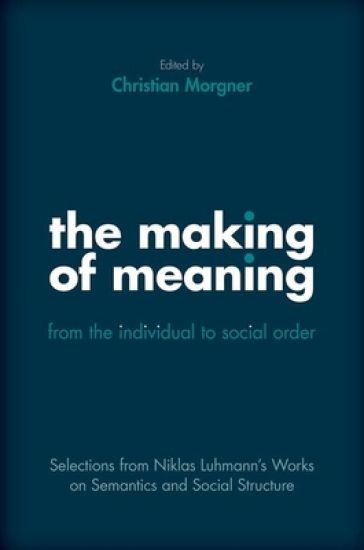
The Making of Meaning: From the Individual to Social Order

The Making of Meaning: From the Individual to Social Order

Niklas Luhmann

OXFORD UNIVERSITY PRESS INC
2022
sidottu
Niklas Luhmann is now widely recognized as one of the most important social theorists of the twentieth century. While several of his key texts have been translated into English significant parts of Luhmann's extensive output remain unavailable to a non-German-speaking readership. His publication in four volumes on Gesellschaftsstruktur and Semantik (Social Structure and Semantics) 1980, 1981, 1989, 1995) together constitute an important part of his work as they not only represent his contribution to a sociology of knowledge and culture, but they also set out the empirical work that underpins the development of his theory of society. In The Making of Meaning, Christian Morgner brings together Luhmann's essential ideas from the four volume series. In this work, Luhmann presents a new empirical strategy that links the production of knowledge and culture to broader societal changes and the transformation of societal complexity. This volume provides insight into the development of Luhmann's theoretical ideas, revealing how his theory was driven by a broad range of detailed historical and comparative studies. Informing a wide range of disciplines, from sociology to history, from law to business studies, from philosophy to cultural studies, The Making of Meaning stands as a major contribution to the sociology of knowledge and the social history of ideas.
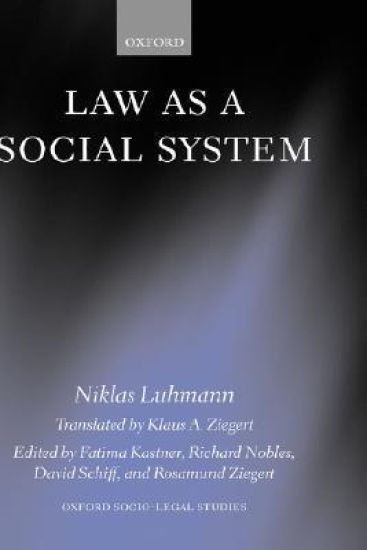
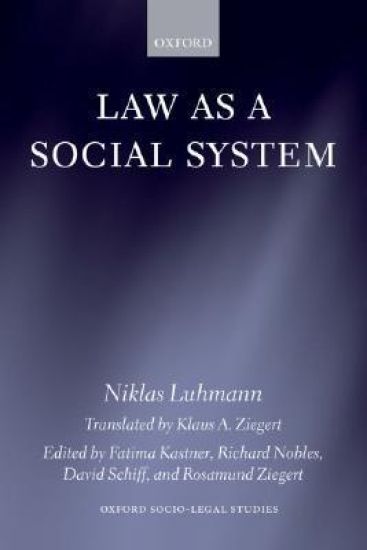
Law as a Social System

Law as a Social System

Niklas Luhmann

Oxford University Press
2004
sidottu
Modern systems theory provides a new paradigm for the analysis of society. In this volume, Niklas Luhmann, its leading exponent, explores its implications for our understanding of law. Luhmann argues that current thinking about how law operates within a modern society is seriously deficient. In this volume he lays out the theoretical and methodological tools that, he argues, can advance our understanding of contemporary society and, in particular, of the identity, performance, and function of the legal system within that society. In systems theory, society is its communications: they are its empirical reality; the items that can be observed and studied. Systems theory identifies how communications operate within a physical world and how different sub-systems of communication operate alongside each other. In this volume, Luhmann uses systems theory to address a question central to legal theory: what differentiates law from other parts of society? However, unlike conventional legal theory, this volume seeks to provide an answer in terms of a general social theory: a methodology that answers this question in a manner applicable not only to law, but also to all the other complex and highly differentiated systems within modern society, such as politics, the economy, religion, the media, and education. This truly sociological approach offers profound insights into the relationships between law and all of these other social systems.
Law as a Social System

Law as a Social System

Niklas Luhmann

Oxford University Press
2008
nidottu
Modern systems theory provides a new method for the analysis of society through an examination of the structures of its communications. In this volume, Niklas Luhmann, the theory's leading exponent, explores its implications for our understanding of law. Luhmann argues that current thinking about how law operates within a modern society is seriously deficient. He lays out the theoretical and methodological tools that, he argues, can advance our understanding of contemporary society and in particular of the identity, performance, and function of the legal system within that society. In systems theory, society is its communications: they are its empirical reality; the items that can be observed and studied. Systems theory identifies how communications operate within a physical world and how different sub-systems of communication operate alongside each other. In this volume, Luhmann uses systems theory to address a question central to legal theory: what differentiates law from other social practices? However, unlike conventional legal theory this volume seeks to provide an answer in terms of a general social theory: a methodology that answers the question in a manner applicable not only to law, but also to all the other complex and highly differentiated systems within modern society, such as politics, the economy, religion, the media, and education. This sociological approach offers profound insights into the relationships between law and other social systems.
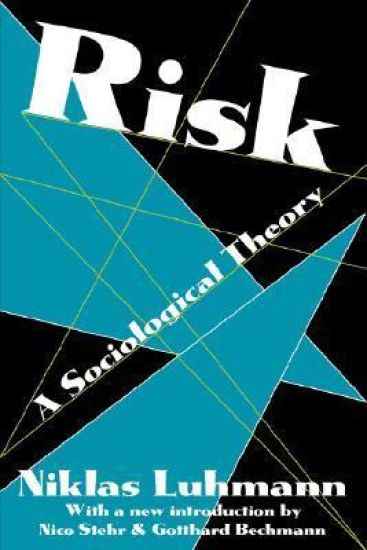
Risk

Risk

Niklas Luhmann

AldineTransaction
2005
nidottu
A great deal of attention has been devoted to risk research. Sociologists in general have limited themselves to varying recognitions of a society at risk and have traced out the paths to disaster. The detailed research has yet to be undertaken. In Risk, now available in paperback, Niklas Luhmann develops a theoretical program for such research. His premise is that the concept of risk projects essential aspects of our description of the future onto the present. Risk is conceived as the possibility of triggering unexpected, unlikely, and detrimental consequences by means of a decision attributable to a decision maker.
A Sociological Theory of Law

A Sociological Theory of Law

Niklas Luhmann

Routledge
2013
sidottu
Niklas Luhmann is recognised as a major social theorist, and his treatise on the sociology of law is a classic text. For Luhmann, law provides the framework of the state, lawyers are the main human resource for the state, and legal theory provides the most suitable base from which to theorize on the nature of society. He explores the concept of law in the light of a general theory of social systems, showing the important part law plays in resolving fundamental problems a society may face. He then goes on to discuss in detail how modern 'positive' – as opposed to ‘natural’ – law comes to fulfil this function. The work as a whole is not only a contribution to legal sociology, but a major work in social theory. With a revised translation, and a new introduction by Martin Albrow.
Love as Passion

Love as Passion

Niklas Luhmann

Polity Press
2012
nidottu
In this important book Niklas Luhmann - one of the leading social thinkers of the late 20th century - analyses the emergence of ‘love' as the basis of personal relationships in modern societies. He argues that, while family systems remained intact in the transition from traditional to modern societies, a semantics for love developed to accommodate extra-marital relationships; this semantics was then transferred back into marriage and eventually transformed marriage itself. Drawing on a diverse range of historical and literary sources, Luhmann retraces the emergence and evolution of the special semantics of passionate love that has come to form the basis of modern forms of intimacy and personal relationships. This classic book by Luhmann has been widely recognized as a work of major importance. It is an outstanding contribution to social theory and it provides an original and illuminating perspective on the nature of modern marriage and sexuality.
The Reality of the Mass Media

The Reality of the Mass Media

Niklas Luhmann

JOHN WILEY AND SONS LTD
2000
sidottu
In The Reality of the Mass Media Luhmann extends his theory of social systems - applied in his earlier works to the economy, the political system, art, religion, the sciences and law - to an examination of the role of mass media in the constitution of social reality. Luhmann argues that the system of mass media is a set of recursive, self-referential programmes of communication, whose functions are not determined by the external values of truthfulness, objectivity, or knowledge, nor by specific social interests or political directives. Rather, he contends that the system of mass media is regulated by the internal code information / non-information, which enables the system to select its information (news) from its own environment and to communicate this information in accordance with its own reflexive criteria. Despite its self-referential quality, however, Luhmann describes the mass media as one of the key cognitive systems of modern society, by means of which society constructs the illusion of its own reality. The reality of mass media, he argues, allows societies to process information without destabilizing social roles or overburdening social actors. It forms a broad reservoir (memory) of options for the future co-ordination of action, and it provides parameters for the stabilization of political expectations. In these respects, it has a crucial function in the general self-reproduction of society, as it produces a continuous self-description of the world around which modern society can orientate itself. In his discussion of mass media, Luhmann elaborates a theory of communication in which communication is seen not as the act of a particular consciousness, nor the medium of integrative social norms, but merely the technical codes through which systemic operations arrange and perpetuate themselves. This book will be of great interest to third year students, graduate students and scholars in sociology, politics, social and political theory, media and cultural studies and communication studies.
Introduction to Systems Theory

Introduction to Systems Theory

Niklas Luhmann

Polity Press
2012
sidottu
Niklas Luhmann ranks as one of the most important sociologists and social theorists of the twentieth century. Through his many books he developed a highly original form of systems theory that has been hugely influential in a wide variety of disciplines. In Introduction to Systems Theory, Luhmann explains the key ideas of general and sociological systems theory and supplies a wealth of examples to illustrate his approach. The book offers a wide range of concepts and theorems that can be applied to politics and the economy, religion and science, art and education, organization and the family. Moreover, Luhmann’s ideas address important contemporary issues in such diverse fields as cognitive science, ecology, and the study of social movements. This book provides all the necessary resources for readers to work through the foundations of systems theory – no other work by Luhmann is as clear and accessible as this. There is also much here that will be of great interest to more advanced scholars and practitioners in sociology and the social sciences.
Introduction to Systems Theory

Introduction to Systems Theory

Niklas Luhmann

Polity Press
2012
nidottu
Niklas Luhmann ranks as one of the most important sociologists and social theorists of the twentieth century. Through his many books he developed a highly original form of systems theory that has been hugely influential in a wide variety of disciplines. In Introduction to Systems Theory, Luhmann explains the key ideas of general and sociological systems theory and supplies a wealth of examples to illustrate his approach. The book offers a wide range of concepts and theorems that can be applied to politics and the economy, religion and science, art and education, organization and the family. Moreover, Luhmann’s ideas address important contemporary issues in such diverse fields as cognitive science, ecology, and the study of social movements. This book provides all the necessary resources for readers to work through the foundations of systems theory – no other work by Luhmann is as clear and accessible as this. There is also much here that will be of great interest to more advanced scholars and practitioners in sociology and the social sciences.
Love

Love

Niklas Luhmann

Polity Press
2010
sidottu
Love seems like the most personal experience, one that touches each of us in a unique way that is more personal than social, and hence it is not surprising that it has been largely neglected by sociologists and social theorists. While it has long been a central preoccupation of writers and novelists, love has rarely attracted anything more than the most cursory attention of social scientists. This short text, originally written in 1969 by the eminent German social theorist Niklas Luhmann, goes a long way to redressing this neglect. Rather than seeing love as a unique and ineffable personal experience, Luhmann treats love as a solution to a problem that depends on a wider range of social structures and forms. Human beings are faced with a world of enormous complexity and they have to find ways to order and make sense of this world. In other words, they need certain facilities for action Ð what Luhmann calls ‘media of communication’ Ð that enable them to select from a host of alternatives in ways that will be understood as meaningful by others. Love is one of these media; truth, power, money and art are others. With the development of modern societies, greater demands are made on this medium of love, altering the relationship between love and sexuality and giving rise to the distinctive difficulties we associate with love today. This short text by one of the most brilliant social theorists of the 20th century will be of great interest to students and scholars throughout the social sciences and humanities. It is a concise and pithy statement of what is still the only sociological theory of love we have.
Love

Love

Niklas Luhmann

Polity Press
2010
nidottu
Love seems like the most personal experience, one that touches each of us in a unique way that is more personal than social, and hence it is not surprising that it has been largely neglected by sociologists and social theorists. While it has long been a central preoccupation of writers and novelists, love has rarely attracted anything more than the most cursory attention of social scientists. This short text, originally written in 1969 by the eminent German social theorist Niklas Luhmann, goes a long way to redressing this neglect. Rather than seeing love as a unique and ineffable personal experience, Luhmann treats love as a solution to a problem that depends on a wider range of social structures and forms. Human beings are faced with a world of enormous complexity and they have to find ways to order and make sense of this world. In other words, they need certain facilities for action Ð what Luhmann calls ‘media of communication’ Ð that enable them to select from a host of alternatives in ways that will be understood as meaningful by others. Love is one of these media; truth, power, money and art are others. With the development of modern societies, greater demands are made on this medium of love, altering the relationship between love and sexuality and giving rise to the distinctive difficulties we associate with love today. This short text by one of the most brilliant social theorists of the 20th century will be of great interest to students and scholars throughout the social sciences and humanities. It is a concise and pithy statement of what is still the only sociological theory of love we have.
Art As a Social System

Art As a Social System

Niklas Luhmann

Stanford University Press
2000
sidottu
This is the definitive analysis of art as a social and perceptual system by Germany's leading social theorist of the late twentieth century. It not only represents an important intellectual step in discussions of art—in its rigor and in its having refreshingly set itself the task of creating a set of distinctions for determining what counts as art that could be valid for those creating as well as those receiving art works—but it also represents an important advance in systems theory. Returning to the eighteenth-century notion of aesthetics as pertaining to the "knowledge of the senses," Luhmann begins with the idea that all art, including literature, is rooted in perception. He insists on the radical incommensurability between psychic systems (perception) and social systems (communication). Art is a special kind of communication that uses perceptions instead of language. It operates at the boundary between the social system and consciousness in ways that profoundly irritate communication while remaining strictly internal to the social. In seven densely argued chapters, Luhmann develops this basic premise in great historical and empirical detail. Framed by the general problem of art's status as a social system, each chapter elaborates, in both its synchronic and diachronic dimensions, a particular aspect of this problem. The consideration of art within the context of a theory of second-order observation leads to a reconceptualization of aesthetic form. The remaining chapters explore the question of the system's code, its function, and its evolution, concluding with an analysis of "self-description." Art as a Social System draws on a vast body of scholarship, combining the results of three decades of research in the social sciences, phenomenology, evolutionary biology, cybernetics, and information theory with an intimate knowledge of art history, literature, aesthetics, and contemporary literary theory. The book also engages virtually every major theorist of art and aesthetics from Baumgarten to Derrida.
Theory of Society, Volume 1

Theory of Society, Volume 1

Niklas Luhmann

Stanford University Press
2012
sidottu
This first volume of Niklas Luhmann's two-part final work was initially published in German in 1997. The culmination of his thirty-year theoretical project to reconceptualize sociology, it offers a comprehensive description of modern society on a scale not attempted since Talcott Parsons. Beginning with an account of the fluidity of meaning and the accordingly high improbability of successful communication, Luhmann analyzes a range of communicative media, including language, writing, the printing press, and electronic media as well as "success media," such as money, power, truth, and love, all of which structure this fluidity and make communication possible. An investigation into the ways in which social systems produce and reproduce themselves, the book asks what gives rise to functionally differentiated social systems, how they evolve, and how social movements, organizations, and patterns of interaction emerge. The advent of the computer and its networks, which trigger potentially far-reaching processes of restructuring, receive particular attention. A concluding chapter on the semantics of modern society's self-description bids farewell to the outdated theoretical approaches of "old Europe," that is, to ontological, holistic, ethical, and critical interpretations of society, and argues that concepts such as "the nation," "the subject," and "postmodernity" are vastly overrated. In their stead, "society"—long considered a suspicious term by sociologists, one open to all kinds of reification—is defined in purely operational terms. It is the always uncertain answer to the question of what comes next in all areas of communication.
Theory of Society, Volume 1

Theory of Society, Volume 1

Niklas Luhmann

Stanford University Press
2012
pokkari
This first volume of Niklas Luhmann's two-part final work was initially published in German in 1997. The culmination of his thirty-year theoretical project to reconceptualize sociology, it offers a comprehensive description of modern society on a scale not attempted since Talcott Parsons. Beginning with an account of the fluidity of meaning and the accordingly high improbability of successful communication, Luhmann analyzes a range of communicative media, including language, writing, the printing press, and electronic media as well as "success media," such as money, power, truth, and love, all of which structure this fluidity and make communication possible. An investigation into the ways in which social systems produce and reproduce themselves, the book asks what gives rise to functionally differentiated social systems, how they evolve, and how social movements, organizations, and patterns of interaction emerge. The advent of the computer and its networks, which trigger potentially far-reaching processes of restructuring, receive particular attention. A concluding chapter on the semantics of modern society's self-description bids farewell to the outdated theoretical approaches of "old Europe," that is, to ontological, holistic, ethical, and critical interpretations of society, and argues that concepts such as "the nation," "the subject," and "postmodernity" are vastly overrated. In their stead, "society"—long considered a suspicious term by sociologists, one open to all kinds of reification—is defined in purely operational terms. It is the always uncertain answer to the question of what comes next in all areas of communication.
The Reality of the Mass Media

The Reality of the Mass Media

Niklas Luhmann

STANFORD UNIVERSITY PRESS
2000
sidottu
In The Reality of the Mass Media, Luhmann extends his theory of social systems-applied in his earlier works to the economy, the political system, art, religion, the sciences, and law-to an examination of the role of mass media in the construction of social reality. Luhmann argues that the system of mass media is a set of recursive, self-referential programs of communication, whose functions are not determined by the external values of truthfulness, objectivity, or knowledge, nor by specific social interests or political directives. Rather, he contends that the system of mass media is regulated by the internal code information/noninformation, which enables the system to select its information (news) from its own environment and to communicate this information in accordance with its own reflexive criteria. Despite its self-referential quality, Luhmann describes the mass media as one of the key cognitive systems of modern society, by means of which society constructs the illusion of its own reality. The reality of mass media, he argues, allows societies to process information without destabilizing social roles or overburdening social actors. It forms a broad reservoir (memory) of options for the future coordination of action, and it provides parameters for the stabilization of political reproduction of society, as it produces a continuous self-description of the world around which modern society can orient itself. In his discussion of mass media, Luhmann elaborates a theory of communication in which communication is seen not as the act of a particular consciousness, nor the medium of integrative social norms, but merely the technical codes through which systemic operations arrange and perpetuate themselves.
The Reality of the Mass Media

The Reality of the Mass Media

Niklas Luhmann

Stanford University Press
2000
pokkari
In The Reality of the Mass Media, Luhmann extends his theory of social systems-applied in his earlier works to the economy, the political system, art, religion, the sciences, and law-to an examination of the role of mass media in the construction of social reality. Luhmann argues that the system of mass media is a set of recursive, self-referential programs of communication, whose functions are not determined by the external values of truthfulness, objectivity, or knowledge, nor by specific social interests or political directives. Rather, he contends that the system of mass media is regulated by the internal code information/noninformation, which enables the system to select its information (news) from its own environment and to communicate this information in accordance with its own reflexive criteria. Despite its self-referential quality, Luhmann describes the mass media as one of the key cognitive systems of modern society, by means of which society constructs the illusion of its own reality. The reality of mass media, he argues, allows societies to process information without destabilizing social roles or overburdening social actors. It forms a broad reservoir (memory) of options for the future coordination of action, and it provides parameters for the stabilization of political reproduction of society, as it produces a continuous self-description of the world around which modern society can orient itself. In his discussion of mass media, Luhmann elaborates a theory of communication in which communication is seen not as the act of a particular consciousness, nor the medium of integrative social norms, but merely the technical codes through which systemic operations arrange and perpetuate themselves.
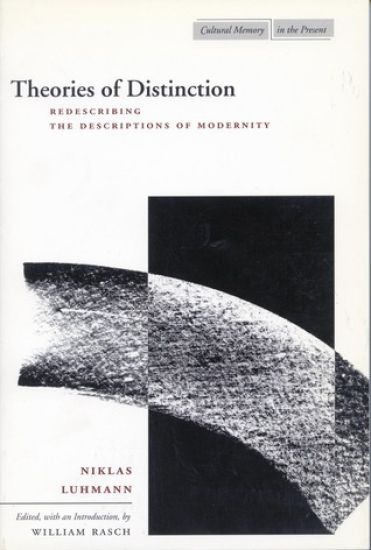
Theories of Distinction

Theories of Distinction

Niklas Luhmann

Stanford University Press
2002
sidottu
The essays in this volume by Germany's leading social theorist of the late twentieth century formulate what he considered to be the preconditions for an adequate theory of modern society. The first two essays deal with the modern European philosophical and scientific tradition, notably the ogy of Edmund Husserl. The next four essays concern the crucial notion of observation as defined by Luhmann. They examine the history of paradox as a logical problem and as a historically conditioned feature of rhetoric; deconstruct the thinking of Jacques Derrida, especially his language-centered allegiances; discuss the usefulness of Spencer Brown's Laws of Form; and assess the consequences of observation and paradox for epistemology. The following essays present Luhmann's theory of communication and his articulation of the difference between thought and communication, a difference that makes clear one of Luhmann's most radical and controversial theses, that the individual not only does not form the basic element of society but is excluded from it altogether, situated instead in the environment of the social system. The book concludes with a polemic against the critical thought of the Frankfurt School of postwar German social thought.
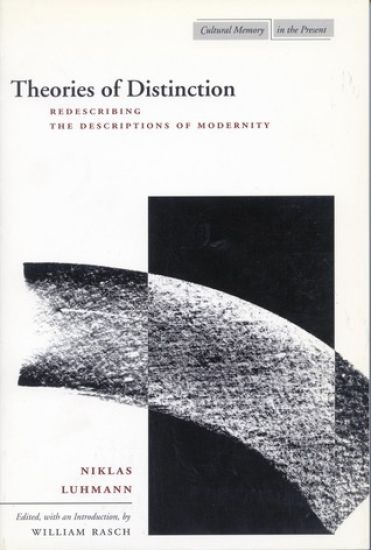
Theories of Distinction

Theories of Distinction

Niklas Luhmann

Stanford University Press
2002
pokkari
The essays in this volume by Germany's leading social theorist of the late twentieth century formulate what he considered to be the preconditions for an adequate theory of modern society. The first two essays deal with the modern European philosophical and scientific tradition, notably the ogy of Edmund Husserl. The next four essays concern the crucial notion of observation as defined by Luhmann. They examine the history of paradox as a logical problem and as a historically conditioned feature of rhetoric; deconstruct the thinking of Jacques Derrida, especially his language-centered allegiances; discuss the usefulness of Spencer Brown's Laws of Form; and assess the consequences of observation and paradox for epistemology. The following essays present Luhmann's theory of communication and his articulation of the difference between thought and communication, a difference that makes clear one of Luhmann's most radical and controversial theses, that the individual not only does not form the basic element of society but is excluded from it altogether, situated instead in the environment of the social system. The book concludes with a polemic against the critical thought of the Frankfurt School of postwar German social thought.