Kirjojen hintavertailu. Mukana 11 712 582 kirjaa ja 12 kauppaa.

Kirjahaku

Etsi kirjoja tekijän nimen, kirjan nimen tai ISBN:n perusteella.

6 kirjaa tekijältä Nora Berend

Stephen I, the First Christian King of Hungary

Stephen I, the First Christian King of Hungary

Nora Berend

Oxford University Press
2024
sidottu
Stephen I, Hungary's first Christian king (reigned 997-1038) has been celebrated as the founder of the Hungarian state and church. Despite the scarcity of medieval sources, and consequent limitations on historical knowledge, he has had a central importance in narratives of Hungarian history and national identity. This book argues that instead of conceptualizing modern political medievalism separately as an 'abuse' of history, we must investigate history's very fabric, because cultural memory is woven into the production of the medieval sources. Medieval myth-making served as a firm basis for centuries of further elaboration and reinterpretation, both in historiography and in political legitimizing strategies. In many ways we cannot reach the 'real' Stephen, but we can do much more to understand the shaping of his myths. The author traces the origin of crucial stories around Stephen, contextualizing both the invention of early narratives and their later use. A challenger to Stephen's rule who may be a medieval literary invention became the protagonist of a rock opera in 1983, also standing in for Imre Nagy, a key figure of the 1956 revolution; moreover, he was reinvented as the embodiment of true Hungarian identity. The alleged right hand relic was 'discovered' to provide added legitimacy for Hungary's kings and then became a protagonist of the entanglement of Church and state. A medieval crown was invested with supernatural status, before turning into a national symbol. This book analyses the often seamless flow that has turned medieval myth into modern history, showing that politicisation was not a modern addition, but a determinant factor from the start.
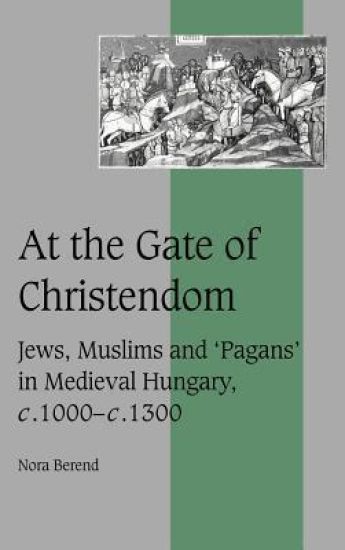
At the Gate of Christendom

At the Gate of Christendom

Nora Berend

Cambridge University Press
2006
pokkari
Modern life in increasingly heterogeneous societies has directed attention to patterns of interaction, often using a framework of persecution and tolerance. This study of the economic, social, legal and religious position of three minorities (Jews, Muslims and pagan Turkic nomads) argues that different degrees of exclusion and integration characterized medieval non-Christian status in the medieval Christian kingdom of Hungary between 1000 and 1300. A complex explanation of non-Christian status emerges from the analysis of their economic, social, legal and religious positions and roles. Existence on the frontier with the nomadic world led to the formulation of a frontier ideology, and to anxiety about Hungary's detachment from Christendom, which affected policies towards non-Christians. The study also succeeds in integrating central European history with the study of the medieval world, while challenging such current concepts in medieval studies as frontier societies, persecution and tolerance, ethnicity and 'the other'.
At the Gate of Christendom

At the Gate of Christendom

Nora Berend

Cambridge University Press
2001
sidottu
Modern life in increasingly heterogeneous societies has directed attention to patterns of interaction, often using a framework of persecution and tolerance. This study of the economic, social, legal and religious position of three minorities (Jews, Muslims and pagan Turkic nomads) argues that different degrees of exclusion and integration characterized medieval non-Christian status in the medieval Christian kingdom of Hungary between 1000 and 1300. A complex explanation of non-Christian status emerges from the analysis of their economic, social, legal and religious positions and roles. Existence on the frontier with the nomadic world led to the formulation of a frontier ideology, and to anxiety about Hungary's detachment from Christendom, which affected policies towards non-Christians. The study also succeeds in integrating central European history with the study of the medieval world, while challenging such current concepts in medieval studies as frontier societies, persecution and tolerance, ethnicity and 'the other'.
El Cid

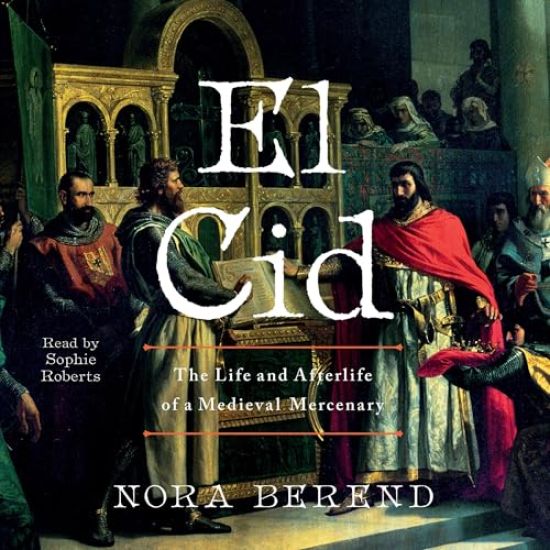
El Cid

Nora Berend

Hodder Stoughton
2024
sidottu
'A fascinating study of historical mythmaking . . . concise and absorbing'Paul Freedman, author of Out of the East'Lively, original and fascinating'David Abulafia, Literary Review'An enthralling study . . . exceptionally fascinating'Washington PostRodrigo Díaz lived a violently colourful life in eleventh-century Spain. An ambitious military leader, exile and brutal mercenary, he served Christian kings, fought against Christian princes in service of Muslim rulers, raided and killed Muslims and eventually struck out on his own, carving out an independent principality. While Rodrigo the man is long dead, El Cid lives on: a superhero; a quasi-saint; the 'spirit of Spain', according to military dictator Franco; and a champion of medieval Spanish multiculturalism. Nora Berend uncovers how el Cid has been transformed across the centuries, confronting the gulf between truth and legend and examining how a military adventurer became a hero to people on opposite ends of the political spectrum. What is it about this man that appeals to us? And why do we transform the most unsuitable people into heroes?'Would the real El Cid please stand up? Nora Berend's fascinating new book covers nearly a thousand years of history and myth-making about this eleventh-century warrior . . . and presents all the delicious ironies of history'Professor Marc David Baer, author of The Ottomans: Khans, Caliphs, and Caesars
El Cid: The Life and Afterlife of a Medieval Mercenary
Exploring the creation of the El Cid legend over the centuries, this masterful and evocative biography peels away the layers of myth to reveal the real-life historical figure.El Cid was perhaps the most famous warrior involved in the indiscriminate fighting--irrespective of religion--on the Iberian Peninsula during the eleventh century.In the centuries after his death, he was transformed into a perfect Christian knight. In modernity, he was seen as the incarnation of Spain's special national character--Franco chose El Cid as the emblem of Nationalist Spain. Yet not only those on the political right but also many others, including academics and those on the political left, were in his thrall. He has been promoted both as the forerunner of white supremacists and of multiculturalism.How can we explain such a stupendous afterlife, and how can El Cid be a hero for so many different people? To begin to understand that, we must try to understand the truth buried beneath the myth.Nora Berend explores the creation of the legends over the centuries and reveals those active in its making. Medieval monks, the women in El Cid's family, a playwright, and a historian are among the creators of the mythic Cid.This riveting narrative seeks to explain their motives, and in so doing peels away the layers of legend to evoke the real-life historical figure.