Kirjojen hintavertailu. Mukana 12 016 292 kirjaa ja 12 kauppaa.

Kirjahaku

Etsi kirjoja tekijän nimen, kirjan nimen tai ISBN:n perusteella.

13 kirjaa tekijältä Norman Finkelstein

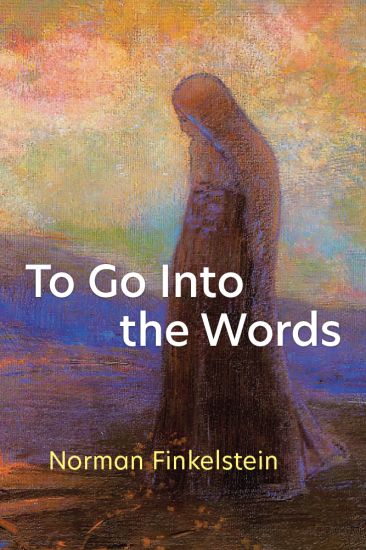
To Go Into the Words

To Go Into the Words

Norman Finkelstein

THE UNIVERSITY OF MICHIGAN PRESS
2023
nidottu
To Go Into the Words is the latest book of critical prose from renowned poet and scholar of Jewish literature Norman Finkelstein. Through a rigorous examination of poets such as William Bronk, Helen Adam, and Nathaniel Mackey, the book engages the contemporary poetic fascination with transcendence through the radical delight with language. By opening up a given poem, Finkelstein seeks the “gnosis” or insight of what it contains so that other readers can understand and appreciate the works even more.Pulling from Finkelstein’s experience of writing thirteen books of poetry and six books of literary criticism, To Go Into the Words consistently rewards the reader with insights as transformative as they are well-considered and deftly mapped out. This volume opens the world of poetry to poets, scholars, and readers by showcasing “the gnosis that is to be found in modern poetry.”
Gaza

Gaza

Norman Finkelstein

University of California Press
2018
sidottu
Gaza is among the most densely populated places in the world. Two-thirds of its inhabitants are refugees, and more than half the population is under eighteen years of age. Since Israel occupied Gaza in 1967, it has systematically de-developed the economy. After Hamas won democratic elections in 2006, Israel intensified its blockade of Gaza, and after Hamas consolidated its control of the territory in 2007, Israel tightened its illegal siege another notch. In the meantime, Israel has launched no less than eight military operations against Gaza-culminating in Operation Cast Lead in 2008-9 and Operation Protective Edge in 2014-that left behind over three million tons of rubble. Recent UN reports predict that Gaza will be unlivable by 2020. Norman G. Finkelstein presents a meticulously researched and devastating inquest into Israel's actions of the last decade. He argues that although Israel justified its blockade and violent assaults in the name of self-defense, in fact these actions were cynical exercises of brutal power against an essentially defenseless civilian population. Based on hundreds of human rights reports, the book scrutinizes multifarious violations of international law Israel committed both during its operations and in the course of its decade-long siege of Gaza. It is a monument to Gaza's martyrs and a scorching accusation against their tormenters.
Gaza

Gaza

Norman Finkelstein

University of California Press
2021
pokkari
"In its comprehensive sweep, deep probing and acute critical analysis, Finkelstein's study stands alone."—Noam Chomsky"No one who ventures an opinion on Gaza . . . is entitled to do so without taking into account the evidence in this book."—The InterceptThe Gaza Strip is among the most densely populated places in the world. More than two-thirds of its inhabitants are refugees, and more than half are under eighteen years of age. Since 2004, Israel has launched eight devastating “operations” against Gaza’s largely defenseless population. Thousands have perished, and tens of thousands have been left homeless. In the meantime, Israel has subjected Gaza to a merciless illegal blockade. What has befallen Gaza is a man-made humanitarian disaster. Based on scores of human rights reports, Norman G. Finkelstein's new book presents a meticulously researched inquest into Gaza’s martyrdom. He shows that although Israel has justified its assaults in the name of self-defense, in fact these actions constituted flagrant violations of international law. But Finkelstein also documents that the guardians of international law—from Amnesty International and Human Rights Watch to the UN Human Rights Council—ultimately failed Gaza. One of his most disturbing conclusions is that, after Judge Richard Goldstone's humiliating retraction of his UN report, human rights organizations succumbed to the Israeli juggernaut. Finkelstein’s magnum opus is both a monument to Gaza’s martyrs and an act of resistance against the forgetfulness of history.
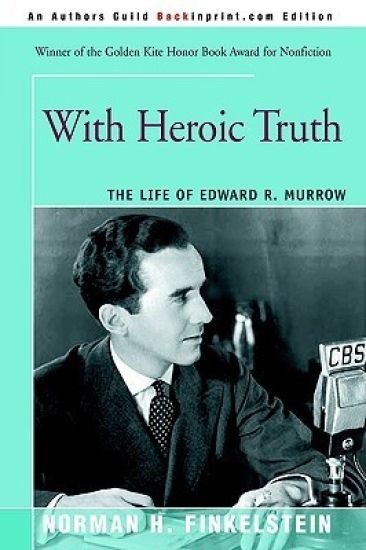
With Heroic Truth

With Heroic Truth

Norman Finkelstein

iUniverse
2005
pokkari
Edward R. Murrow was one of America's "most dedicated and eloquent spokesmen. The people of the free world are deeply in his debt. So is broadcast journalism, which, in so many ways, he helped establish and to which he was one of the finest practitioners. He set standards of excellence that remain unsurpassed. His thoughtful spirit of inqui9ry, his profound insight and his single-minded devotion to quality were without parallel in radio, television or any other medium." --Memorial plaque, CBS Broadcast Center, New York City
Like a Dark Rabbi

Like a Dark Rabbi

Norman Finkelstein

Hebrew Union College Press,U.S.
2019
nidottu
Wallace Stevens' "dark rabbi", from his poem "Le Monocle de Mon Oncle", provides a title for this collection of essays on the "lordly study" of modern Jewish poetry in English. Including chapters on such poets as Charles Reznikoff, Allen Grossman, Chana Bloch, and Michael Heller, this volume explores the tensions between religious and secular worldviews in recent Jewish poetry, the often conflicted linguistic and cultural matrix from which this poetry arises, and the complicated ways in which Jewish tradition shapes the sensibilities of not only Jewish, but also non-Jewish, poets. Finkelstein, described as "one of American poetry's indispensable makers" (Lawrence Joseph), whose previous critical work has been called "the exemplary study of the religious aspect of the works of contemporary American poets" (Peter O'Leary), considers large literary and cultural trends while never losing sight of the particular formal powers of individual poems. In Like a Dark Rabbi he offers a passionate argument for the importance of Jewish-American poetry to modern Jewish culture—and to American poetry—as it engages with the contradictions of contemporary life.
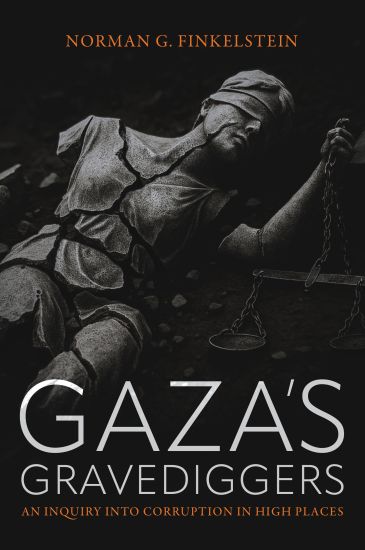
Gaza's Gravediggers

Gaza's Gravediggers

Norman Finkelstein

OR Books
2025
sidottu
Norman Finkelstein at his most fearless and incisive. In his groundbreaking career, Norman Finkelstein has laid bare the politics behind Israel’s military assaults on Gaza, forensically debunking the narratives of its apologists. Since October 7, 2023, he has emerged as one of the most prominent voices condemning Israel’s onslaughts, offering piercing analyses of their historical and ethical implications. Now, in Gaza’s Gravediggers, Finkelstein shifts his critical lens to the global enablers of genocide—those in positions of power who distort truth and manipulate justice. With meticulous research and razor-sharp analysis, he systematically dismantles the most influential arguments defending Israel’s actions. He exposes how a United Nations special representative lent credence to an Israeli smear campaign, how judges on the world’s highest court perverted the law in Israel’s defence, and how even Israel’s severe critics colluded in misrepresenting genocide as a war. This is more than a book; it is a searing indictment of those who abuse their authority to whitewash oppression. Gaza’s Gravediggers serves as a clarion call for accountability, reminding those in power: the world is watching, and history will not forgive. As Finkelstein warns: “It will not be forgotten, it will no longer be business as usual, if you choose to do the Devil’s work.”
Track

Track

Norman Finkelstein

Shearsman Books
2012
pokkari
Track is a book-length poem, originally released in the USA by Spuyten Divil in three volumes. "Norman Finkelstein's Track undertakes a voyage beset by recombinatory duress. An excursis through realms where "the letters / arrive to be destroyed," this wickedly wise poem keeps on arriving long after it's done - a lingering trade or track of mind in mind, trouble in mind. It is a beautiful, beguiling book of unrest." - Nathaniel Mackey
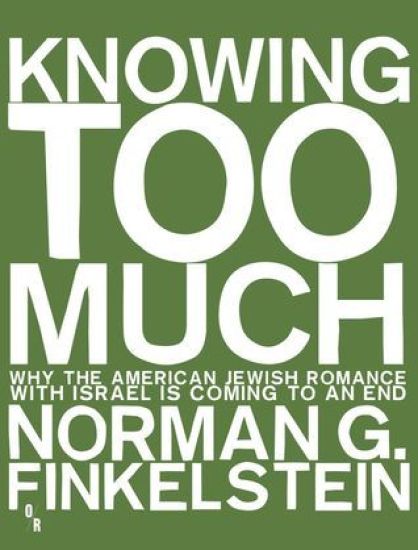
Knowing Too Much

Knowing Too Much

Norman Finkelstein

OR Books
2012
pokkari
Traditionally, American Jews have been broadly liberal in their political outlook; indeed African-Americans are the only ethnic group more likely to vote Democratic in US elections. Over the past half century, however, attitudes on one topic have stood in sharp contrast to this group's generally progressive stance: support for Israel. Despite Israel's record of militarism, illegal settlements and human rights violations, American Jews have, stretching back to the 1960s, remained largely steadfast supporters of the Jewish "homeland". But, as Norman Finkelstein explains in an elegantly-argued and richly-textured new book, this is now beginning to change. Reports by Human Rights Watch, Amnesty International and the United Nations, and books by commentators as prominent as President Jimmy Carter and as well-respected in the scholarly community as Stephen Walt, John Mearsheimer and Peter Beinart, have increasingly pinpointed the fundamental illiberalism of the Israeli state. In the light of these exposes, the support of America Jews for Israel has begun to fray. This erosion has been particularly marked among younger members of the community. A 2010 Brandeis University poll found that only about one quarter of Jews aged under 40 today feel "very much" connected to Israel. In successive chapters that combine Finkelstein's customary meticulous research with polemical brio, Knowing Too Much sets the work of defenders of Israel such as Jeffrey Goldberg, Michael Oren, Dennis Ross and Benny Morris against the historical record, showing their claims to be increasingly tendentious. As growing numbers of American Jews come to see the speciousness of the arguments behind such apologias and recognize Israel's record as simply indefensible, Finkelstein points to the opening of new possibilities for political advancement in a region that for decades has been stuck fast in a gridlock of injustice and suffering.
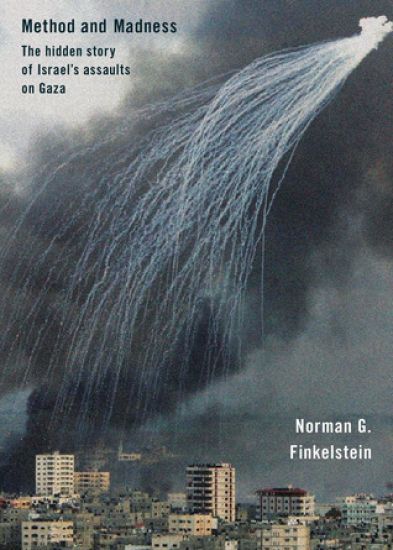
Method and Madness

Method and Madness

Norman Finkelstein

OR Books
2015
pokkari
In the past five years Israel has mounted three major assaults on the 1.8 million Palestinians trapped behind its blockade of the Gaza Strip. Taken together, Operation Cast Lead (2008-9), Operation Pillar of Defense (2012), and Operation Protective Edge (2014), have resulted in the deaths of some 3,700 Palestinians. Meanwhile, a total of 90 Israelis were killed in the invasions. On the face of it, this succession of vastly disproportionate attacks has often seemed frenzied and pathological. Senior Israeli politicians have not discouraged such perceptions, indeed they have actively encouraged them. After the 2008-9 assault Israel’s then-foreign minister, Tzipi Livni, boasted, "Israel demonstrated real hooliganism during the course of the recent operation, which I demanded." However, as Norman G. Finkelstein sets out in this concise, paradigm-shifting new book, a closer examination of Israel's motives reveals a state whose repeated recourse to savage war is far from irrational. Rather, Israel's attacks have been designed to sabotage the possibility of a compromise peace with the Palestinians, even on terms that are favorable to it. Looking also at machinations around the 2009 UN sponsored Goldstone report and Turkey's forlorn attempt to seek redress in the UN for the killing of its citizens in the 2010 attack on the Gaza freedom flotilla, Finkelstein documents how Israel has repeatedly eluded accountability for what are now widely recognized as war crimes. Further, he shows that, though neither side can claim clear victory in these conflicts, the ensuing stalemate remains much more tolerable for Israelis than for the beleaguered citizens of Gaza. A strategy of mass non-violent protest might, he contends, hold more promise for a Palestinian victory than military resistance, however brave.
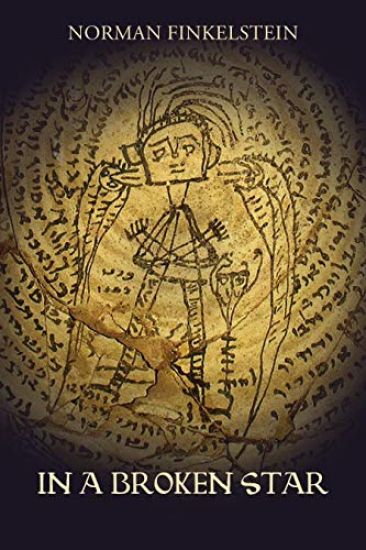
In a Broken Star

In a Broken Star

Norman Finkelstein

DOS Madres Press
2021
nidottu
At the heart of In a Broken Star, we find the themes of diaspora and quest romance, prophecy and gnosis, which have long suffused Norman Finkelstein's poetry. The central poem of the book, "The Adventures of Pascal Wanderlust," is a long narrative featuring an uncanny protagonist of indeterminate gender, age, and cultural identity, a bookish, wandering mage with mysterious links to the Immanent Foundation, the equally uncanny institution from Finkelstein's previous book, From the Files of the Immanent Foundation, a work which Nathaniel Mackey read "wishing it would never end." There are also intimate lyric sequences suffused with historical loss and cosmological vision. Poignant and darkly ironic, veering weirdly between Kafkaesque comedy and Lovecraftian creepiness, In a Broken Star may be Finkelstein's most compelling and sheerly entertaining work.Norman Finkelstein's In a Broken Star is a Wunderkammer of shining and enigmatic song-lyrics, memos and dispatches from an extra-dimensional dead letter office, and gnomic fragments of ancient wisdom texts. At its center is the astonishing narrative The Adventures of Pascal Wanderlust, in which Finkelstein has reinvented the quest narrative for our own moment-whether postmodern, post-political, post-gender, or post-truth. A knight-errant (or vagrant) in "flowered Docs," Pascal wanders in quest of-well, they're not quite sure: origins? genealogies? foundations (immanent or architectural)? answers? Pascal traverses waste lands recalling those of Eliot, Browning, and Lovecraft, swims and flies through libraries of Alexandria and Babel, and receives tantalizing hints of destinations in colloquies with specters from beneath the sea, from eldritch dimensions and "faery lands forlorn." Where will Pascal find the key to all mythologies: in the Zohar? the Necronomicon? the Standard Edition of Freud? And are they all finally the same book, its pages reshaping themselves beneath the (three-lobed) reading eye? Engaging, nightmarish, intensely erudite in the arcana of canonical literature, philosophy, outsider art, and pop culture, Pascal Wanderlust is one of the most electrifying adventures in contemporary poetry.
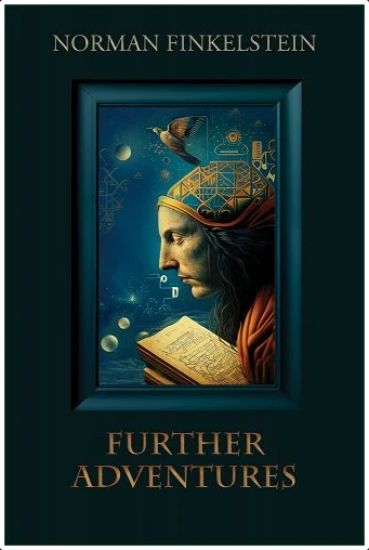
Further Adventures

Further Adventures

Norman Finkelstein

DOS Madres Press
2023
nidottu
Both a prequel and a sequel to the earlier From the Files of the Immanent Foundation and In a Broken Star, this new volume of poems is Finkelstein at his most uncanny. A dark, fragmented narrative weirdly illuminated by sudden bursts of lyricism, Further Adventures is a philosophical quest-romance that draws equally from the tradition of visionary poetry and from modern pop culture. At its heart is Pascal Wanderlust, first introduced in Broken Star, who, as Mark Scroggins puts it "traverses waste lands recalling those of Eliot, Browning, and Lovecraft, swims and flies through libraries of Alexandria and Babel, and receives tantalizing hints of destinations in colloquies with specters from beneath the sea, from eldritch dimensions and 'faery lands forlorn.'" A reluctant knight-errant who would rather "sit quietly in a room alone," the young Pascal is charged with the task of restoring the mysterious Immanent Foundation, where "The horns of Elfland and the summons / of the shofar echo throughout the grounds. / Myth calls to counter-myth, song suggests / song, fallen forms rise again..."
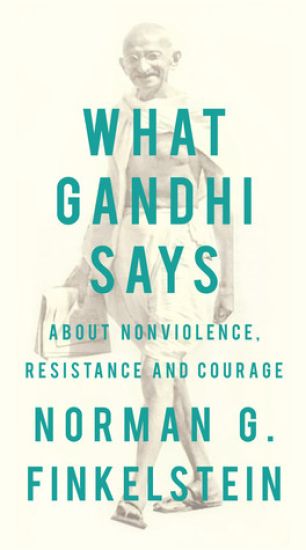
What Gandhi Says

What Gandhi Says

Norman Finkelstein

OR Books
2017
pokkari
Long treated as a moral icon, Gandhi remains one of the most demanding and misunderstood political thinkers of the modern era. There is much that will surprise in these pages : Mahatma Gandhi was not a pacifist; he believed in the right of those being attacked to strike back and regarded inaction as a result of cowardice to be a greater sin than even the most ill-considered aggression. Gandhi's calls for the sacrifice of lives in order to shame the oppressor into concessions can easily seem chilling and ruthless. Drawing on extensive readings of Gandhi’s copious oeuvre, Norman Finkelstein sets out, in clear and concise language, the basic principles of Gandhi’s approach and applies this thinking to the Israel–Palestine conflict. The wave of protest movements that gathered force in the early 2010s—from Occupy to the uprisings that inspired it— renewed global attention to Gandhi’s work on nonviolent resistance, articulated during the struggle for Indian independence and later echoed in Tahrir Square, Puerta del Sol, and Zuccotti Park. Yet admiration for Gandhi’s influence has often obscured the rigor and severity of his thinking. This book confronts that gap directly, examining Gandhi’s insistence on courage as an active and demanding virtue, his rejection of passivity and moral evasion, and his belief that resistance must be judged by its consequences in human lives. Central to this argument is Gandhi’s conviction that peaceful resistance, however exacting, is ultimately less costly in human terms than armed opposition, and that the role of a protest movement is not to persuade people of something new but to compel them to act on behalf of what they already accept as right.In doing so, it restores the sharp political edge of Gandhi’s thought and demonstrates its continuing relevance to contemporary struggles for justice and democracy.