
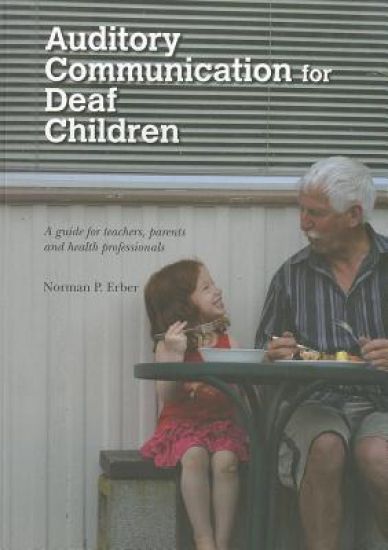
Auditory Communication for Deaf Children
Norman P. Erber
Australian Council Educational Research (ACER)
2011
nidottu
Auditory Communication for Deaf Children presents a rationale and framework for auditory learning in childhood and describes a wide range of practical listening activities that adults can apply during everyday interaction with the child. The book serves as a guide to intervention and practice for teachers, parents, speech pathologists, audiologists and other health professionals. Important, recurring themes include:adult–child interactionobservation of communication behaviouradaptation to the child’s abilitieslistening tasks that challenge the childeffective communication strategiesThe book contains basic activities for listening practice, and provides methods for adaptive auditory assessment, conversation-based therapy, telephone-communication training and self-help communication strategies for hearing-impaired children. The use of a hearing-loss simulator to develop speech and language clarity in communication partners is also discussed.Auditory Communication for Deaf Children shows adults how to become better communicators in order to help hearing-impaired children maximise their listening skills, and develop their spoken language and conversational competence. The therapeutic methods are founded upon evidence-based research, as well as practical experience obtained in pre-schools, classrooms, clinics and parent-advisory centres. References to supporting literature are provided throughout the text.