Kirjojen hintavertailu. Mukana 11 342 296 kirjaa ja 12 kauppaa.

Kirjahaku

Etsi kirjoja tekijän nimen, kirjan nimen tai ISBN:n perusteella.

6 kirjaa tekijältä Oliver Zimmer

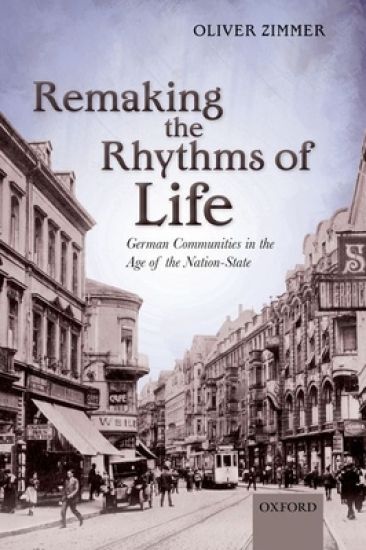
Remaking the Rhythms of Life

Remaking the Rhythms of Life

Oliver Zimmer

Oxford University Press
2015
nidottu
Across Europe the late nineteenth century marked a period of rapid economic change, increased migration, religious conflict, and inter-state competition. In Germany, these developments were further accentuated by the creation of the imperial state in 1870-1871, and the conflicting hopes and expectations it provoked. Attempting to make sense of this turbulent period of German history, historians have frequently reverted to terms such as industrialization, urbanization, nation-formation, modernity or modernization. Using the prism of comparative urban history, Oliver Zimmer highlights the limitations of these conceptual abstractions and challenges the separation of local and national approaches to the past. He shows how men and women drew on their creative energies to instigate change at various levels. Focusing on conflicts over the local economy and elementary schools, as well as on nationalist and religious processions, Remaking the Rhythms of Life examines how urban residents sought to regain a sense of place in a changing world - less by resisting the novel than by reconfiguring their environments in ways that reflected their sensibilities and aspirations; less by lamenting the decline of civic virtues than by creating surroundings that proved sufficiently meaningful to sustain lives. In their capacity as consumers, citizens, and members of religious or economic associations, people embarked on a multitude of journeys. As they did, larger phenomena such as religion, nationalism, and the state became intertwined with their everyday affairs and concerns.
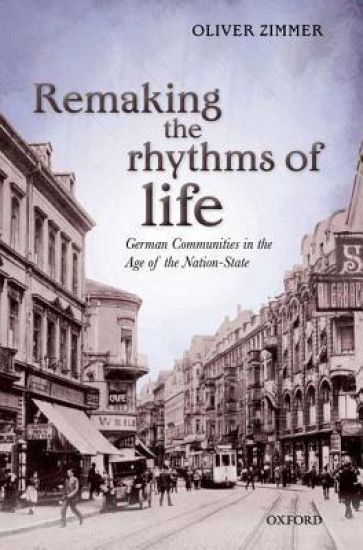
Remaking the Rhythms of Life

Remaking the Rhythms of Life

Oliver Zimmer

Oxford University Press
2013
sidottu
Across Europe the late nineteenth century marked a period of rapid economic change, increased migration, religious conflict, and inter-state competition. In Germany, these developments were further accentuated by the creation of the imperial state in 1870-1871, and the conflicting hopes and expectations it provoked. Attempting to make sense of this turbulent period of German history, historians have frequently reverted to terms such as industrialization, urbanization, nation-formation, modernity or modernization. Using the prism of comparative urban history, Oliver Zimmer highlights the limitations of these conceptual abstractions and challenges the separation of local and national approaches to the past. He shows how men and women drew on their creative energies to instigate change at various levels. Focusing on conflicts over the local economy and elementary schools, as well as on nationalist and religious processions, Remaking the Rhythms of Life examines how urban residents sought to regain a sense of place in a changing world - less by resisting the novel than by reconfiguring their environments in ways that reflected their sensibilities and aspirations; less by lamenting the decline of civic virtues than by creating surroundings that proved sufficiently meaningful to sustain lives. In their capacity as consumers, citizens, and members of religious or economic associations, people embarked on a multitude of journeys. As they did, larger phenomena such as religion, nationalism, and the state became intertwined with their everyday affairs and concerns.

Nationalism in Europe, 1890-1940

Nationalism in Europe, 1890-1940

Oliver Zimmer

Red Globe Press
2003
nidottu
While nationalism had become politically significant well before the late nineteenth century, it was between 1890 and 1940 that it revealed its political explosiveness and destructive potential.Organised around specific themes, many of which are currently hotly debated among experts in the field, Oliver Zimmer's study discusses such key issues as: the modernity of nations and nationalism, the formation of the nationalising state and the significance of national ritual for modern mass-nations, the ways in which nationalism shaped the treatment of minorities, the relationship between nationalism and fascism, and the perception of nationalism by liberals and socialists. Zimmer's account is more explicitly focused on conceptual issues than most textbooks on the subject, and also more historical and historiographical than many of the existing theoretical overviews. The result is an incisive examination of the most powerful ideology of modern times.
A Contested Nation

A Contested Nation

Oliver Zimmer

Cambridge University Press
2007
pokkari
This book examines the ways in which the Swiss defined their national identity in the long nineteenth century, in the face of a changing domestic and international background. Its narrative begins in 1761, when the first Swiss patriotic society of national significance was founded, and ends in 1891, when the Swiss celebrated their 600-year existence as a nation in a monumental national festival. While conceding that the creation of a nation-state in 1848 marked a watershed in the history of Swiss nation-formation, the author does not focus one-sidedly - as many others have done - on the activities of the nationalizing state. Instead, he attributes a key role to the competitive and contentious struggles over the shaping of public institutions and over the symbolic representation of the nation. These struggles, to which the nation-state and civil society contributed in equal measure, were framed increasingly along national lines.
A Contested Nation

A Contested Nation

Oliver Zimmer

Cambridge University Press
2003
sidottu
This book examines the ways in which the Swiss defined their national identity in the long nineteenth century, in the face of a changing domestic and international background. Its narrative begins in 1761, when the first Swiss patriotic society of national significance was founded, and ends in 1891, when the Swiss celebrated their 600-year existence as a nation in a monumental national festival. While conceding that the creation of a nation-state in 1848 marked a watershed in the history of Swiss nation-formation, the author does not focus one-sidedly - as many others have done - on the activities of the nationalising state. Instead, he attributes a key role to the competitive and contentious struggles over the shaping of public institutions and over the symbolic representation of the nation. These struggles, to which the nation-state and civil society contributed in equal measure, were framed increasingly along national lines.