Kirjojen hintavertailu. Mukana 11 627 363 kirjaa ja 12 kauppaa.

Kirjahaku

Etsi kirjoja tekijän nimen, kirjan nimen tai ISBN:n perusteella.

4 kirjaa tekijältä Osvaldo Simeone

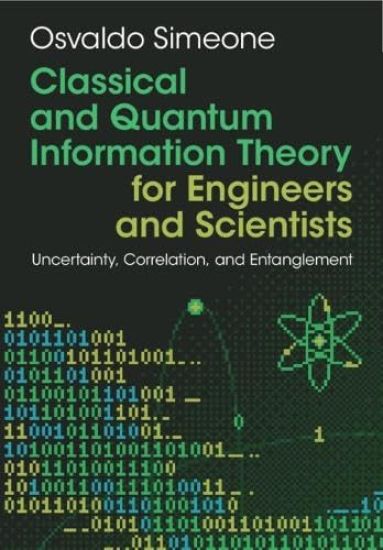
Classical and Quantum Information Theory

Classical and Quantum Information Theory

Osvaldo Simeone

Cambridge University Press
2025
sidottu
Discover the foundations of classical and quantum information theory in the digital age with this modern introductory textbook. Familiarise yourself with core topics such as uncertainty, correlation, and entanglement before exploring modern techniques and concepts including tensor networks, quantum circuits and quantum discord. Deepen your understanding and extend your skills with over 250 thought-provoking end-of-chapter problems, with solutions for instructors, and explore curated further reading. Understand how abstract concepts connect to real-world scenarios with over 400 examples, including numerical and conceptual illustrations, and emphasising practical applications. Build confidence as chapters progressively increase in complexity, alternating between classic and quantum systems. This is the ideal textbook for senior undergraduate and graduate students in electrical engineering, computer science, and applied mathematics, looking to master the essentials of contemporary information theory.
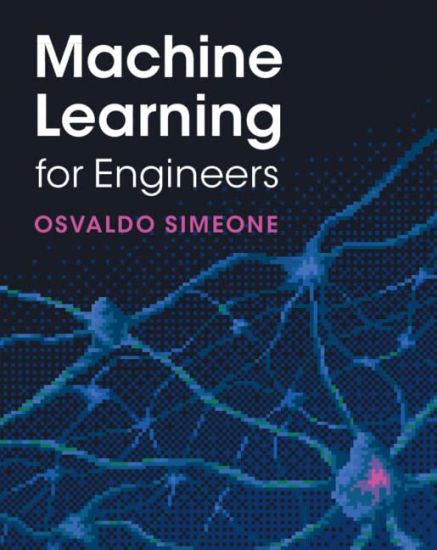
Machine Learning for Engineers

Machine Learning for Engineers

Osvaldo Simeone

Cambridge University Press
2022
sidottu
This self-contained introduction to machine learning, designed from the start with engineers in mind, will equip students with everything they need to start applying machine learning principles and algorithms to real-world engineering problems. With a consistent emphasis on the connections between estimation, detection, information theory, and optimization, it includes: an accessible overview of the relationships between machine learning and signal processing, providing a solid foundation for further study; clear explanations of the differences between state-of-the-art techniques and more classical methods, equipping students with all the understanding they need to make informed technique choices; demonstration of the links between information-theoretical concepts and their practical engineering relevance; reproducible examples using Matlab, enabling hands-on student experimentation. Assuming only a basic understanding of probability and linear algebra, and accompanied by lecture slides and solutions for instructors, this is the ideal introduction to machine learning for engineering students of all disciplines.
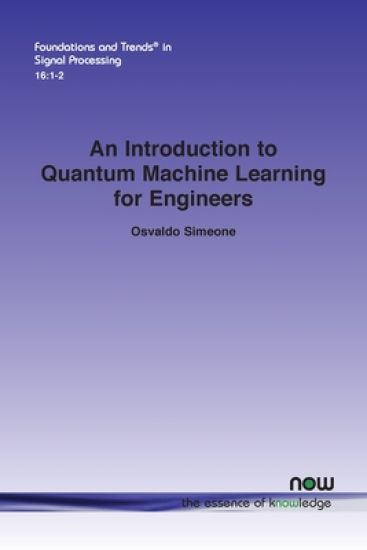
An Introduction to Quantum Machine Learning for Engineers
This monograph is motivated by a number of recent developments that appear to define a possible new role for researchers with an engineering profile. First, there are now several software libraries – such as IBM’s Qiskit, Google’s Cirq, and Xanadu’s PennyLane – that make programming quantum algorithms more accessible, while also providing cloud-based access to actual quantum computers. Second, a new framework is emerging for programming quantum algorithms to be run on current quantum hardware: quantum machine learning.In the current noisy intermediate-scale quantum (NISQ) era, quantum machine learning is emerging as a dominant paradigm to program gate-based quantum computers. In quantum machine learning, the gates of a quantum circuit are parametrized, and the parameters are tuned via classical optimization based on data and on measurements of the outputs of the circuit. Parametrized quantum circuits (PQCs) can efficiently address combinatorial optimization problems, implement probabilistic generative models, and carry out inference (classification and regression).This monograph provides a self-contained introduction to quantum machine learning for an audience of engineers with a background in probability and linear algebra. It first describes the background, concepts, and tools necessary to describe quantum operations and measurements. Then, it covers parametrized quantum circuits, the variational quantum eigensolver, as well as unsupervised and supervised quantum machine learning formulations.
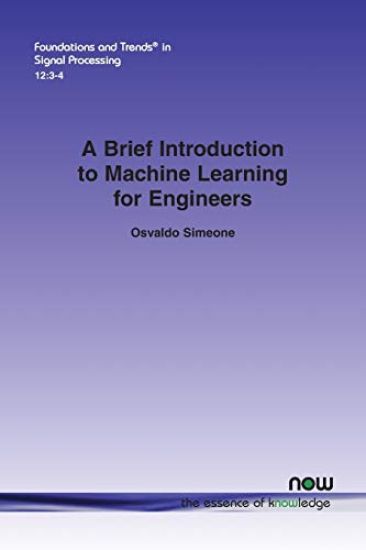
A Brief Introduction to Machine Learning for Engineers
There is a wealth of literature and books available to engineers starting to understand what machine learning is and how it can be used in their everyday work. This presents the problem of where the engineer should start. The answer is often “for a general, but slightly outdated introduction, read this book; for a detailed survey of methods based on probabilistic models, check this reference; to learn about statistical learning, this text is useful” and so on.This monograph provides the starting point to the literature that every engineer new to machine learning needs. It offers a basic and compact reference that describes key ideas and principles in simple terms and within a unified treatment, encompassing recent developments and pointers to the literature for further study.A Brief Introduction to Machine Learning for Engineers is the entry point to machine learning for students, practitioners, and researchers with an engineering background in probability and linear algebra.