Kirjojen hintavertailu. Mukana 12 410 611 kirjaa ja 12 kauppaa.

Kirjahaku

Etsi kirjoja tekijän nimen, kirjan nimen tai ISBN:n perusteella.

10 kirjaa tekijältä Owen Anderson

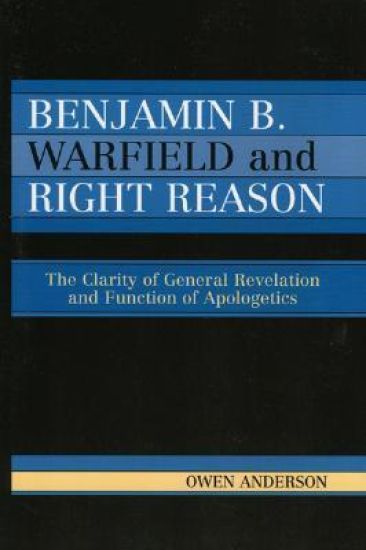
Benjamin B. Warfield and Right Reason

Benjamin B. Warfield and Right Reason

Owen Anderson

University Press of America
2005
nidottu
Benjamin B. Warfield and Right Reason offers a study of Princeton Theologian Benjamin B. Warfield's view of apologetics and the role of reason in religious belief. In order to understand Warfield's view of "right reason," the book explores the intellectual development of Princeton Theological Seminary, Warfield's debate with Abraham Kuyper over the need for apologetics, and the manner in which Cornelius VanTil attempted to adopt the best from both Warfield and Kuyper. The first chapter examines the influence of Scottish Common Sense Philosophy on Princeton Theological Seminary. This chapter focuses on Charles Hodge and his affirmation that reason can be used to know God. The second chapter concentrates on Warfield and his continuation of the Princeton approach to apologetics. The third chapter considers the challenge raised by Abraham Kuyper and looks at Warfield's response. The final chapter discusses Cornelius VanTil and his attempt to take what he saw as best from Warfield and Kuyper while avoiding potential problems in each. The theme of this book is Warfield's affirmation that the redemptive claims of Christianity must be established by first arguing that there is a God and a need for special revelation. Warfield's approach to apologetics contains the potential to establish the foundation for a natural theology, especially with respect to the existence and nature of God.
Reason and Worldviews

Reason and Worldviews

Owen Anderson

University Press of America
2008
nidottu
After the challenges of the Enlightenment from philosophers such as David Hume, contemporary philosophers of religion tend to think that proof is not possible and that at best humans have arguments for the probability or plausibility of belief in God. But, Christianity maintains that humans should know God. This book explores attempts to respond to the Enlightenment challenges by thinkers at Princeton Theological like Benjamin Warfield. It considers Warfield's view of reason and knowledge of God, his debate with Abraham Kuyper, and the attempt to reconcile differences between these two by Cornelius Van Til. It also considers Reformed Epistemology, which has become popular in recent decades and is credited for a renewed interest in Christian philosophy.
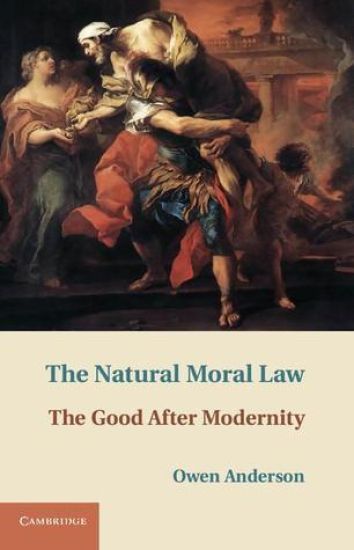
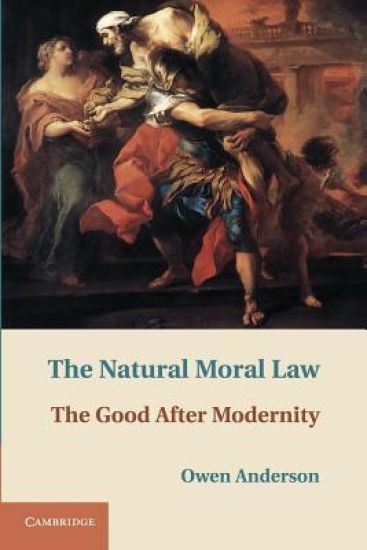
The Natural Moral Law

The Natural Moral Law

Owen Anderson

Cambridge University Press
2012
sidottu
The Natural Moral Law argues that the good can be known and that therefore the moral law, which serves as a basis for human choice, can be understood. Proceeding historically through ancient, modern and postmodern thinkers, Owen Anderson studies beliefs about the good and how it is known, and how such beliefs shape claims about the moral law. The focal challenge is whether the skepticism of postmodern thinkers can be answered in a way that preserves knowledge claims about the good. Considering the failures of modern thinkers to correctly articulate reason and the good and how postmodern thinkers are responding to these failures, Anderson argues that there are identifiable patterns of thinking about what is good, some of which lead to false dichotomies. The book concludes with a consideration of how a moral law might look if the good is correctly identified.
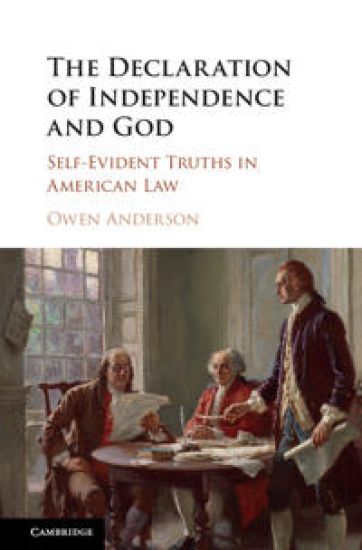
The Declaration of Independence and God

The Declaration of Independence and God

Owen Anderson

Cambridge University Press
2015
sidottu
'Self-evident truths' was a profound concept used by the drafters of the American Declaration of Independence to insist on their rights and freedom from oppressive government. How did this Enlightenment notion of self-evident human rights come to be used in this historic document and what is its true meaning? In The Declaration of Independence and God, Owen Anderson traces the concept of a self-evident creator through America's legal history. Starting from the Declaration of Independence, Anderson considers both challenges to belief in God from thinkers like Thomas Paine and American Darwinists, as well as modifications to the concept of God by theologians like Charles Finney and Paul Tillich. Combining history, philosophy and law in a unique focus, this book opens exciting new avenues for the study of America's legal history.
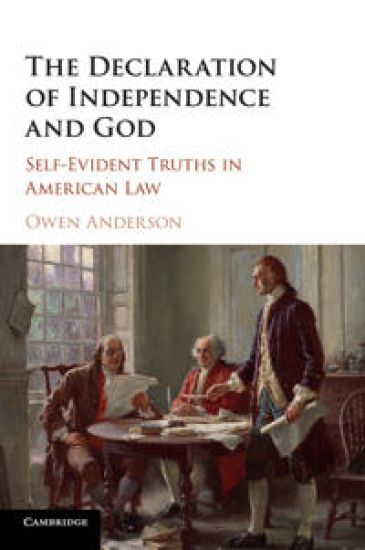
The Declaration of Independence and God

The Declaration of Independence and God

Owen Anderson

Cambridge University Press
2017
pokkari
'Self-evident truths' was a profound concept used by the drafters of the American Declaration of Independence to insist on their rights and freedom from oppressive government. How did this Enlightenment notion of self-evident human rights come to be used in this historic document and what is its true meaning? In The Declaration of Independence and God, Owen Anderson traces the concept of a self-evident creator through America's legal history. Starting from the Declaration of Independence, Anderson considers both challenges to belief in God from thinkers like Thomas Paine and American Darwinists, as well as modifications to the concept of God by theologians like Charles Finney and Paul Tillich. Combining history, philosophy and law in a unique focus, this book opens exciting new avenues for the study of America's legal history.
The Natural Moral Law

The Natural Moral Law

Owen Anderson

Cambridge University Press
2013
pokkari
The Natural Moral Law argues that the good can be known and that therefore the moral law, which serves as a basis for human choice, can be understood. Proceeding historically through ancient, modern and postmodern thinkers, Owen Anderson studies beliefs about the good and how it is known, and how such beliefs shape claims about the moral law. The focal challenge is whether the skepticism of postmodern thinkers can be answered in a way that preserves knowledge claims about the good. Considering the failures of modern thinkers to correctly articulate reason and the good and how postmodern thinkers are responding to these failures, Anderson argues that there are identifiable patterns of thinking about what is good, some of which lead to false dichotomies. The book concludes with a consideration of how a moral law might look if the good is correctly identified.
Running Form

Running Form

Owen Anderson

Human Kinetics
2018
pokkari
Running technique is often an afterthought for many runners, one that's not thought about until an injury or plateau stops them achieving their goals. Running Form highlights how important proper technique can be to elevating performance. Author Owen Anderson has coached several elite runners from around the world. In his new book, he identifies the components of good form, including foot strike, stance time and posture. These help runners understand where to make small changes that improve performance. Readers are then able to analyse their form and apply specific drills and exercises using a basic video equipment or a smartphone. The guide features numerous photographs that help readers clearly identify the correct angles and movements need for sound technique. Running Form gives readers all they need to perfect their running technique and train consistently.
The Clarity of God's Existence

The Clarity of God's Existence

Owen Anderson

Wipf Stock Publishers
2008
pokkari
The Clarity of God's Existence examines the need for theistic proofs within historic Christianity, and the challenges to these since the Enlightenment. Historically (and scripturally), Christianity has maintained that unbelief is inexcusable. If failing to know God is a sin, the implication is that humans can and should know God. Humans should know God because his eternal power and divine nature are clearly revealed in the things that are made. And yet, Anderson argues, more time is spent on avoiding the need for clarity to establish inexcusability than on actually providing an argument or proof. Proofs that rely on Aristotle or Plato and that establish a Prime Mover or designer are thought to be sufficient. But the adequacy of these, not only to prove the God of theism, but also to prove anything at all, has been called into question by Enlightenment thinkers like David Hume. After considering the traditional proofs, and tracing the history of challenges to theistic proofs (from Hume to Kant and down to the twentieth century), Anderson argues that the standard methods of apologetics have failed to sufficiently respond. Classical Apologetics, Evidentialism, Presuppositionalism, Reformed Epistemology, and others fail to adequately answer the challenges of the Enlightenment. If this is the case, what is the outcome for Christianity? Anderson offers an explanation as to why traditional proofs have failed, and for what is necessary to offer a proof that not only responds to Hume and Kant but also establishes the clarity of God's existence. The traditional proofs failed precisely in not aiming at the clarity of God's existence, and they failed in this because of a faulty view of the goal of Christian life. If the blessed life is to be attained in a direct vision of God in heaven, then there is little to no reason to ask for more than the bare minimum required to get into heaven (justification). Furthermore, if the highest blessing is this direct vision, then the glory of God revealed in his work is considered as less important and even set aside. By way of contrast, if God's eternal power and divine nature are clearly revealed in his works, and the blessing comes in knowing God, then it is of the utmost importance for Christianity to demonstrate the clarity of God's existence. Owen Anderson recognizes the necessity in Historic Christian Theism for clarity and inexcusability in contrast to skepticism and fideism. He responds to this legacy of the Enlightenment by showing the relevance of proof for the existence of God. The shape of a classic problem is being brought to light. --Surrendra Gangadean, author of ""Philosophical Foundation: A Critical Analysis of Basic Belief"" This is an exciting book that advances the status of philosophy of religion by analyzing and probing some fundamental issues in contemporary philosophy and theology. The emphasis on clarity is, to me, new and fresh and provocative. I'm really surprised that the constellation of clarity, responsibility, and inexcusability has not been examined in detail before. --Stephen Webb, Wabash College Owen Anderson is Assistant Professor of Philosophy of Religion at Arizona State University West. He is the author of Reason and Worldviews (2008).
Journal of Public Philosophy

Journal of Public Philosophy

Kelly Fitzsimmons Burton; Owen Anderson

Public Philosophy Press
2021
pokkari
The Journal of Public Philosophy is the official publication of the Public Philosophy Society. The goal of the Journal is to publish papers, essays, and book reviews in the mode of classical philosophy. We seek to know the basic truths that are foundational for the common good, and a just and civil society.The goal of public philosophy is to make the practice of philosophy more accessible and more relevant to students, scholars, and the broadly educated public. We hope to inspire young and old alike in the shared, rational pursuit of wisdom and in love of Being, Unity, the True, the Good, and the Beautiful.Public philosophy is inspired by Socrates' engagement in dialogue in the agora, the shared public space of the city-state. It is the pursuit of the common good, our shared life together. Currently, we are a group of professors seeking to bring the discussions usually reserved for the classroom into a broader context. We hope that others will join us in an ever-broadening and deepening discussion. The arena for discussions has been college and university public lecture forums, book discussion groups, and campus clubs. We hope that others will expand the public context, perhaps meeting at coffee shops and houses of worship. We have expanded the discussion to an international group with the formation of the Public Philosophy Society.The Journal of Public Philosophy is published by Public Philosophy Press: www.publicphilosophypress.com