Kirjojen hintavertailu. Mukana 11 627 220 kirjaa ja 12 kauppaa.

Kirjahaku

Etsi kirjoja tekijän nimen, kirjan nimen tai ISBN:n perusteella.

7 kirjaa tekijältä P.M. Cohn

Elements of Linear Algebra

Elements of Linear Algebra

P.M. Cohn

CRC Press
1994
nidottu
This volume presents a thorough discussion of systems of linear equations and their solutions. Vectors and matrices are introduced as required and an account of determinants is given. Great emphasis has been placed on keeping the presentation as simple as possible, with many illustrative examples. While all mathematical assertions are proved, the student is led to view the mathematical content intuitively, as an aid to understanding. The text treats the coordinate geometry of lines, planes and quadrics, provides a natural application for linear algebra and at the same time furnished a geometrical interpretation to illustrate the algebraic concepts.
Elements of Linear Algebra

Elements of Linear Algebra

P.M. Cohn

CRC Press
2017
sidottu
This volume presents a thorough discussion of systems of linear equations and their solutions. Vectors and matrices are introduced as required and an account of determinants is given. Great emphasis has been placed on keeping the presentation as simple as possible, with many illustrative examples. While all mathematical assertions are proved, the student is led to view the mathematical content intuitively, as an aid to understanding. The text treats the coordinate geometry of lines, planes and quadrics, provides a natural application for linear algebra and at the same time furnished a geometrical interpretation to illustrate the algebraic concepts.
Algebraic Numbers and Algebraic Functions

Algebraic Numbers and Algebraic Functions

P.M. Cohn

Taylor Francis Ltd
2017
sidottu
This book is an introduction to the theory of algebraic numbers and algebraic functions of one variable. The basic development is the same for both using E Artin's legant approach, via valuations. Number Theory is pursued as far as the unit theorem and the finiteness of the class number. In function theory the aim is the Abel-Jacobi theorem describing the devisor class group, with occasional geometrical asides to help understanding. Assuming only an undergraduate course in algebra, plus a little acquaintance with topology and complex function theory, the book serves as an introduction to more technical works in algebraic number theory, function theory or algebraic geometry by an exposition of the central themes in the subject.
Basic Algebra

Basic Algebra

P.M. Cohn

Springer London Ltd
2012
nidottu
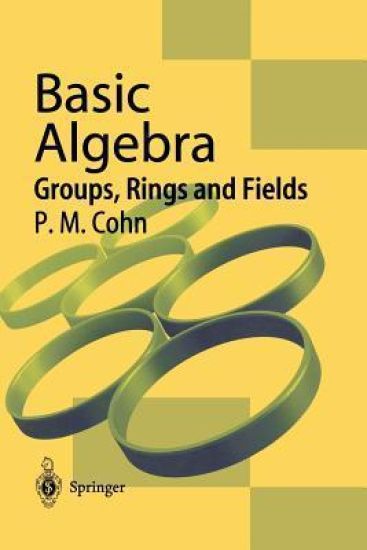
Basic Algebra is the first volume of a new and revised edition of P.M. Cohn's classic three-volume text Algebra which is widely regarded as one of the most outstanding introductory algebra textbooks. For this edition, the text has been reworked and updated into two self-contained, companion volumes, covering advanced topics in algebra for second- and third-year undergraduate and postgraduate research students. In this first volume, the author covers the important results of algebra; the companion volume, Further Algebra and Applications, brings more advanced topics and focuses on the applications. Readers should have some knowledge of linear algebra and have met groups and fields before, although all the essential facts and definitions are recalled. The coverage is comprehensive and includes topics such as: - Groups - lattices and categories - rings, modules and algebras - fields The author gives a clear account, supported by worked examples, with full proofs. There are numerous exercises with occasional hints, and some historical remarks.
Basic Algebra

Basic Algebra

P.M. Cohn

Springer London Ltd
2002
sidottu
Basic Algebra is the first volume of a new and revised edition of P.M. Cohn's classic three-volume text Algebra which is widely regarded as one of the most outstanding introductory algebra textbooks. For this edition, the text has been reworked and updated into two self-contained, companion volumes, covering advanced topics in algebra for second- and third-year undergraduate and postgraduate research students. In this first volume, the author covers the important results of algebra; the companion volume, Further Algebra and Applications, brings more advanced topics and focuses on the applications. Readers should have some knowledge of linear algebra and have met groups and fields before, although all the essential facts and definitions are recalled. The coverage is comprehensive and includes topics such as: - Groups - lattices and categories - rings, modules and algebras - fields The author gives a clear account, supported by worked examples, with full proofs. There are numerous exercises with occasional hints, and some historical remarks.
Universal Algebra

Universal Algebra

P.M. Cohn

Kluwer Academic Publishers
1981
sidottu
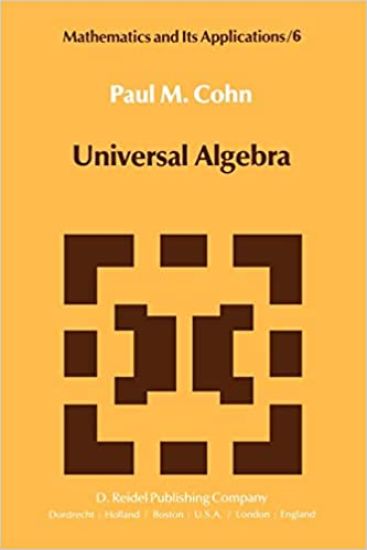
The present book was conceived as an introduction for the user of universal algebra, rather than a handbook for the specialist, but when the first edition appeared in 1965, there were practically no other books entir~ly devoted to the subject, whether introductory or specialized. Today the specialist in the field is well provided for, but there is still a demand for an introduction to the subject to suit the user, and this seemed to justify a reissue of the book. Naturally some changes have had to be made; in particular, I have corrected all errors that have been brought to my notice. Besides errors, some obscurities in the text have been removed and the references brought up to date. I should like to express my thanks to a number of correspondents for their help, in particular C. G. d'Ambly, W. Felscher, P. Goralcik, P. J. Higgins, H.-J. Hoehnke, J. R. Isbell, A. H. Kruse, E. J. Peake, D. Suter, J. S. Wilson. But lowe a special debt to G. M. Bergman, who has provided me with extensivecomments. particularly on Chapter VII and the supplementary chapters. I have also con­ sulted reviews of the first edition, as well as the Italian and Russian translations.
Universal Algebra

Universal Algebra

P.M. Cohn

Kluwer Academic Publishers
1981
nidottu
The present book was conceived as an introduction for the user of universal algebra, rather than a handbook for the specialist, but when the first edition appeared in 1965, there were practically no other books entir~ly devoted to the subject, whether introductory or specialized. Today the specialist in the field is well provided for, but there is still a demand for an introduction to the subject to suit the user, and this seemed to justify a reissue of the book. Naturally some changes have had to be made; in particular, I have corrected all errors that have been brought to my notice. Besides errors, some obscurities in the text have been removed and the references brought up to date. I should like to express my thanks to a number of correspondents for their help, in particular C. G. d'Ambly, W. Felscher, P. Goralcik, P. J. Higgins, H.-J. Hoehnke, J. R. Isbell, A. H. Kruse, E. J. Peake, D. Suter, J. S. Wilson. But lowe a special debt to G. M. Bergman, who has provided me with extensivecomments. particularly on Chapter VII and the supplementary chapters. I have also con­ sulted reviews of the first edition, as well as the Italian and Russian translations.