Kirjojen hintavertailu. Mukana 12 390 323 kirjaa ja 12 kauppaa.

Kirjahaku

Etsi kirjoja tekijän nimen, kirjan nimen tai ISBN:n perusteella.

7 kirjaa tekijältä Pamela Elizabeth Clark

Dynamic Planet

Dynamic Planet

Pamela Elizabeth Clark

Springer-Verlag New York Inc.
2007
sidottu
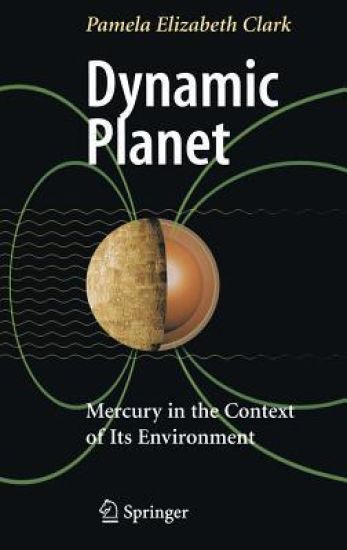
UNDERSTANDING THE PLANET MERCURY Thirty years have elapsed since the one and only mission to Mercury, Mariner 10, performed three ?ybys of the planet, capturing moderate-reso- tion (100 m at best) images of one hemisphere (45% of the surface) and d- covering that Mercury could be the only other terrestrial planet to have a global magnetic ?eld and core dynamo analogous to the Earth’s. At the time of this writing, the MESSENGER mission to Mercury has been launched. We are still a couple of years away from the ?rst of the next ?ybys of Mercury, by MESSENGER, on its way to insertion into a nearly polar, but highly ellip- cal, orbit, seven years from launch. In the interim, a plethora of ground-based observations has been providing information on hitherto unseen aspects of Mercury’s surface and exosphere. Furthermore, Mariner 10 data have been analyzed and reanalyzed as the technology for modeling and image processing has improved, leading to important breakthroughs in our understanding of Mercury and its environment. Thus, we are writing this book with the realization that we are in a time of transition in our understanding of the planet Mercury. Of particular interest to us in this book is the emerging picture of Mercury as a very dynamic system, with interactions between interior, surface, exosphere, and magne- sphere that have in?uenced and constrained the evolution of each part of the system.
Dynamic Planet

Dynamic Planet

Pamela Elizabeth Clark

Springer-Verlag New York Inc.
2010
nidottu
UNDERSTANDING THE PLANET MERCURY Thirty years have elapsed since the one and only mission to Mercury, Mariner 10, performed three ?ybys of the planet, capturing moderate-reso- tion (100 m at best) images of one hemisphere (45% of the surface) and d- covering that Mercury could be the only other terrestrial planet to have a global magnetic ?eld and core dynamo analogous to the Earth’s. At the time of this writing, the MESSENGER mission to Mercury has been launched. We are still a couple of years away from the ?rst of the next ?ybys of Mercury, by MESSENGER, on its way to insertion into a nearly polar, but highly ellip- cal, orbit, seven years from launch. In the interim, a plethora of ground-based observations has been providing information on hitherto unseen aspects of Mercury’s surface and exosphere. Furthermore, Mariner 10 data have been analyzed and reanalyzed as the technology for modeling and image processing has improved, leading to important breakthroughs in our understanding of Mercury and its environment. Thus, we are writing this book with the realization that we are in a time of transition in our understanding of the planet Mercury. Of particular interest to us in this book is the emerging picture of Mercury as a very dynamic system, with interactions between interior, surface, exosphere, and magne- sphere that have in?uenced and constrained the evolution of each part of the system.
Mercury's Interior, Surface, and Surrounding Environment

Mercury's Interior, Surface, and Surrounding Environment

Pamela Elizabeth Clark

Springer-Verlag New York Inc.
2015
nidottu
This SpringerBrief details the MESSENGER Mission, the findings of which present challenges to widely held conventional views and remaining mysteries surrounding the planet. The work answers the question of why Mercury is so dense, and the implications from geochemical data on its planetary formation. It summarizes imaging and compositional data from the terrestrial planet surface processes and explains the geologic history of Mercury. It also discusses the lack of southern hemisphere coverage. Our understanding of the planet Mercury has been in a transitional phase over the decades since Mariner 10. The influx of new data from the NASA MESSENGER Mission since it was inserted into the orbit of Mercury in March of 2011 has greatly accelerated that shift. The combined compositional data of relatively high volatiles (S, K), relatively low refractories (Al, Ca), and low crustal iron, combined with an active, partially molten iron rich core, has major implications for Mercury and Solar System formation. From a scientist at NASA Goddard Space Flight Center, this presents a comprehensive overview of the discoveries from the ten-year MESSENGER mission.
Extreme Exploration

Extreme Exploration

Pamela Elizabeth Clark

Springer Nature Switzerland AG
2025
nidottu
This book describes a relatively unsung triumph of the Apollo program. The extreme limitation of resources available for exploring the lunar surface required the creation of an altogether new approach to science and exploration-- the "Apollo Approach," also known as the "Extreme Science Approach." This book analyses the record of Apollo and essential pre-Apollo precursor (Ranger, Surveyor, Lunar Orbiter) programs, including firsthand interviews with the people involved; recently archived training, simulation, planning documentation; and the Apollo Lunar Surface Log, to show how the missions to the Moon created a novel baseline for field exploration. As we approach the new series of Artemis missions, the book looks forward, applying what Apollo taught us to the scientific exploration that will be conducted in the future. With each breakthrough, Apollo created the foundations not only for lunar missions, but for any space exploration activity that followed. This book will show you how it did so, and what's next.
Remote Sensing Tools for Exploration

Remote Sensing Tools for Exploration

Pamela Elizabeth Clark; Michael Lee Rilee

Springer-Verlag New York Inc.
2010
sidottu
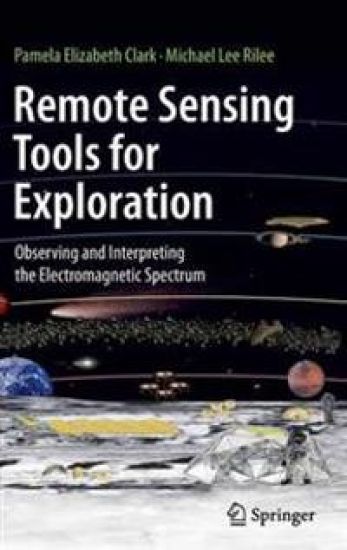
Remote Sensing from a New Perspective The idea for this book began many years ago, when I was asked to teach a course on remote sensing. Not long before that time, I had been part of the effort to develop the first database for planetary data with a common digital array format and interactive processing capabilities to correlate those data easily: the lunar consortium. All the available lunar remote sensing data were included, orbital and ground-based, ranging across the entire electromagnetic spectrum. I had used this powerful tool extensively, and, in that spirit, I was determined to create a course which covered the entire spectrum and a variety of targets. As I looked around for the equivalent of a textbook, which I was willing to pull together from several sources, I realized that available material was very heavily focused on the visual and near visual spectrum and on the Earth as a target. Even The Surveillant Science, edited by Edward Holz and published in 1973, which broke newground in having diverse articles on most of the spectrum when it was created, focused entirely on the Earth. My personal favorite, the exceedingly well written book on remote sensing by Floyd Sabins first published in 1978, covered the visual, infrared, and microwave portions of the spectrum beautifully but focused on the Earth as well. Unhindered, I developed what I called ‘packets’ of material for each part of the spectrum.
Constant-Scale Natural Boundary Mapping to Reveal Global and Cosmic Processes

Constant-Scale Natural Boundary Mapping to Reveal Global and Cosmic Processes

Pamela Elizabeth Clark; Chuck Clark

Springer-Verlag New York Inc.
2013
nidottu
Whereas conventional maps can be expressed as outward-expanding formulae with well-defined central features and relatively poorly defined edges, Constant Scale Natural Boundary (CSNB) maps have well-defined boundaries that result from natural processes and thus allow spatial and dynamic relationships to be observed in a new way useful to understanding these processes. CSNB mapping presents a new approach to visualization that produces maps markedly different from those produced by conventional cartographic methods. In this approach, any body can be represented by a 3D coordinate system. For a regular body, with its surface relatively smooth on the scale of its size, locations of features can be represented by definite geographic grid (latitude and longitude) and elevation, or deviation from the triaxial ellipsoid defined surface. A continuous surface on this body can be segmented, its distinctive regional terranes enclosed, and their inter-relationships defined, by using selected morphologically identifiable relief features (e.g., continental divides, plate boundaries, river or current systems). In this way, regions of distinction on a large, essentially spherical body can be mapped as two-dimensional ‘facets’ with their boundaries representing regional to global-scale asymmetries (e.g., continental crust, continental and oceanic crust on the Earth, farside original thicker crust and nearside thinner impact punctuated crust on the Moon). In an analogous manner, an irregular object such as an asteroid, with a surface that is rough on the scale of its size, would be logically segmented along edges of its impact-generated faces. Bounded faces are imagined with hinges at occasional points along boundaries, resulting in a foldable ‘shape model.’ Thus, bounded faces grow organically out of the most compelling natural features. Obvious boundaries control the map’s extremities, and peripheral regions are not dismembered or grosslydistorted as in conventional map projections. 2D maps and 3D models grow out of an object’s most obvious face or terrane ‘edges,’ instead of arbitrarily by imposing a regular grid system or using regularly shaped facets to represent an irregular surface.
Remote Sensing Tools for Exploration

Remote Sensing Tools for Exploration

Pamela Elizabeth Clark; Michael Lee Rilee

Springer-Verlag New York Inc.
2014
nidottu
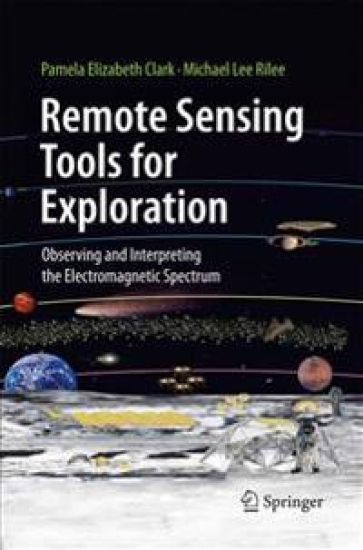
Remote Sensing from a New Perspective The idea for this book began many years ago, when I was asked to teach a course on remote sensing. Not long before that time, I had been part of the effort to develop the first database for planetary data with a common digital array format and interactive processing capabilities to correlate those data easily: the lunar consortium. All the available lunar remote sensing data were included, orbital and ground-based, ranging across the entire electromagnetic spectrum. I had used this powerful tool extensively, and, in that spirit, I was determined to create a course which covered the entire spectrum and a variety of targets. As I looked around for the equivalent of a textbook, which I was willing to pull together from several sources, I realized that available material was very heavily focused on the visual and near visual spectrum and on the Earth as a target. Even The Surveillant Science, edited by Edward Holz and published in 1973, which broke newground in having diverse articles on most of the spectrum when it was created, focused entirely on the Earth. My personal favorite, the exceedingly well written book on remote sensing by Floyd Sabins first published in 1978, covered the visual, infrared, and microwave portions of the spectrum beautifully but focused on the Earth as well. Unhindered, I developed what I called ‘packets’ of material for each part of the spectrum.