Kirjojen hintavertailu. Mukana 11 717 486 kirjaa ja 12 kauppaa.

Kirjahaku

Etsi kirjoja tekijän nimen, kirjan nimen tai ISBN:n perusteella.

4 kirjaa tekijältä Pankaj S. Joshi

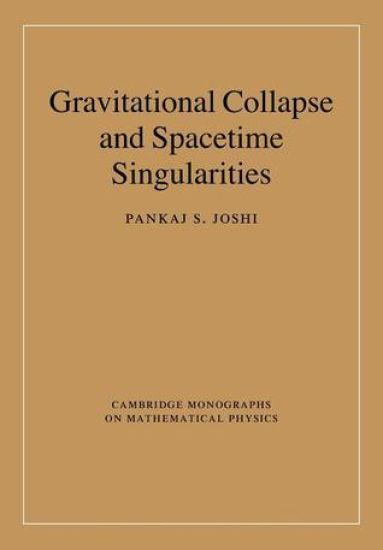
The Story of Collapsing Stars

The Story of Collapsing Stars

Pankaj S. Joshi

Oxford University Press
2018
nidottu
This book journeys into one of the most fascinating intellectual adventures of recent decades - understanding and exploring the final fate of massive collapsing stars in the universe. The issue is of great interest in fundamental physics and cosmology today, from both the perspective of gravitation theory and of modern astrophysical observations. This is a revolution in the making and may be intimately connected to our search for a unified understanding of the basic forces of nature, namely gravity that governs the cosmological universe, and the microscopic forces that include quantum phenomena. According to the general theory of relativity, a massive star that collapses catastrophically under its own gravity when it runs out of its internal nuclear fuel must give rise to a space-time singularity. Such singularities are regions in the universe where all physical quantities take their extreme values and become arbitrarily large. The singularities may be covered within a black hole, or visible to faraway observers in the universe. Thus, the final fate of a collapsing massive star is either a black hole or a visible naked singularity. We discuss here recent results and developments on the gravitational collapse of massive stars and possible observational implications when naked singularities happen in the universe. Large collapsing massive stars and the resulting space-time singularities may even provide a laboratory in the cosmos where one could test the unification possibilities of basic forces of nature.
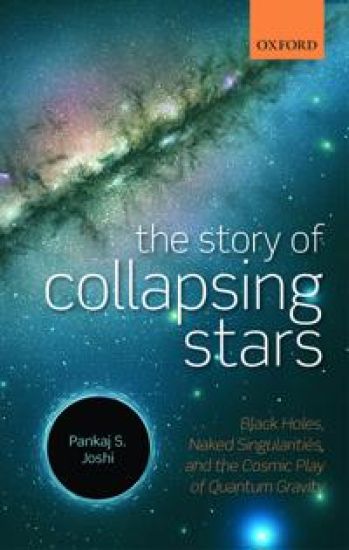
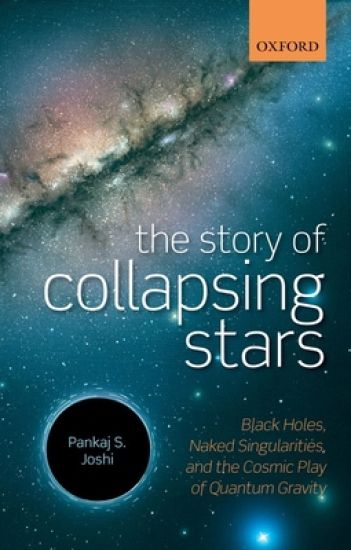
The Story of Collapsing Stars

The Story of Collapsing Stars

Pankaj S. Joshi

Oxford University Press
2015
sidottu
This book journeys into one of the most fascinating intellectual adventures of recent decades - understanding and exploring the final fate of massive collapsing stars in the universe. The issue is of great interest in fundamental physics and cosmology today, from both the perspective of gravitation theory and of modern astrophysical observations. This is a revolution in the making and may be intimately connected to our search for a unified understanding of the basic forces of nature, namely gravity that governs the cosmological universe, and the microscopic forces that include quantum phenomena. According to the general theory of relativity, a massive star that collapses catastrophically under its own gravity when it runs out of its internal nuclear fuel must give rise to a space-time singularity. Such singularities are regions in the universe where all physical quantities take their extreme values and become arbitrarily large. The singularities may be covered within a black hole, or visible to faraway observers in the universe. Thus, the final fate of a collapsing massive star is either a black hole or a visible naked singularity. We discuss here recent results and developments on the gravitational collapse of massive stars and possible observational implications when naked singularities happen in the universe. Large collapsing massive stars and the resulting space-time singularities may even provide a laboratory in the cosmos where one could test the unification possibilities of basic forces of nature.
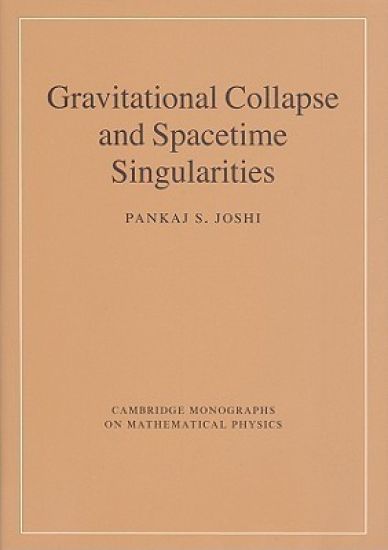
Gravitational Collapse and Spacetime Singularities

Gravitational Collapse and Spacetime Singularities

Pankaj S. Joshi

Cambridge University Press
2007
sidottu
Physical phenomena in astrophysics and cosmology involve gravitational collapse in a fundamental way. The final fate of a massive star when it collapses under its own gravity at the end of its life cycle is one of the most important questions in gravitation theory and relativistic astrophysics, and is the foundation of black hole physics. General relativity predicts that continual gravitational collapse gives rise to a space-time singularity. Quantum gravity may take over in such regimes to resolve the classical space-time singularity. This book investigates these issues, and shows how the visible ultra-dense regions arise naturally and generically as an outcome of dynamical gravitational collapse. It will be of interest to graduate students and academic researchers in gravitation physics, fundamental physics, astrophysics, and cosmology. It includes a detailed review of research into gravitational collapse, and several examples of collapse models are investigated in detail.
Gravitational Collapse and Spacetime Singularities

Gravitational Collapse and Spacetime Singularities

Pankaj S. Joshi

Cambridge University Press
2012
pokkari
Physical phenomena in astrophysics and cosmology involve gravitational collapse in a fundamental way. The final fate of a massive star when it collapses under its own gravity at the end of its life cycle is one of the most important questions in gravitation theory and relativistic astrophysics, and is the foundation of black hole physics. General relativity predicts that continual gravitational collapse gives rise to a space-time singularity. Quantum gravity may take over in such regimes to resolve the classical space-time singularity. This book investigates these issues, and shows how the visible ultra-dense regions arise naturally and generically as an outcome of dynamical gravitational collapse. It will be of interest to graduate students and academic researchers in gravitation physics, fundamental physics, astrophysics, and cosmology. It includes a detailed review of research into gravitational collapse, and several examples of collapse models are investigated in detail.