
Kirjojen hintavertailu. Mukana 11 516 443 kirjaa ja 12 kauppaa.

Kirjahaku

Etsi kirjoja tekijän nimen, kirjan nimen tai ISBN:n perusteella.

5 kirjaa tekijältä Panos Mourdoukoutas

Business Strategy in a Semiglobal Economy

Business Strategy in a Semiglobal Economy

Panos Mourdoukoutas

Routledge
2006
sidottu
This groundbreaking text provides both theory and strategy for operating in a semiglobal economy in which international businesses must compete in highly globalized and highly localized markets at the same time. Unlike the traditional transnational and matrix corporate models, a semiglobal corporation organizes its operations according to the global/local content of its value propositions rather than according to geographical regions, products, or contribution to the parent company's performance. As an example of a semiglobal corporation, the Honda Motor Company has a global vision when it comes to highly global bundles like car engines, and a local vision when it comes to highly localized car financing and servicing. Designed as a supplementary text for courses in international business, development economics, marketing, and strategic planning, "Business Strategy in a Semiglobal Economy" raises important challenges to the conventional models of business organization and the competitive strategies that proceed from them.

Business Strategy in a Semiglobal Economy

Business Strategy in a Semiglobal Economy

Panos Mourdoukoutas

Routledge
2006
nidottu
This groundbreaking text provides both theory and strategy for operating in a semiglobal economy in which international businesses must compete in highly globalized and highly localized markets at the same time. Unlike the traditional transnational and matrix corporate models, a semiglobal corporation organizes its operations according to the global/local content of its value propositions rather than according to geographical regions, products, or contribution to the parent company's performance. As an example of a semiglobal corporation, the Honda Motor Company has a global vision when it comes to highly global bundles like car engines, and a local vision when it comes to highly localized car financing and servicing. Designed as a supplementary text for courses in international business, development economics, marketing, and strategic planning, "Business Strategy in a Semiglobal Economy" raises important challenges to the conventional models of business organization and the competitive strategies that proceed from them.
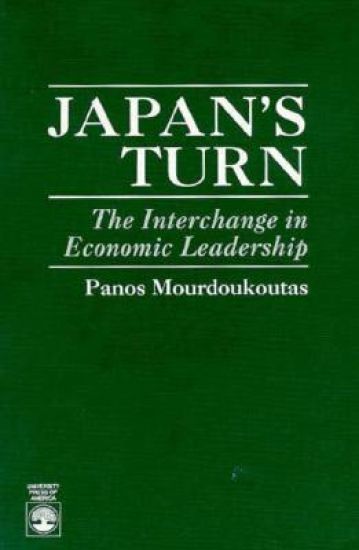
Japan's Turn

Japan's Turn

Panos Mourdoukoutas

University Press of America
1993
nidottu
With a lead in microelectronics applications and flexible institutions, Japan, rather than Europe, is to succeed the United States' economic leadership in the post-Soviet era. This book is an inquiry into the transition economics of this era and the differences between the American and Japanese economic problems. Contents: Introduction; PART I. Economic Performance, Resources and Institutions; The Japanese Economy and Government: An Overview; The Japanese Corporation and Industry; Employment Relations; Assimilation of New Technology: Labor Adjustment; PART II. Economic Relations with the U.S. and the Pacific; The Anatomy of the Japanese Trade Surplus; Japanese Direct Investment in the U.S.; Japan and the Region; Japan in the 21st Century: An Unusual Leadership. Tables and graphs with each chapter.
The Global Corporation

The Global Corporation

Panos Mourdoukoutas

Praeger Publishers Inc
1999
sidottu
The globalization of business has ended corporate colonialism in international commerce, and out of this has emerged what the author calls the global corporation. Differing in many important ways from the now obsolete multinational corporation it is replacing, the global corporation is actually a network of independent entrepreneurs, liberated from the control of headquarters, and thus able to implement a new vision of the overall enterprise, its competitive strategies, and how it coordinates and communicates within itself. The author carefully delineates the subtle distinctions among concepts that are often taken, mistakenly, as synonyms for globalization, such as multinationalization, and elicits the implications these distinctions have for the management of international business.Nurtured in the post-GATT era, and especially in the last twenty years, the model of the global corporation describes an international business organization in which the parent company treats each national market as a part of a single, integrated regional or global market, setting up autonomous divisions or forming alliances and partnerships to handle each product and business line for the entire region or entire world market. In this network organization, the parent company plays the role of support office for the individual divisions, which are treated as equals. The structure consists of the support level, which handles company-wide concerns, and unit level, which handles unit-specific concerns. The two-level management is supported and re-enforced by a corporate vision and by efficient and effective communication and incentive structures.
Collective Entrepreneurship in a Globalizing Economy

Collective Entrepreneurship in a Globalizing Economy

Panos Mourdoukoutas

Praeger Publishers Inc
1999
sidottu
Mourdoukoutas argues that as globalization gains momentum and reengineering becomes universal, firms can no longer be sure of achieving sustainable competitive advantages through improved operating effectiveness alone. The new business strategy will focus on revenue growth and on the constructive destruction of conventional corporations, through collective entrepreneurship and its division in the product supply chain. To enhance revenues through the management of constructive destruction, companies must achieve organizational mutations and permutations, turning themselves from hierarchical managerial units into entrepreneurial networks. These entrepreneurial networks are communities that share a common fate: the risks and rewards associated with the discovery and exploitation of new businesses. Mourdoukoutas says that in some cases entrepreneurial networks can be extended outside the conventional borders of the corporation—vertically to suppliers, distributors, and customers, and horizontally to former competitors. In such networks the focus of business strategy should not be on the division of labor by task or process; rather, upon the divison of entrepreneurship and its diffusion among all of the firm's members. This is a challenging and thoughtful study and analysis for corporate management and their academic colleagues.