Kirjojen hintavertailu. Mukana 11 417 157 kirjaa ja 12 kauppaa.

Kirjahaku

Etsi kirjoja tekijän nimen, kirjan nimen tai ISBN:n perusteella.

12 kirjaa tekijältä Paul B. Thompson

What Is Agriculture For?

What Is Agriculture For?

Paul B. Thompson

OXFORD UNIVERSITY PRESS INC
2025
sidottu
What Is Agriculture For? describes four contrasting rationales for technical and policy change in agriculture and food systems. Technological Modernization applies an ethic common to every sector in the industrial economy: production should seek greater efficiencies in order to lower consumer costs and secure adequate supply but should not do so in ways that harm third parties or the environment. The other views single out a feature of agriculture giving it unique moral significance. Sustainable Intensification emphasizes future challenges to the global food supply, and Rural Resilience places special value on the social role of farmers and other producers. Urban Agriculture highlights cities' growing vulnerability to rurally based supply chains. Each perspective leads to distinct policy goals and suggests different priorities for technical innovation. At the same time, the argument for any particular innovation may draw on two of more of these archetypal rationales. The book does greater justice to the complexity of food politics, providing tools for critical evaluation of implicit value commitments and greater understanding of opposing points of view.
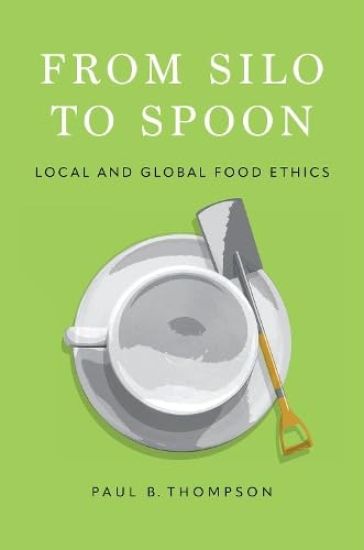
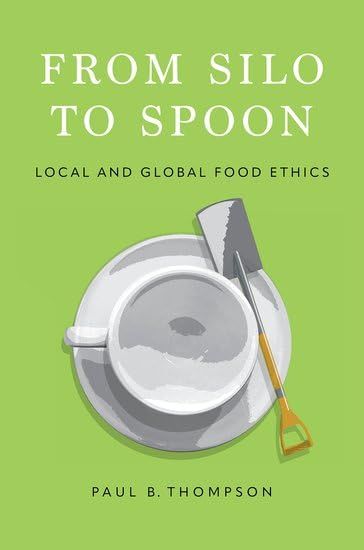
From Silo to Spoon

From Silo to Spoon

Paul B. Thompson

OXFORD UNIVERSITY PRESS INC
2023
nidottu
Following the pattern of From Field to Fork (OUP, 2015) Paul B. Thompson provides a highly readable and up-to-date analysis of contemporary ethical issues connected with food. Thompson reinterprets Peter Singer's work on famine relief in light of the history of funding development assistance through food aid, defends locavore diets against philosophical critics, and analyzes the ethics of food labelling in light of J.S. Mill's On Liberty. Further exploring today's key ethical questions about food, Thompson compares anthropological and toxicological approaches to pollution and defends a revised notion of agricultural sustainability. These topics provide an entry point for a novel approach in practical ethics that blends pragmatist philosophy of language, historical interpretation of agrarian thought, and recent philosophical writings on race and structural racism.
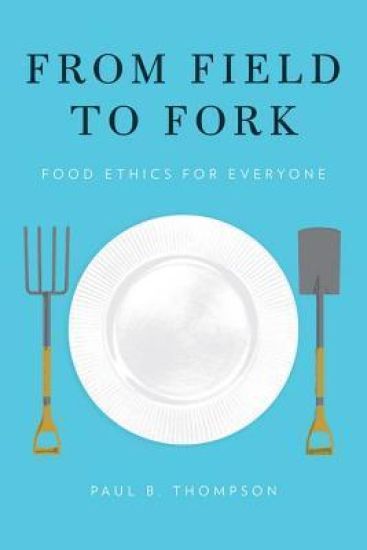
From Field to Fork

From Field to Fork

Paul B. Thompson

Oxford University Press Inc
2015
sidottu
After centuries of neglect, the ethics of food are back with a vengeance. Justice for food workers and small farmers has joined the rising tide of concern over the impact of industrial agriculture on food animals and the broader environment, all while a global epidemic of obesity-related diseases threatens to overwhelm modern health systems. An emerging worldwide social movement has turned to local and organic foods, and struggles to exploit widespread concern over the next wave of genetic engineering or nanotechnologies applied to food. Paul B. Thompson's book applies the rigor of philosophy to key topics in the first comprehensive study explore interconnections hidden deep within this welter of issues. Bringing more than thirty years of experience working closely with farmers, agricultural researchers and food system activists to the topic, he explores the eclipse of food ethics during the rise of nutritional science, and examines the reasons for its sudden re-emergence in the era of diet-based disease. Thompson discusses social injustice in the food systems of developed economies and shows how we have missed the key insights for understanding food ethics in the developing world. His discussions of animal production and the environmental impact of agriculture breaks new ground where most philosophers would least expect it. By emphasizing the integration of these issues, Thompson not only brings a comprehensive philosophical approach to moral issues in the production, processing, distribution, and consumption of food -- he introduces a fresh way to think about practical ethics that will have implications in other areas of applied philosophy.
From Field to Fork

From Field to Fork

Paul B. Thompson

Oxford University Press Inc
2015
nidottu
After centuries of neglect, the ethics of food are back with a vengeance. Justice for food workers and small farmers has joined the rising tide of concern over the impact of industrial agriculture on food animals and the broader environment, all while a global epidemic of obesity-related diseases threatens to overwhelm modern health systems. An emerging worldwide social movement has turned to local and organic foods, and struggles to exploit widespread concern over the next wave of genetic engineering or nanotechnologies applied to food. Paul B. Thompson's book applies the rigor of philosophy to key topics in the first comprehensive study explore interconnections hidden deep within this welter of issues. Bringing more than thirty years of experience working closely with farmers, agricultural researchers and food system activists to the topic, he explores the eclipse of food ethics during the rise of nutritional science, and examines the reasons for its sudden re-emergence in the era of diet-based disease. Thompson discusses social injustice in the food systems of developed economies and shows how we have missed the key insights for understanding food ethics in the developing world. His discussions of animal production and the environmental impact of agriculture breaks new ground where most philosophers would least expect it. By emphasizing the integration of these issues, Thompson not only brings a comprehensive philosophical approach to moral issues in the production, processing, distribution, and consumption of food -- he introduces a fresh way to think about practical ethics that will have implications in other areas of applied philosophy.
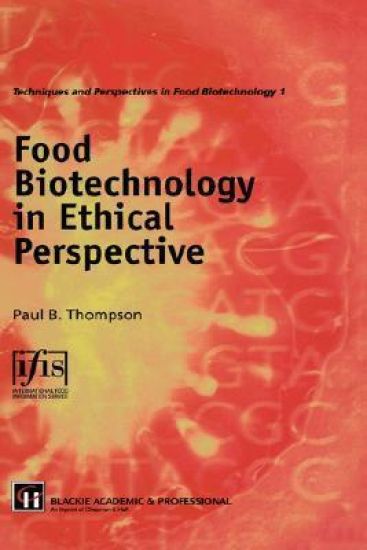
Food Biotechnology in Ethical Perspective

Food Biotechnology in Ethical Perspective

Paul B. Thompson

Chapman and Hall
1997
sidottu
This book provides an overview of ethical issues arising in connection with progress made in food biotechnology. There is substantive discussion of the ethical issues referring to food safety, animal welfare, environmental impact, ownership of intellectual property, and consumer perception of the product. The arguments for and against issues causing major concern are evaluated, advancing the quality of the debate. It will be of interest to companies exploiting the new biotechnology techniques, government policy makers, food scientists and biotechnologist in academic research institutions.
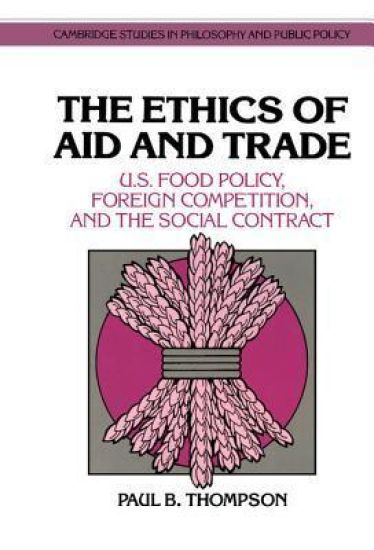
The Ethics of Aid and Trade

The Ethics of Aid and Trade

Paul B. Thompson

Cambridge University Press
1992
sidottu
The traditional military-territorial model of the nation state defines international duties in terms of protecting citizens' property from foreign threats. In this 1992 book about the principles of the US agricultural policy and foreign aid, Professor Thompson replaces this model with the notion of the trading state that sees its role in terms of the establishment of international institutions that stabilize and facilitate cultural and intellectual, as well as commercial, exchanges between nations. The argument focuses on protectionist challenges to foreign aid and development assistance programs, and engages with the views of a variety of economists, commodity organizations, and philosophers on world hunger and development. What emerges is a new interpretation of social contract theory that can determine goals for international trade and development policy.
The Spirit of the Soil

The Spirit of the Soil

Paul B. Thompson

Routledge
2017
sidottu
In this second edition of The Spirit of the Soil: Agriculture and Environmental Ethics, Paul B. Thompson reviews four worldviews that shape competing visions for agriculture. Productionists have sought increasing yields—to make two seeds grow where only one grew before—while traditional visions of good farming have stressed stewardship. These traditional visions have been challenged by two more worldviews: a call for a total cost accounting for farming and an advocacy for a holistic perspective. Thompson argues that an environmentally defensible systems approach must draw upon all four worldviews, recognizing their flaws and synthesizing their strengths in a new vision of sustainable agriculture. This classic 1995 study has been thoroughly revised and significantly expanded in its second edition with up-to-date examples of agriculture’s impact on the environment. These include extensive discussions of new pesticides and the effects of animal agriculture on climate and other areas of the environment. In addition, a new final chapter discusses sustainability, which has become a dominant idea within environmental studies and agrarian political philosophy.
The Spirit of the Soil

The Spirit of the Soil

Paul B. Thompson

Routledge
2017
nidottu
In this second edition of The Spirit of the Soil: Agriculture and Environmental Ethics, Paul B. Thompson reviews four worldviews that shape competing visions for agriculture. Productionists have sought increasing yields—to make two seeds grow where only one grew before—while traditional visions of good farming have stressed stewardship. These traditional visions have been challenged by two more worldviews: a call for a total cost accounting for farming and an advocacy for a holistic perspective. Thompson argues that an environmentally defensible systems approach must draw upon all four worldviews, recognizing their flaws and synthesizing their strengths in a new vision of sustainable agriculture. This classic 1995 study has been thoroughly revised and significantly expanded in its second edition with up-to-date examples of agriculture’s impact on the environment. These include extensive discussions of new pesticides and the effects of animal agriculture on climate and other areas of the environment. In addition, a new final chapter discusses sustainability, which has become a dominant idea within environmental studies and agrarian political philosophy.
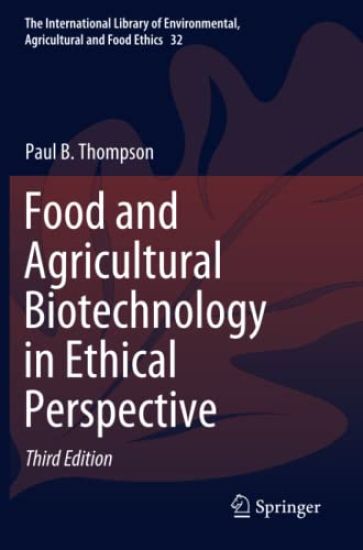
Food and Agricultural Biotechnology in Ethical Perspective

Food and Agricultural Biotechnology in Ethical Perspective

Paul B. Thompson

Springer Nature Switzerland AG
2020
sidottu
This 3rd edition of Food and Agricultural Biotechnology in Ethical Perspective updates Thompson’s analysis to reflect the next generation of biotechnology, including synthetic biology, gene editing and gene drives. The first two editions of this book, published as Food Biotechnology in Ethical Perspective in 1997 and 2007, were the first comprehensive philosophical studies of genetic engineering applied to food systems. The book is structured with chapter length treatments of risk in four categories: food safety, to animals, to the environment and socio-economic risks. These chapters are preceded by two chapters providing orientation to the uses of gene technology in food and agriculture, and to the goals, methods and background assumptions of technological ethics. There is also a chapter covering all four types of risk as applied to the first US technology, recombinant bovine somatotropin. The last four chapters take up 1) intellectual property debates, 2) religious, metaphysical and “intrinsic” objections to biotechnology, 3) issues in risk and trust and 4) a review of ethical issues in synthetic biology, gene editing and gene drives, the three key technologies that have emerged since the book was last revised.
Food and Agricultural Biotechnology in Ethical Perspective

Food and Agricultural Biotechnology in Ethical Perspective

Paul B. Thompson

Springer Nature Switzerland AG
2021
nidottu
This 3rd edition of Food and Agricultural Biotechnology in Ethical Perspective updates Thompson’s analysis to reflect the next generation of biotechnology, including synthetic biology, gene editing and gene drives. The first two editions of this book, published as Food Biotechnology in Ethical Perspective in 1997 and 2007, were the first comprehensive philosophical studies of genetic engineering applied to food systems. The book is structured with chapter length treatments of risk in four categories: food safety, to animals, to the environment and socio-economic risks. These chapters are preceded by two chapters providing orientation to the uses of gene technology in food and agriculture, and to the goals, methods and background assumptions of technological ethics. There is also a chapter covering all four types of risk as applied to the first US technology, recombinant bovine somatotropin. The last four chapters take up 1) intellectual property debates, 2) religious, metaphysical and “intrinsic” objections to biotechnology, 3) issues in risk and trust and 4) a review of ethical issues in synthetic biology, gene editing and gene drives, the three key technologies that have emerged since the book was last revised.
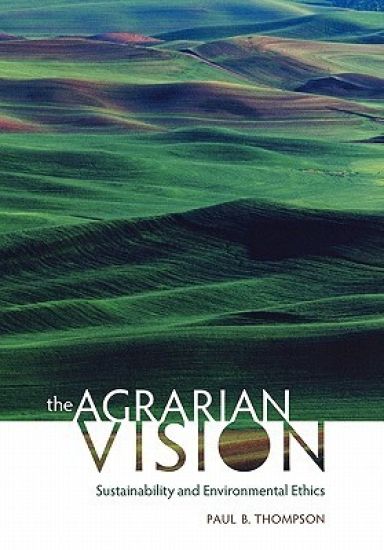
The Agrarian Vision

The Agrarian Vision

Paul B. Thompson

The University Press of Kentucky
2010
sidottu
As industry and technology proliferate in modern society, sustainability has jumped to the forefront of contemporary political and environmental discussions. The balance between progress and the earth's ability to provide for its inhabitants grows increasingly precarious as we attempt to achieve sustainable development. In The Agrarian Vision: Sustainability and Environmental Ethics, Paul B. Thompson articulates a new agrarian philosophy, emphasizing the vital role of agrarianism in modern agricultural practices. Thompson, a highly regarded voice in environmental philosophy, unites concepts of agrarian philosophy, political theory, and environmental ethics to illustrate the importance of creating and maintaining environmentally conscious communities. Thompson describes the evolution of agrarian values in America, following the path blazed by Thomas Jefferson, John Steinbeck, and Wendell Berry. Providing a pragmatic approach to ecological responsibility and commitment, The Agrarian Vision is a significant, compelling argument for the practice of a reconfigured and expanded agrarianism in our efforts to support modern industrialized culture while also preserving the natural world.